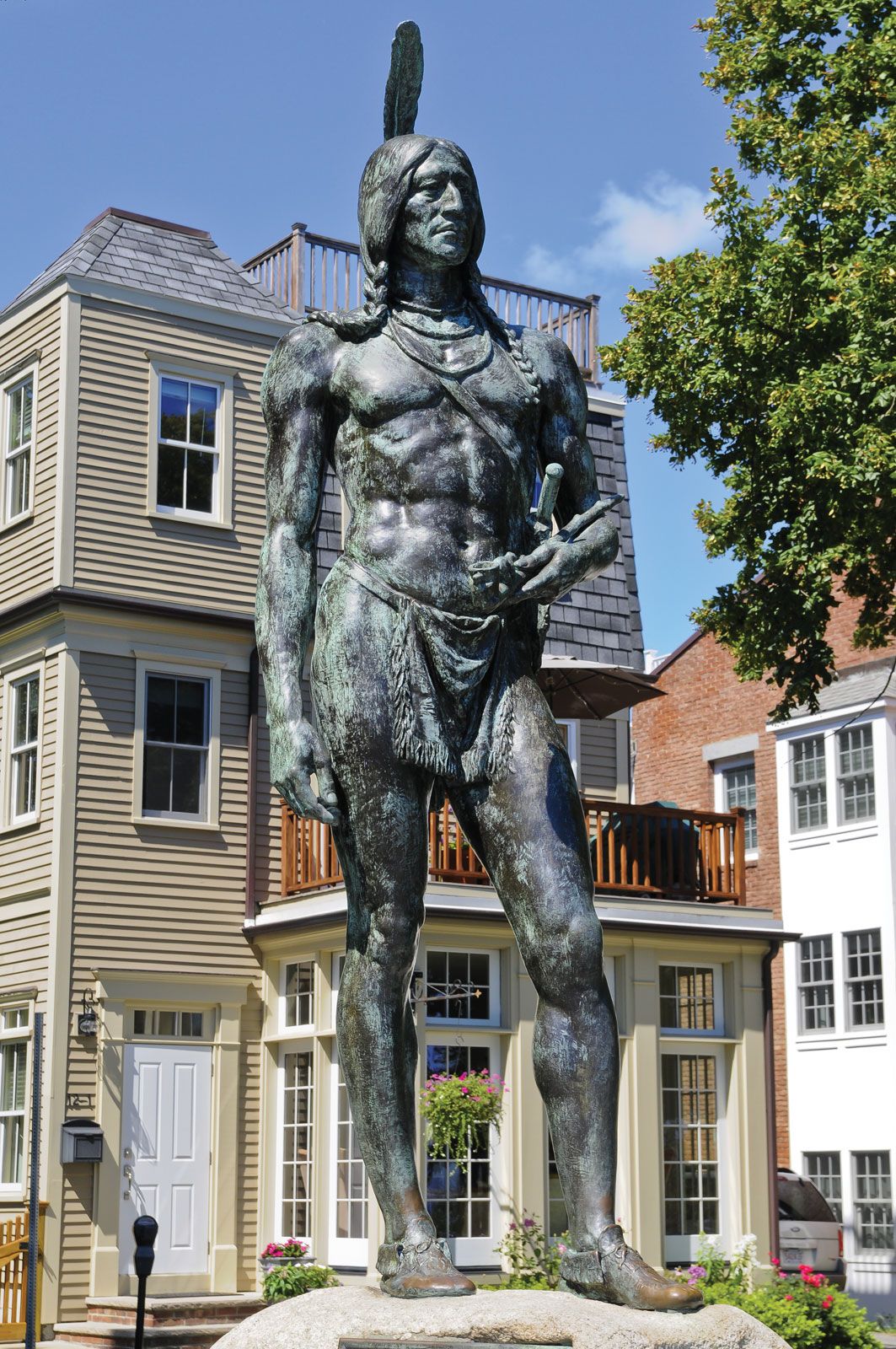
Massasoit
35
MENTIONS
8
EPISODES
7
PODCASTS
Search complete. 35 mentions across 8 episodes found for "Massasoit".
Oct 23, 2026

Samuel BiagettiHOST
As of the 1610s, the confederation had a fairly powerful paramount sachem, whose given name was Usamequin, and that's generally how I'm going to refer to him.
Samuel BiagettiHOST
although he also used the title of Massasoit, meaning great leader or great spokesman, and that is how the European colonists came to know him as Massasoit.
Samuel BiagettiHOST
But Usamequin came from a village called Poconoket, a relatively large and powerful village on the slopes of a large hill called Montauk or Mount Hope, which overlooks Mount Hope Bay, a major inlet on the eastern side of Narragansett Bay.
Samuel BiagettiHOST
And this village probably became a very important center of power and defense during this long feud with the Narragansetts.
49 MINS LATER
Samuel BiagettiHOST
So this basic cadre, Bradford, Standish, Winslow, and Brewster, and a few of their friends and kin, they would basically run the colony and provide it with remarkable stability and continuity for about the next 30 years.
Samuel BiagettiHOST
Now still, the colony would likely not have survived without the Anglo-Wampanoag alliance, which provided external stability.
Samuel BiagettiHOST
And over the course of 1621, small English delegations made the several-day-long overland trip to Poconoket to visit and exchange gifts with the Massasoit.
Samuel BiagettiHOST
Usamequin, for his part, agreed to stop natives from making too many random visits to Plymouth in search of food and entertainment.

FishPANELIST
I'll get there.
FishPANELIST
It was a 50-foot tall granite outcrop that the local Wampanoag believed was an image of Massasoit.
FishPANELIST
On June 19th, 2019, part of the outcrop broke off.
FishPANELIST
Oh, kind of old man in the mountain style? It kind of went old man in the mountain style.
FishPANELIST
what
AndyHOST
might
FishPANELIST
be considered Massasoit.
AndyHOST
I was just wondering if you look up and you see ghostly images of the Profile

David TennentHOST
Yeah.
Tim BartonGUEST
And so, like, literally, Governor Bradford helps do a peace treaty with Chief Massasoit, the chief of the Wampanoag Indians.
Tim BartonGUEST
Goes for more than 50 years, the longest lasting peace treaty between any whites and any natives in American history.
Tim BartonGUEST
And, again, worth pointing out, uh, that first winter when the Pilgrims arrive, they, they, they don't really get to Plymouth.
Tim BartonGUEST
He then in 1619 comes back.
Tim BartonGUEST
Not to digress too much in the story, it's incredible, but what's worth noting is when the Pilgrims, they, that, that second winter is when we had, they had the fir- or that, that fall, they had the first Thanksgiving.
Tim BartonGUEST
They're having a Thanksgiving because they're gonna thank God that God brought them friends and allies like Squanto and Samoset and Chief Massasoit, and that Squanto had showed them how to grow crops, and they, they, they thought, "This year we might not starve." [laughs]
David TennentHOST
Yeah.

KalindaNARRATOR
At night, the five Indians went away, but Samoset had made up his mind to stay longer with his new friends.
KalindaNARRATOR
A few days later, seeing that he had no idea of going home, the Puritans sent him to find Massasoit, who, as Samoset had told them, was the chief of the Indian tribes in that neighborhood, the Wampanoags.
KalindaNARRATOR
Soon, Massasoit, the chief, came with sixty armed and painted warriors, terrible to look at in their feathers and paint.
KalindaNARRATOR
But Massasoit did not come to fight.
KalindaNARRATOR
He wanted peace between his tribe and the strange people.
KalindaNARRATOR
After a little talk, he sat down with John Carver, the governor of this little colony, smoked the pipe of peace with him, and promised to befriend the colony as long as he should live.
KalindaNARRATOR
This treaty he always kept, and as he was a very powerful chief, the Puritans were safe from Indian attack as long as he lived.
KalindaNARRATOR
It was after his death that their real trouble with Indians began.

John DoyleHOST
So what are you going to do? Finally, you have the Pilgrims and New England, and they actually had a significantly more peaceful start making an alliance with the Wampanoag, who were a weaker tribe in the area in search of alliances facilitated by Squanto, who had spent a little time abroad, learned English.
John DoyleHOST
He was able to help facilitate contact and trade, but he would also inflame the tensions by playing his own power politics between himself and Massasoit would eventually demand the English hand over Squanto to be killed, and their refusal to do so would strain these kinds of relations.
John DoyleHOST
However, there wouldn't be a major conflict until the Pequot War, and the Pequot were heavily resented by the Narragansett and the Mohegan due to their aggressive pushes for territory and control and kind of subjugating surrounding tribes into subordinate relationships of offering tribute.
John DoyleHOST
When they killed the English traitor John Oldham, the Massachusetts Bay Colony would respond with their own attacks, aided by these other tribes basically sick of the Pequot eventually resulting in victory over them after the attack on Mystic Village.