Mason–Dixon line
146
MENTIONS
82
EPISODES
75
PODCASTS
Search complete. 146 mentions across 82 episodes found for "Mason–Dixon line".
Nov 20, 2026

Michael SmerconishHOST
I think I've got a great poll question today at Smirconish.com. And there's a story, of course, that I want to tell you as to why I'm asking.
Michael SmerconishHOST
But I'm asking, will the United States still be one country in 50 years? Will we still be one country in 50 years? Or does the prospect exist that some among us are going to go a separate way? And don't think Mason-Dixon line.
Michael SmerconishHOST
Think differently.
Michael SmerconishHOST
I'll explain in just a moment.
7 MINS LATER
Michael SmerconishHOST
It's put down.
Michael SmerconishHOST
And then come seven years of negotiating the split.
Michael SmerconishHOST
And what I found so interesting about Kurt Andersen's envisioning an America which goes its separate ways is that it's not a Mason-Dixon kind of a thing.
Michael SmerconishHOST
Right.

Evan BuckHOST
Yeah.
Evan BuckHOST
But basically, a lot of the colonies that are north of, hey, what a lot of people would call the Mason-Dixon line now, roughly speaking, were kind of more for these religious endeavors.
Evan BuckHOST
Yeah.
Evan BuckHOST
One big thing I'm going to drop even before we kind of move forward with how a timeline looks different here is the age-old eternal – I'm not even going to call it a debate.

Ashley NewbyHOST
Yeah, I mean, that's our, the VP level office of diversity, equity, inclusion, and accessibility, that name was changed without necessarily, you know, a vote on whether or not that should happen, but it's belonging and community here as well.
Ashley NewbyHOST
And, you know, technically we are below the Mason-Dixon line, But it's a different context in terms of a lot of things.
Ashley NewbyHOST
We're talking about like a Maryland versus a Georgia.
Ashley NewbyHOST
But yeah, now that those are changes that are being made many different places at

Michael SmerconishHOST
It's 2045.
Michael SmerconishHOST
The country has split in two, but we don't do it along the Mason-Dixon line.
Michael SmerconishHOST
It's really intriguing.
Michael SmerconishHOST
And he pursues, you know, how could an American red state, blue state breakup actually work? And he takes it down to a municipal level.
Kurt AndersonGUEST
So they feel we have no recourse but to start committing violence and assassinating people and performing massacres of civilians and and blowing up stuff and and and that leads to after a few months of oh it's not a war it's not a war there's nobody wants to call it a civil war But then when drones get involved and there are all these drone attacks on civilians as well as military bases, and there's a lot of attacks on military bases as well as on civilians, it is a war.
Kurt AndersonGUEST
And because it's the United States of America, 52 states versus scattered but serious attacks, violent terrorist attacks around the United States they're crushed in a year and a half it it takes a while and it's horrific and tens of thousands of Americans die and that's where we are and so then where we are is seven years after that violence and that war takes place having spent years and years of negotiating and renegotiating counties and states and cities figuring out which country they're in and how to divide this, the largest gerrymander ever, to try to figure out how these interlocking countries would exist.
Michael SmerconishHOST
I think that many people hear secession, you favor disunion, and like me, they think Mason-Dixon line.
Michael SmerconishHOST
But Kurt Anderson has something entirely different in mind.

Brian DonlevyVOICE_ACTOR
No, not particularly.
Brian DonlevyVOICE_ACTOR
How about you? Sounds like this is the farthest you've ever been away from the Mason-Dixon line.
speaker_10VOICE_ACTOR
Oh, now you're just poking fun at me, Stevie.
speaker_10VOICE_ACTOR
I think I have myself a mighty fine boat ride soon enough.

Matt VespaHOST
The problem with Bernie, though, is he will do well.
Matt VespaHOST
in states above the Mason-Dixon line.
Matt VespaHOST
Black Democrats will always block someone like Bernie Sanders getting the
Corey InganamortHOST
nomination.
Corey InganamortHOST
And how the
Matt VespaHOST
Democrats have their delegates allocated by proportion.
Matt VespaHOST
If you get, you know, taken to the woodshed below the Mason-Dixon line by black Democrats.
Matt VespaHOST
You're not going to win the nomination.

Stewart HowdenHOST
Should I? Wink, wink.
Steve SaffierHOST
I was south of the Mason-Dixon line this weekend.
Steve SaffierHOST
I just wanted to mention that.
Jay WardSOUNDBITE_SPEAKER
Well, what were you doing? Shout out to Shenandoah Valley.

KaraGUEST
we're in the South.
Donna BoyleHOST
Did she grow up below the Mason-Dixon line, below Atlanta, below Georgia?
KaraGUEST
No. No.
KaraGUEST
We were North Carolinians.

Kevin O'KeefeHOST
You had California as a state, but otherwise, the entire reason, or certainly, One of the major reasons that we went to war was this conflict about how the slave question was going to be settled as states started to be organized and admitted to the United States.
Kevin O'KeefeHOST
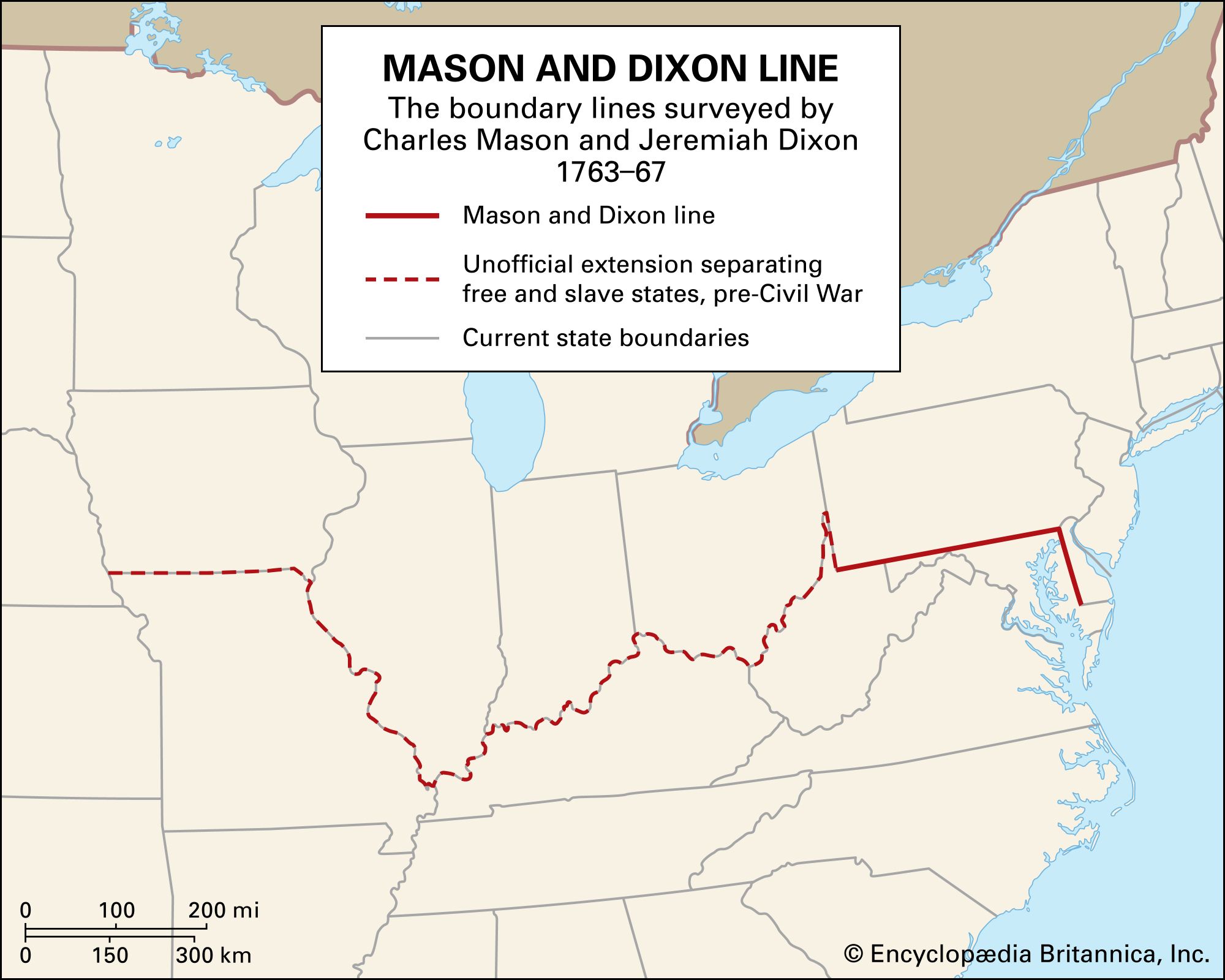
So there was this Mason-Dixon line, which is this imaginary line going from east to west, the southern tip of Pennsylvania, if it was above that line, you were a free state.
Kevin O'KeefeHOST
Slavery was not allowed.
Kevin O'KeefeHOST
If it was south of that line, you were considered to be able to have slaves.

Paul GlastrisGUEST
It was founded by abolitionists.
Paul GlastrisGUEST
and was the first college south of the Mason-Dixon line to maybe anywhere to have blacks and whites study together and one of the first to allow women in.
Paul GlastrisGUEST
And they have a couple of policies that have made it so that, first of all, all of their students come from Appalachia.
Paul GlastrisGUEST
virtually all, and virtually all of them from modest backgrounds, poor backgrounds, working class backgrounds.
72 more episodes mention Mason–Dixon line.
Create an account to see the whole feed, search across every transcript, and follow the entities you care about.