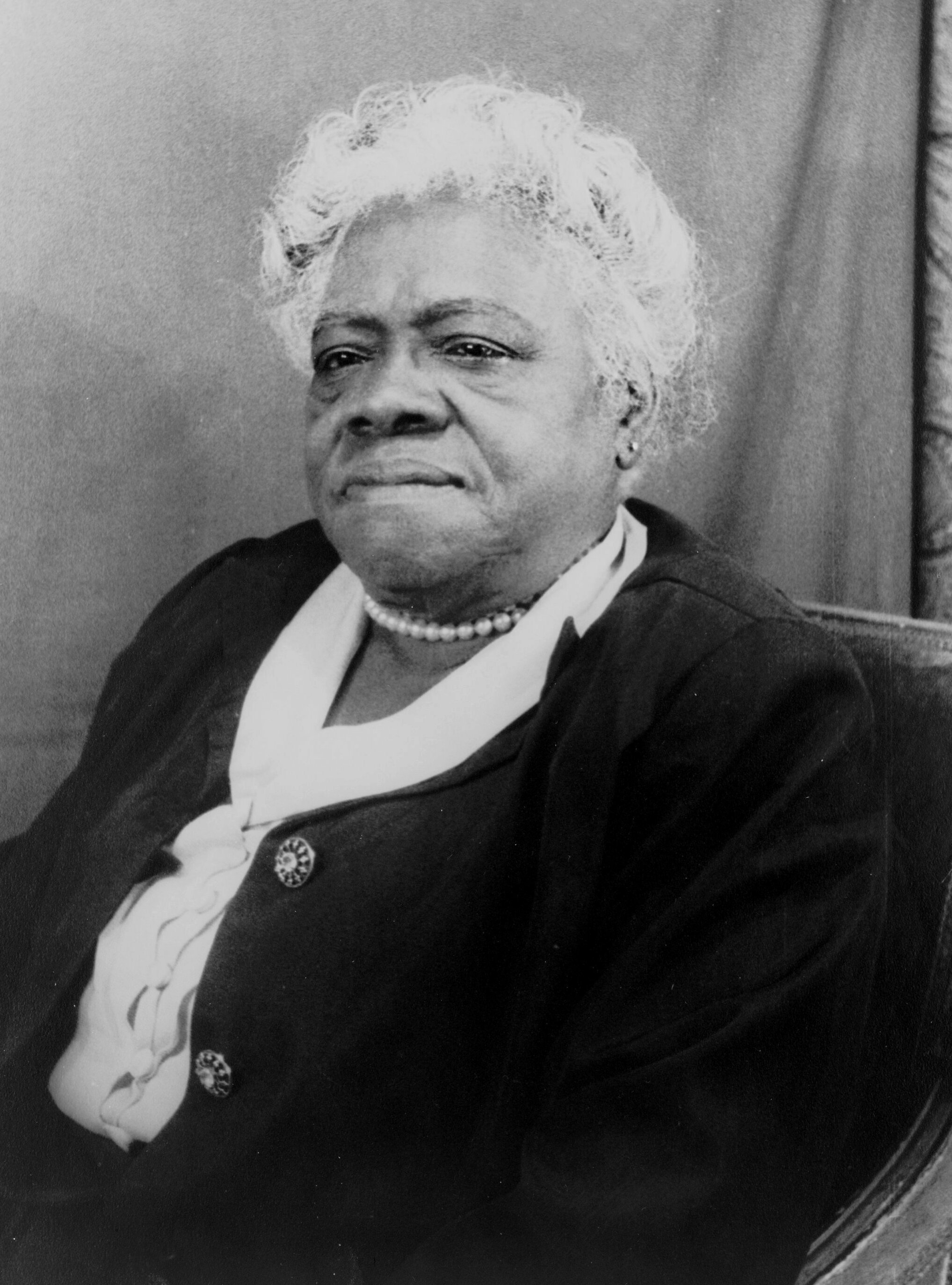
Mary McLeod Bethune
American educator and philanthropistWikipedia
26
MENTIONS
22
EPISODES
20
PODCASTS
Search complete. 26 mentions across 22 episodes found for "Mary McLeod Bethune".
Oct 18, 2026

speaker_0UNKNOWN
None of you are familiar.
speaker_0UNKNOWN
Her name was Mary McLeod Bethune.
speaker_0UNKNOWN
She wanted to be a missionary, but was turned down because at that time there weren't any black missionary or missions, weren't any black missions organizations.
speaker_0UNKNOWN
And so they turned her down.

Keri Leigh MerrittGUEST
But she was also friends with, you know, multiple people in SNCC and worked in SNCC throughout the last years of her life.
Keri Leigh MerrittGUEST
She gets introduced to Eleanor Roosevelt through Mary McLeod Bethune, who she's been, she was friends with throughout the '30s and '40s and ends up writing, um, some kind of testament to Congress when Bethune is accused of communism.
Keri Leigh MerrittGUEST
And as a thank you, Bethune says, "Hey, I want to introduce you to Roosevelt because you guys have a lot in common." And I think Bethune also realizes how lonely it probably is for, for white women who are, you know, not subscribing to white supremacy and who are not, you know, actively racist themselves.
Keri Leigh MerrittGUEST
And it does.

Marta Cruz KellyGUEST
I think we need to teach people how to look at stories differently.
Marta Cruz KellyGUEST
For example, one of the programs I used to do is on the Mary McLeod Bethune.
Marta Cruz KellyGUEST
Mary McLeod Bethune, I worked at her site.
Marta Cruz KellyGUEST
And, you know, it's a site where I say who she was, what she did, and, you know, everything.
Marta Cruz KellyGUEST
But one of her most informative speeches that moves me deeply is what does democracy mean to me? And so the presentation is about learning about her through this speech, but also what does democracy mean to you and what other sites, what other places that you can go to to learn about democracy? So it becomes more about exploring what the story means to us and how we carry it forward and not, you know, Mrs.

Keri Leigh MerrittGUEST
But she was also friends with, you know, multiple people in SNCC and worked in SNCC throughout the last years of her life.
Keri Leigh MerrittGUEST
She gets introduced to Eleanor Roosevelt through Mary McLeod Bethune, who she's been, she was friends with throughout the '30s and '40s, and ends up writing, um, some kind of testament to Congress when Bethune is accused of communism.
Keri Leigh MerrittGUEST
And as a thank you, Bethune says, "Hey, I wanna introduce you to Roosevelt because you guys have a lot in common." And I think Bethune also realizes how lonely it probably is for, for white women who are, you know, not subscribing to white supremacy and are, who are not, you know, actively racist themselves.
Keri Leigh MerrittGUEST
And it does.

Keri Leigh MerrittGUEST
But she was also friends with, you know, multiple people in SNCC and worked in SNCC throughout the last years of her life.
Keri Leigh MerrittGUEST
She gets introduced to Eleanor Roosevelt through Mary McLeod Bethune, who she's been- she was friends with throughout the '30s and '40s, and ends up writing, um, some kind of testament to Congress when Bethune is accused of communism.
Keri Leigh MerrittGUEST
And as a thank you, Bethune says, "Hey, I wanna introduce you to Roosevelt because you guys have a lot in common." And I think Bethune also realizes how lonely it probably is for, for white women who are, you know, not subscribing to white supremacy and who are not, you know, actively racist themselves.
Keri Leigh MerrittGUEST
And it does.

Keri Leigh MerrittGUEST
But she was also friends with, you know, multiple people in SNCC and worked in SNCC throughout the last years of her life.
Keri Leigh MerrittGUEST
She gets introduced to Eleanor Roosevelt through Mary McLeod Bethune, who she's been, she was friends with throughout the '30s and '40s and ends up writing, um, some kind of testament to Congress when Bethune is accused of communism.
Keri Leigh MerrittGUEST
And as a thank you, Bethune says, "Hey, I wanna introduce you to Roosevelt because you guys have a lot in common." And I think Bethune also realizes how lonely it probably is for, for white women who are, you know, not subscribing to white supremacy and who are not, you know, actively racist themselves.
Keri Leigh MerrittGUEST
And it does.

Chuck StevensNARRATOR
Third, as a historian, I would like to urge our community to point out those teachers in our history who made a difference not only in their community, but in the entire nation.
Chuck StevensNARRATOR
These teachers include Mary McLeod Bethune, who took a few orange crates and started a school that later became a college.
Chuck StevensNARRATOR
Charlotte Hawkins Brown, who created a school for black girls in the early 1900s.
Chuck StevensNARRATOR
Dr. Rufus E. Clement, who was a skilled teacher and who created three different schools.

Abdul Haleem MuhammadGUEST
She's just an icon.
Abdul Haleem MuhammadGUEST
And she really was an acolyte or a mentee of the great Mary McLeod Bethune, the star of Bethune-Cookman College.
Abdul Haleem MuhammadGUEST
So then you had everybody all the way over to people who were, you know, We got our black power in our streets.
Abdul Haleem MuhammadGUEST
It was great.

Keri Leigh MerrittGUEST
Right.
Keri Leigh MerrittGUEST
She meets Eleanor in the, I think it's the late or sorry, the early forties through Mary McLeod Bethune.
Keri Leigh MerrittGUEST
Bethune had been accused of communism and, and, uh, Smith had written a letter to help her out.
Keri Leigh MerrittGUEST
And Bethune says, look, I think you need to meet Roosevelt because you two are basically working for the same things, two white women that need to know each other.

Tanisha FordGUEST
And he finds work as a low-level administrator in FDR's White House.
Tanisha FordGUEST
So he's part of that so-called black cabinet of people that includes folks like Mary McLeod Bethune and Robert Weaver who becomes the first director of HUD for example and so he too was deeply invested in justice work and would go on to become the publicity director of the NAACP.
Tanisha FordGUEST
So you have Molly Moon working with the National Urban League, and Henry Lee Moon, a prominent leader with the NAACP.
Tanisha FordGUEST
So they were this social justice power couple, if you will.
12 more episodes mention Mary McLeod Bethune.
Create an account to see the whole feed, search across every transcript, and follow the entities you care about.