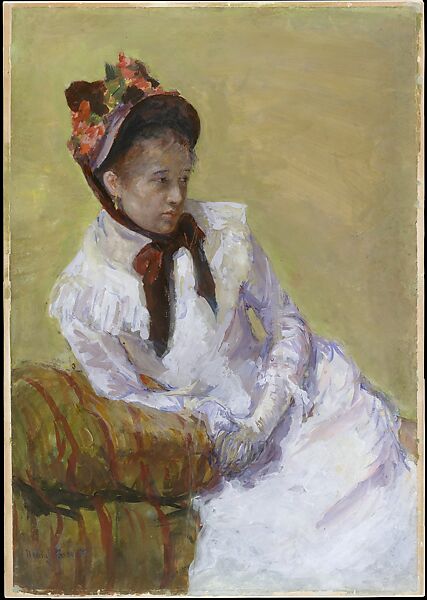
Mary Cassatt
American painterWikipedia
37
MENTIONS
12
EPISODES
12
PODCASTS
Search complete. 37 mentions across 12 episodes found for "Mary Cassatt".
Sep 24, 2026

Min ChenGUEST
But I, I think the term narrative art, again, just to go back, it's specific, but I also find it quite expansive.
Min ChenGUEST
Like, when you first hear it, you think about film, illustration, comics, you know? But it also cover a ton of work, you know, Mary Cassatt's painting of mothers, Frida Kahlo's self-portrait.
Min ChenGUEST
You know, it's harder to think of art that doesn't tell a story, I feel.
Ben DavisHOST
Yeah.
Min ChenGUEST
Sure, yeah.
Min ChenGUEST
The Frida Kahlo self-portrait is across the, uh, comics gallery, so there are some interesting juxtapositions there, and I think it goes to what's Lucas's mission of celebrating illustrators who are often, you know, overlooked.
Min ChenGUEST
They deserve to be on the museum wall next to a Picasso, next to a Mary Cassatt, you know? And the museum does have an introductory gallery with an exhibition called The History of Narrative Art, where it takes you through-
Ben DavisHOST
Okay

Jim NolanHOST
This time, we'll be reading about painting in 19th century France.
Jim NolanHOST
I don't need to tell you that this is one of the most glorious centuries of painting ever, and many of the big names, Manet, Degas, Cassatt, Monet, were working in France.
Jim NolanHOST
So this should be an interesting listen, no? No.
Jim NolanHOST
It's going to be deadly boring.
28 MINS LATER
Jim NolanHOST
Bayreaux and Raffaelli are exceedingly clever in street scenes and character pieces.
Jim NolanHOST
Pissarro handles the peasantry in high color, Brown the racehorse, and Renoir the middle class of social life.
Jim NolanHOST
Calabat, Roll, Forain, and Miss Cassatt, an American, are also classed with the Impressionists.
Jim NolanHOST
Impressionist landscape painters.

Kerry DixonHOST
Sometimes it's techniques, sometimes the struggles we all have as artists and sometimes like today we take a little trip back through art history.
Kerry DixonHOST
Today we're doing another Meet the Masters and we're heading back to the 1800s to meet an artist I've really enjoyed learning more about, Mary Cassatt.
Kerry DixonHOST
Now if you know Cassatt's work, you probably know her for her beautiful paintings of mothers and children.
Kerry DixonHOST
But what particularly interested me was her pastel work.
Kerry DixonHOST
I suddenly feel like I have to finish everything.
Kerry DixonHOST
So the more I look at Cassatt's work the more I realise there are some really useful lessons here for those of us painting today and not just pastel artists.
Kerry DixonHOST
So today we're going to learn a little bit about Mary Cassatt but more importantly we're going to look at her as artists ourselves.
Kerry DixonHOST
What can we learn from the way she worked? So who was Mary Cassatt? Mary Cassatt was born in Pennsylvania in 1844 into a fairly well-to-do family.

Maxwell KingGUEST
He's not one of the great American artists.
Maxwell KingGUEST
Mary Cassatt, who came out of Pittsburgh, is one of the great American artists and impressionists who mostly did portraits.
Maxwell KingGUEST
But Gorson is one of America's leading painters of industrial landscapes.
Maxwell KingGUEST
And I would say in Pennsylvania, he is the leading painter of industrial landscapes.

Lisa D. SmithHOST
Today, we're rethinking everything we thought we knew about Mary Cassatt.
Lisa D. SmithHOST
In her book, Cassatt Reconsidered, our guest Mary G. Morton makes this case for an artist who was bold, modern, and uncompromising.
Lisa D. SmithHOST
and whose true radicalism has been overlooked for far too long.
Lisa D. SmithHOST
Today we have a special guest joining us on the World of Art Show, as you know, hosted by Victoria Chick, who's a contemporary figurative artist, an art historian, a collector of early 19th and 20th century prints, and also the spearhead behind the project of creating the Southwest Regional Museum of Art and Art Center in Silver City, New Mexico.
Lisa D. SmithHOST
So you can learn more about Victoria, as always, at victoriachick.com.
Lisa D. SmithHOST
But today, we're going to be talking about the artist Mary Cassatt.
Lisa D. SmithHOST
And I think it was like 10, maybe 15 years ago that Victoria was on the show talking about her and wrote an article.
Lisa D. SmithHOST
We've done so much on women and artists, pretty amazing, their stories.

Leanne HowlettNARRATOR
The subject, as well as the treatment, is as different as can be imagined from that of Mrs. McMoney's.
Leanne HowlettNARRATOR
Miss Cassatt has chosen the modern woman, and has tried to represent the fashions of the day as accurately and as much in detail as possible.
Leanne HowlettNARRATOR
The subject of the central and largest composition is young women plucking the fruits of knowledge and science, and this enabled placing of the figures out of doors and allowed of brilliancy of color.
Leanne HowlettNARRATOR
The occasion being one of rejoicing, a great national fete, the general effect has been made as bright and amusing as possible.

Sasha-Ann SimonsHOST
Let's give our art lovers some fun news, Cassie.
Sasha-Ann SimonsHOST
There's a new exhibit at the Art Institute of Chicago celebrating Impressionist Mary Cassatt.
Sasha-Ann SimonsHOST
What should we expect to see?
Cassie Walker-BurkePANELIST
Well, I think Cassatt is often thought of as sort of the woman who was in the avant-garde boys club of impressionism.

Holly BlackGUEST
Manet and Van Gogh and Whistler and all these different people.
Holly BlackGUEST
And Mary Cassatt was very much taken with the works of Utamaro, who was an artist who was known for his bijinga, which bijinga are beautiful women.
Holly BlackGUEST
So the idea of creating these portraits of women who either existed or were archetypes, or so they might be famous courtesans or they might be the idea of a woman and so Mary Cassatt takes a lot of that iconography and translates it from a female perspective so she inserts a more domestic sensibility and this image in particular uses the idea of the nape of the neck and the back was seen as like as a specific area of beauty within the female figure um within uh the prince of a tomorrow and other people um but what's fantastic is a you can see the influences not only in that composition but in the flatness that mary cassatt uses so
Erin-Atlanta ArgunHOST
and it's interesting because obviously the influence is from woodblock but yes
Holly BlackGUEST
this is all in taglio yeah So you have this beautiful carpet, we'll say, that doesn't really bear much relation to what you might expect.
Holly BlackGUEST
They bite further and further into the plates.
Holly BlackGUEST
You get areas of, um, of different levels of shading and then using a technique called a la poupe, which is when you use, um, It basically means with a doll and you use this little fabric covered mounds that you then use different colours and you put it on the plate and then that goes through the press.
Holly BlackGUEST
But, you know, Mary Cassatt was a fantastic artist.

DrewHOST
In the 1950s, along with London, Paris was undoubtedly one of the most popular vacation destinations.
DrewHOST
It also became a common second home for American expats, particularly artists and writers such as Ernest Hemingway, Gertrude Stein, F. Scott Fitzgerald, and James Baldwin, Josephine Baker, and Mary Cassatt.
DrewHOST
Oh yeah, and Ysa Sarah Kanye.
DrewHOST
And Jerry.

Daniel KeysGUEST
...
Daniel KeysGUEST
Mary Cassatt or a Degas?"
Lisa SkellyHOST
Mm-hmm.
Daniel KeysGUEST
I- immediately it registers, like, "Oh yeah, okay," you know?
2 more episodes mention Mary Cassatt.
Create an account to see the whole feed, search across every transcript, and follow the entities you care about.