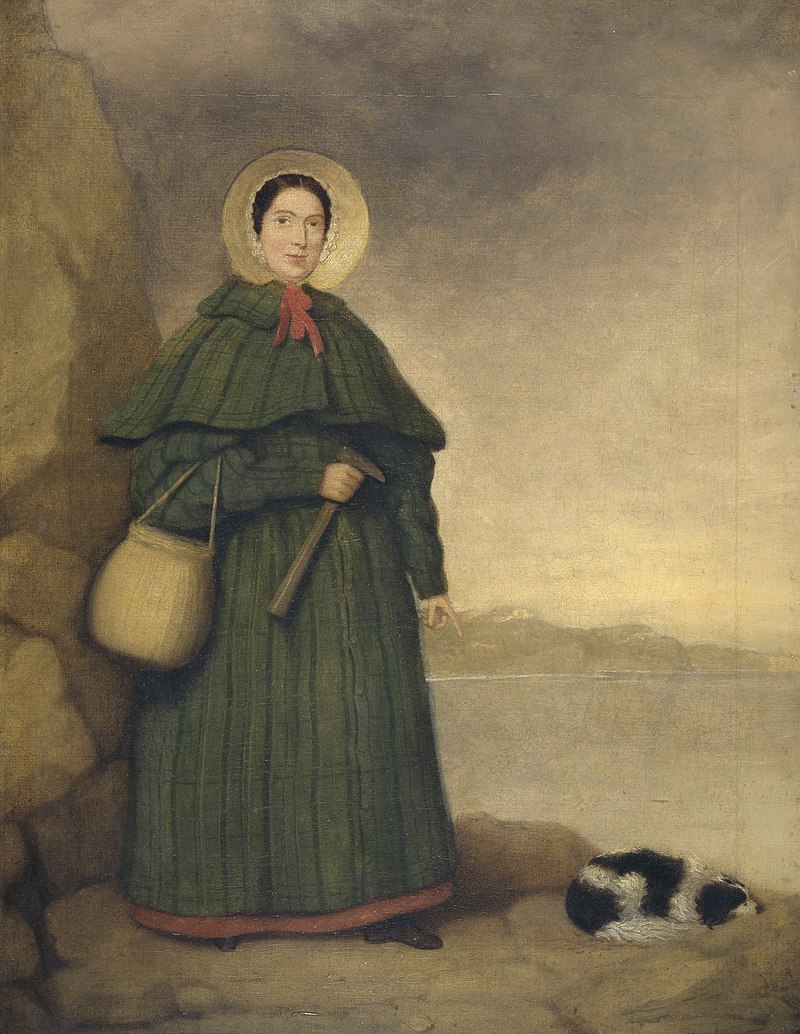
Mary Anning
English paleontologistWikipedia
32
MENTIONS
16
EPISODES
16
PODCASTS
Search complete. 32 mentions across 16 episodes found for "Mary Anning".
Nov 21, 2026

Stephen KingGUEST
Oh, absolutely.
Stephen KingGUEST
I mean, one of the other heroes of this museum is Mary Anning.
Stephen KingGUEST
And she, down in Lyme Regis in the beginning of the 19th century, is getting out these amazing Jurassic sea monsters, these impossible monsters.
Stephen KingGUEST
And they are, you know, the size of a truck kind of thing.
22 MINS LATER
Stephen KingGUEST
Yeah, it is the kind of thing.
Stephen KingGUEST
I mean, I have, you know, talking about tours you'd like to give, I have a kind of Victorian paleontologist tour.
Stephen KingGUEST
And we're sitting in the Mary Anning room here, for example.
Stephen KingGUEST
And again, the fossils that we have from Mary Anning in this building are stunning.

Anjana KhatwaGUEST
I think it's seventy-nine.
Anjana KhatwaGUEST
He came over to the UK, uh, three years ago, where I took him on a walk along the beaches where Mary Anning walked, the paleontologist, and, um, it's called Every Rock Has a Story.
Anjana KhatwaGUEST
And so that's his huge YouTube channel where he creates beautiful stories about rocks.
Anjana KhatwaGUEST
So that's, that's the first place I think you could start.

Adrian ShineGUEST
I've taken it thus far to the sea serpent, and talked about the boat wakes.
Adrian ShineGUEST
But at sea, the sea serpent in the 19th century stopped being a sea serpent and became a Jurassic plesiosaur following the discovery of Jurassic fossils, Mary Anning on the south coast of England.
Adrian ShineGUEST
We, I think, take our myths, but attempt to make them more rational, more plausible as time goes on.
Adrian ShineGUEST
And so when the sea serpent with its lots of humps and its short neck became the plesiosaur with its long neck but a stumpy body, It was more rational because plesiosaurs had once been real.

Matt KaplanGUEST
And there weren't a lot of women associated with perpetual fever.
Matt KaplanGUEST
I mean, you do have female paleontologists like Mary Anning.
Matt KaplanGUEST
who was a British fossil collector along the Dorset Coast.
Matt KaplanGUEST
She was collecting these marine reptiles that are now enshrined on the walls of the British Natural History Museum.

Louise OrdHOST
No.
Louise OrdHOST
Now another Mary enters our story, a very famous Mary, Mary Anning, very famous fossil collector and paleontologist.
Louise OrdHOST
And she's noticed something quite important about these objects, particularly because she finds some in the abdominal region of a fossilized ichthyosaur that she's studying.
Louise OrdHOST
When she cuts these open, she finds kind of fish scales and fragments of bones inside these bizarre stones.

Emily RayfieldGUEST
So think about it.
Emily RayfieldGUEST
In the last 10 years, coming to light are the discoveries of Mary Anning from Lyme Regis, where we're finding extinct animals that don't look anything like living animals.
Misha GlennyHOST
Tell us a bit about Mary Anning.
Emily RayfieldGUEST
So Mary Anning was a fossil hunter.
Emily RayfieldGUEST
She was working in Lyme Regis.
Emily RayfieldGUEST
She was discovering, along with her family, her brother and her family, were discovering these unusual creatures from the rocks around Lyme Regis.
Steve BrusatteGUEST
And of course, we recognize it today as the starting point, the starting pistol for dynomania.
Steve BrusatteGUEST
And really it is because the public started to become fascinated as well because it wasn't only Buckland that was discovering these fossils.

Mary F. DavisGUEST
The uniqueness of this really hit home last summer as I was able to be a director of a new study abroad for women in the history of science.
Mary F. DavisGUEST
It was a phenomenal experience exploring different fields of science in many countries, including learning about Marie Curie, Rosalind Franklin, Florence Nightingale, Mary Anning, and Emmanuelle Charpentier.
Mary F. DavisGUEST
I learned about more female scientists than I knew existed, and I learned more about their lives and their challenges in addition to their academic achievements.
Mary F. DavisGUEST
I also spent the past year

Emily RayfieldGUEST
So think about it.
Emily RayfieldGUEST
In the last 10 years, coming to light are the discoveries of Mary Anning from Lyme Regis, where we're finding extinct animals that don't look anything like living animals.
Misha GlennyHOST
Tell us a bit about Mary Anning.
Emily RayfieldGUEST
So Mary Anning was a fossil hunter.
Emily RayfieldGUEST
She was working in Lyme Regis.
Emily RayfieldGUEST
She was discovering, along with her family, her brother and her family, were discovering these unusual creatures from the rocks around Lyme Regis.
Steve BrusatteGUEST
And of course, we recognize it today as the starting point, the starting pistol for dynomania.
Steve BrusatteGUEST
And really it is because the public started to become fascinated as well because it wasn't only Buckland that was discovering these fossils.

Steve StocktonHOST
While scientists have known about the presence of simple organic carbon on the Red Planet for over a decade, this new data reveals a level of molecular complexity previously thought impossible for the Martian surface.
Steve StocktonHOST
The discovery, centered on a sample nicknamed Mary Anning 3, has confirmed the existence of diverse organic molecules, including key building blocks for genetic information that have been preserved in the Martian clay for over 3.5 billion years.
Steve StocktonHOST
Let's delve into the Mars organic mystery.
Steve StocktonHOST
The factual foundation of this mystery began in October 2020 when the Curiosity rover drilled into a rock target at the base of Mount Sharp in the Gale Crater.
Steve StocktonHOST
TMAH chemically breaks apart large, complex molecules into smaller, more stable components that can be analyzed by the rover's mass spectrometer without destroying their diagnostic signatures.
Steve StocktonHOST
Curiosity carried only two cups of this chemical for the entire mission.
Steve StocktonHOST
The decision to use one of these precious samples on Mary Anning 3 was a high-stakes scientific gamble that resulted in the discovery of benzothiamine and the DNA precursor molecules.
Steve StocktonHOST
Now let's take a look at the benzothiophene connection.
6 more episodes mention Mary Anning.
Create an account to see the whole feed, search across every transcript, and follow the entities you care about.