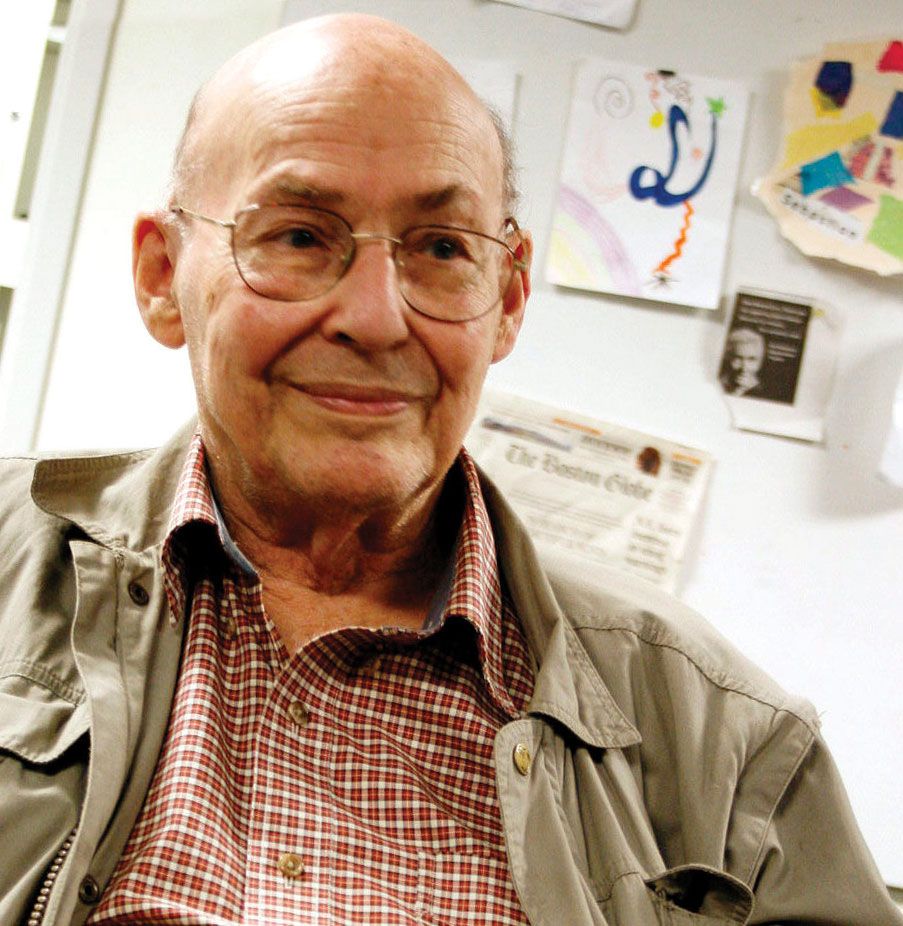
Marvin Minsky
American mathematicianWikipedia
44
MENTIONS
32
EPISODES
26
PODCASTS
Search complete. 44 mentions across 32 episodes found for "Marvin Minsky".
Sep 29, 2026

Kristie D'Ambrosio-CorrellGUEST
And right at that time, the MIT computer science and AI lab was in full swing.
Kristie D'Ambrosio-CorrellGUEST
Marvin Minsky was still at MIT and Patrick Winston, his protege, was leading the lab at the time.
Kristie D'Ambrosio-CorrellGUEST
And I kind of fell full force into this world of AI that no one was really falling into.
Kristie D'Ambrosio-CorrellGUEST
Everyone was obsessed with mobile and web development.

John BatchelorHOST
Frank Rosenblatt sees what the future is.
John BatchelorHOST
However, a man named Marvin Minsky, who's a professor at MIT, believes that neural networks, that is, just throwing a lot of information into a computer's brain and letting it decide it can sort it out, that's a dead end.
John BatchelorHOST
He has a rules-based approach that you report, Gary... made AI extremely unlikely and almost unpopular to the point that you shouldn't mention it.
John BatchelorHOST
Is that correct?

Scott AaronsonGUEST
People were trying to train these very small neural networks on small amounts of data, and sometimes they could do something, but it just, It wasn't very impressive.
Scott AaronsonGUEST
I recently read an interview with Marvin Minsky, another founder of AI from about 1979, I think.
Scott AaronsonGUEST
He was very, very skeptical of neural nets.
Scott AaronsonGUEST
In fact, wrote a book called Perceptrons that killed off neural net research for a decade.

Michael BensonGUEST
Um, I just wanted to say about Hal, um, and the research behind Hal, that, um, there were two com- there were two pioneering, uh, artificial intelligence theorists/scientists, you know, brilliant people, uh, who consulted with Kubrick and Clarke about Hal.
Michael BensonGUEST
Um, one of them was Marvin Minsky, co-founder of MIT's Artificial Intelligence Lab, which is going strong to this day, as you can imagine, um, and who really had significant theoretical breakthroughs in the '60s about, uh, neural networks and so forth.
Michael BensonGUEST
Um, a key figure actually in the development of the ideas behind artificial intelligence.
Michael BensonGUEST
And the other one, that was in, that was in the US, although he then visited the set, uh, in Boreham Wood, north of London.

Bobby CapucciHOST
The witness answers, no.
Bobby CapucciHOST
Back to manager, how about Marvin Minsky? Answer, I don't know.
Bobby CapucciHOST
Manager, George Lucas.
Bobby CapucciHOST
Answer, no.

Andrew M. HenryHOST
Other theorists believe we are destined for a post-biological future as well.
Andrew M. HenryHOST
Back in 1994, the computer scientist Marvin Minsky published Will Robots Inherit the Earth?, where he argues we'll soon be able to build bodies and brains to replace our failing biology.
Andrew M. HenryHOST
And the engineer Kevin Warwick, who works on interfacing computers with the human nervous system, argues against the mind-upload model but says that we'll be able to enhance ourselves as cyborgs with powerful implants.
Andrew M. HenryHOST
Whatever the model, Beth Singler characterizes these predictions as positive forms of AI apocalypticism, an existentially hopeful vision of the future that, through technology, the architecture of the human mind and body can be transformed, free from suffering and perhaps even free from death.

Bobby CapucciHOST
The witness answers, no.
Bobby CapucciHOST
Back to manager, how about Marvin Minsky? Answer, I don't know.
Bobby CapucciHOST
Manager, George Lucas.
Bobby CapucciHOST
Answer, no.

Gary MarcusGUEST
And there's been- Like, or hatred between the two.
Gary MarcusGUEST
Like in 1969, Marvin Minsky, who was one of the founders of AI, wrote a, a book, uh, with Seymour Papert called Perceptrons, arguing that neural networks weren't going anywhere, basically.
Gary MarcusGUEST
If you really look at the argument, it was structured very carefully, but nobody ever does, and they just take it as he, he killed the field, which is not entirely right.
Gary MarcusGUEST
Um, but anyway, there's been hostility back and forth in different sides.

Peter WolfendaleGUEST
So are
Rahul SamaranayakeHOST
these like frames in Marvin Minsky's, like you build frames of the world, that kind of top-down
Peter WolfendaleGUEST
approach? So I'm actually a big fan of frame theory, right? I think because...
Peter WolfendaleGUEST
Interesting.

Ellie LeonardHOST
She mentions ASU professor Lawrence Krauss, who was a good friend of Epstein.
Ellie LeonardHOST
MIT professor Marvin Minsky.
Ellie LeonardHOST
I'm trying to think if he was considered the godfather of AI.
Ellie LeonardHOST
It was either him or the other guy.
22 more episodes mention Marvin Minsky.
Create an account to see the whole feed, search across every transcript, and follow the entities you care about.