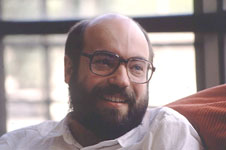
Mark Weiser
American computer scientistWikipedia
9
MENTIONS
6
EPISODES
3
PODCASTS
Search complete. 9 mentions across 6 episodes found for "Mark Weiser".
Nov 4, 2026

Scott HudsonGUEST
And I don't know what that kid was supposed to do, but we don't have that.
Scott HudsonGUEST
But something that did arrive, Mark Weiser had a vision of ubiquitous computing, where computing could be sort of all over our lives and everywhere.
Scott HudsonGUEST
And that vision has really served us phenomenally well.
Scott HudsonGUEST
It's been tremendously insightful.
Niklas ElmqvistGUEST
Now, of course, if these discussion sound familiar? It's because they are.
Niklas ElmqvistGUEST
This is Mark Weiser.
Niklas ElmqvistGUEST
He's the head of the computer science department at Syracuse Park, just about three miles from here.
Niklas ElmqvistGUEST
I looked up before I came here, which is really cool.
Niklas ElmqvistGUEST
It has come.
Niklas ElmqvistGUEST
We don't just recognize it.
Niklas ElmqvistGUEST
It looks slightly different from the vision that Mark Weiser, who's hailed as one of the fathers of ubiquitous computing, thought of.
Niklas ElmqvistGUEST
He talked about disposable tabs, computers, tablets you could use and then throw aside so they were not personal.
Terry WinogradGUEST
I was not involved in these particular projects, but was around and sort of seeing what went on.
Terry WinogradGUEST
Who's this? the guy with the suspenders, Mark Weiser.
Terry WinogradGUEST
So he had a group at PARC that was developing what they called ubiquitous computing.
Terry WinogradGUEST
And his idea was you didn't want to think of a computer as just that thing on the desk, but it should be all different scales.
Ethan FastGUEST
So, and if you think about it, this is really a key component of many of these core ideas we've had in human-computer interaction.
Ethan FastGUEST
For example, here's Mark Weiser, the founder of Ubiquitous Computing.
Ethan FastGUEST
And when Mark was first motivating this idea, he gives this example of a smart home that knows you might want to drink coffee after you wake up.
Ethan FastGUEST
Now, it's been decades since Mark first introduced this idea, but how close are we really to systems that understand these kinds of relationships today? For example, take an activity like packing.