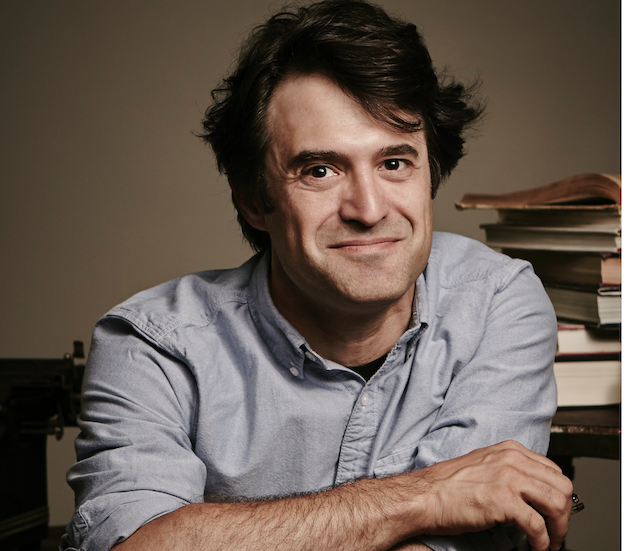
Mark Oppenheimer
Author
13
APPEARANCES
10
PODCASTS
Aug 10, 2026

Katherine MarshMODERATOR
And I'm wondering if you could bring us into that and just describe what she's like, not only as a public person, but maybe if there's a sense of her as a private person that you got from that.
Mark OppenheimerGUEST
And just Washington, DC, where I lived briefly around that time in 96 and 97, right after getting out of college.
13 MINS LATER
Katherine MarshMODERATOR
So I'd like you to psychoanalyze her a little bit because I think we'd all like to know what the secret is there.


Mark OppenheimerGUEST
The Jewish Book Council is this incredible group who pull together these tours for authors who write on Jewish themes.
29 MINS LATER


Mark OppenheimerGUEST
So Are You There, God? It's Me, Margaret came out in 1970, right after, soon after Iggy's House and Freckle Juice, but it was her first kind of big book.
Mark OppenheimerGUEST
And, um, uh, you know, it definitely was seen as controversial from the start, I think not only because of Margaret discussing menstruation and breast size, but also, um, that she was a daughter of an interfaith marriage, which was in some ways a bigger deal for the public.
30 MINS LATER


Andrew WestHOST
Tell us some of their stories or, or just remind us of the, of the humanity that was lost.
Mark OppenheimerGUEST
One of the points that I made in my book is that most Jews, like most people of most faiths, are not at worship every single weekend.
Mark OppenheimerGUEST
Most people, if they're affiliated with a church or a synagogue or a mosque, maybe they go once a month, maybe they go five times a year, but for the most part, they aren't there.
Mark OppenheimerGUEST
So if you go in, especially early on a Saturday, where, you know, only the most stalwart people show up at the very beginning and stay through the whole worship service, the people you find are, by definition, going to be among the real pillars of the community, the people who go every week, the people who literally turn the lights on, who make sure that there's coffee for the coffee hour afterwards.
Mark OppenheimerGUEST
I mean, these are the often elderly, often retired, lifelong members, people who have dedicated their, their elderly years to serving the Jewish community and, and, and giving back.
Mark OppenheimerGUEST
Several of the people who were killed were quite elderly, including one woman in her 90s, Rose Mallinger.
Mark OppenheimerGUEST
There were also two brothers with intellectual disabilities, uh, quite profound disabilities, who had made the Tree of Life synagogue their home ever since they were children.
8 MINS LATER
Andrew WestHOST
... stalwarts of their community.Tell us some of their stories or, or just remind us of the, of the humanity that was lost.
Mark OppenheimerGUEST
One of the points that I made in my book is that most Jews, like most people of most faiths, are not at worship every single weekend.
Mark OppenheimerGUEST
Most people, if they're affiliated with a church or a synagogue or a mosque, maybe they go once a month, maybe they go five times a year, but for the most part, they aren't there.
Mark OppenheimerGUEST
So if you go in, especially early on a Saturday, where, you know, only the most stalwart people show up at the very beginning and stay through the whole worship service, the people you find are by definition going to be among the real pillars of the community, the people who go every week, the people who literally turn the lights on, who make sure that there's coffee for the coffee hour afterwards.
Mark OppenheimerGUEST
I mean, these are the often elderly, often retired, lifelong members, people who have dedicated their, their elderly years to serving the Jewish community and, and, and giving back.
Mark OppenheimerGUEST
Several of the people who were killed were quite elderly, including one woman in her nineties, Rose Mallinger.
Mark OppenheimerGUEST
There were also two brothers with intellectual disabilities, uh, quite profound disabilities, who had made the Tree of Life synagogue their home ever since they were children.
9 MINS LATER


Jeff SalkinHOST
So for s- those of us who have never read her, what is significant about Judy Blume as a cultural institution?
Mark OppenheimerGUEST
[lip smack] All right, well, let me say a couple things about her importance.
Mark OppenheimerGUEST
I'll, I'll start with the, the just kind of big picture, the raw data, which is that she has sold, some say, and it's hard to count these things, ninety million books or more.
Mark OppenheimerGUEST
These, she began publishing in nineteen sixty-nine, nineteen seventy, and her last book came out in two thousand and fifteen.
Mark OppenheimerGUEST
She lives in Key West, where she helps run a bookstore that she and her husband co-founded, a nonprofit bookstore.
15 MINS LATER
Jeff SalkinHOST
And just to circle back to a theme that pops up, some of that does seem to me to be a rebellion against the blandness of, of, of the world of her childhood, but w- was there anyone else writing about this at the time, and was that kind of honesty radical in children's literature?


Emily BazelonHOST
novels for for young for like tweens right you're kind of distinguishing her from what we now think of as why a young adult um so anyway that's a lot of detail for me to be giving but why why was she the person who generated so much love and controversy and so many book sales
12 MINS LATER

Emily BazelonHOST
novels for for young for like tweens right you're kind of distinguishing her from what we now think of as why a young adult um so anyway that's a lot of detail for me to be giving but why why was she the person who generated so much love and controversy and so many book sales
12 MINS LATER

Emily BazelonHOST
So anyway, that's a lot of detail for me to be giving, but why? Why was she the person who generated so much love and controversy and so many book sales?
Mark OppenheimerGUEST
And also, um, her books really are, as you indicate, for middle grade readers.
12 MINS LATER


Mike PescaHOST
But then there is the question, I think it's great that it's always a debatable, ineffable question out there, why her? I have some theories, but what theories do you bring to it that go beyond what I laid out already?
Mark OppenheimerGUEST
Well, I want your theories in a minute because as you say, I haven't cracked the code.
Mark OppenheimerGUEST
I'd been interviewing Judy for several, a bunch of hours over a couple days, and at one point her third husband, George Cooper, who is the husband who, who is the love of her life.
22 MINS LATER
Mark OppenheimerGUEST
A lot of her ideas came from her own childhood.The line in Margaret, we must, we must, we must increase our bust, this famous line, came directly from this quartet of friends that Judy had, the preteen kittens, who in the book became the preteen sensations.
Mark OppenheimerGUEST
So she was always drawing on her own childhood for this and that, and she would draw on her children's lives.
Mark OppenheimerGUEST
Um, Blubber is based on a story that her daughter Randy told her about school.

Alison StewartHOST
I'm curious, what did Judy miss about the kind of media attention that can happen to you in 2018?
Mark OppenheimerGUEST
Uh, she was writing Iggy's House in the aftermath of the Newark race riots, and she, you know, there she is less than a half an hour from Newark.
Mark OppenheimerGUEST
So race was very much on her mind, and I think that that book suffers a little bit from feeling like a commentary on current events.
Mark OppenheimerGUEST
I think that book does hold up, and, uh, white and Black writers have told her over the years that it holds up, that it, it's, it's not cringe-inducing to read that book now.
Mark OppenheimerGUEST
Um, it is from the point of view of this white family and, but it feels authentically from their point of view as they struggle with how to feel about racial integration and, and, and it's also a generational divide because the children are at odds with, with the parents, with the mom about this, and with some of the adults in the neighborhood.

Mark OppenheimerGUEST
I had said happened in 1972, and she said, "You know, it was 1973." In some cases, she was correcting herself.
Mark OppenheimerGUEST
She had said one thing to me in an interview, but then on further thought, she realized actually that guy's name wasn't Bob, it was Frank or something like that.
Mark OppenheimerGUEST
Mostly very trivial stuff, but it's important to get all that right as far as one can.
Mark OppenheimerGUEST
There were interpretations I made that she didn't like or disagreed with, and she pushed back.
9 MINS LATER
Alison StewartHOST
Um, how different a life was that for Judy, a- and do we see Miami in her books anywhere?