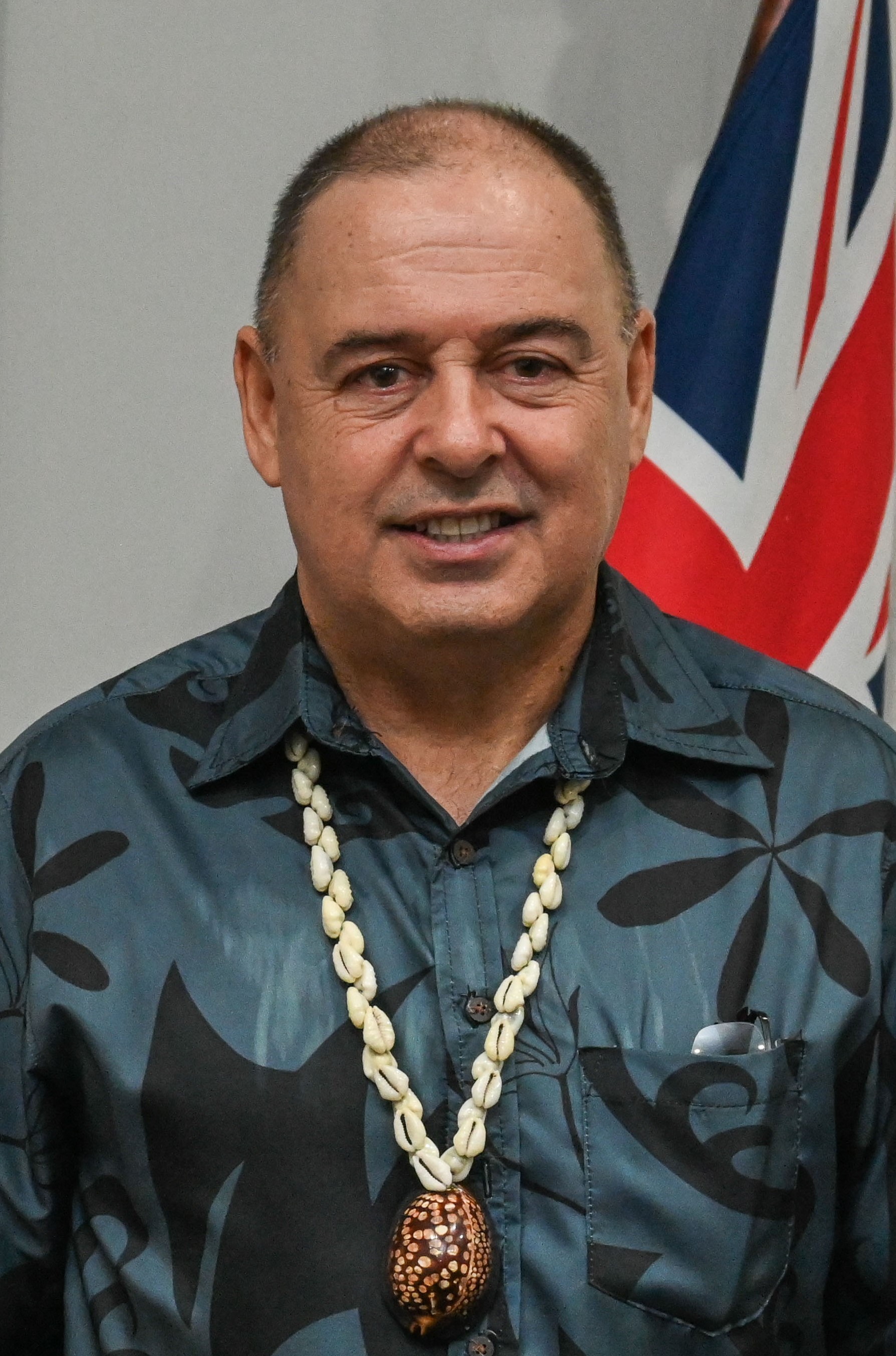
Mark Brown
Prime Minister of the Cook Islands
17
APPEARANCES
14
PODCASTS
Sep 4, 2026

Daniel RobertsHOST
Could you just share a little bit about what, what that journey was like and kind of leading up to this point? Yeah.
Mark BrownGUEST
Yeah, so when I got into education, I had no thoughts of getting into administration.
Mark BrownGUEST
I got into education because I wanted to coach, and I had some mentors early on in undergrad.
Mark BrownGUEST
They helped me understand and realize that the best way to get into coaching, high school coaching, is to become an educator.
Mark BrownGUEST
And so I became an education major, and I majored in health and PE, and then I specifically here in Newburgh.
Mark BrownGUEST
She graduated in 2007 and she herself was a, is a third generation Newburgh high school graduate.
13 MINS LATER


Israel DaggHOST
So have the group rallied around that to continue on that momentum this year and ensure that you respect that shield and a proud province in Otago?
Mark BrownGUEST
But I think to answer your first question, the boys, you know, there's a good level of belief there.
Mark BrownGUEST
And the boys have sort of really embraced that, which I think that just drives higher standards internally.
Mark BrownGUEST
So I think they're their own hardest critics, but it's also driving like a really good culture and connection and a real willingness just to work hard, challenge each other and challenge the coaches as well, just for the betterment of getting better.
Israel DaggHOST
Talk to us about them and the shift that you've noticed this year, only relatively fresh into the season, but they started very, very well in round one against Southland.
Israel DaggHOST
So have the group rallied around that to continue on that momentum this year and ensure that you respect that shield and a proud province in Otago?
Mark BrownGUEST
But I think to answer your first question, the boys, you know, there's a good level of belief there.
Mark BrownGUEST
And the boys have sort of really embraced that, which I think that just drives higher standards internally.
Mark BrownGUEST
So I think they're their own hardest critics, but it's also driving like a really good culture and connection and a real willingness just to work hard, challenge each other and challenge the coaches as well, just for the betterment of getting better.
Mark BrownGUEST
um so that's uh you know we're in a nice place there and then when you factor in uh the ramp really shield um yeah that brings its that brings its own level of intensity um teams are you know teams get up for it as you say it's really coveted so everyone who comes down to challenge for it has got that extra little edge and and we've just we've got to meet that and and exceed it really if we want to retain it
Israel DaggHOST
Talk to us about them and the shift that you've noticed this year, only relatively fresh into the season, but they started very, very well in Round 1 against Southland.


Victor BlackwellHOST
But the question here, as long as they're in the classroom learning and engaged, why does it matter if a student wears a bonnet to her 810 class?
Mark BrownGUEST
Let me just be clear that you are talking about, and we are hearing and reading, about one piece of a more holistic focus, which is student success.
Mark BrownGUEST
Our conversation has really been about student success and all elements of that.
Mark BrownGUEST
The classroom is essentially a laboratory, right? If you are a student, that's where you go to do your business.
Mark BrownGUEST
conditioning students to be ready to enter the workforce in many different spaces and to be comfortable when they enter that workforce and to be appropriate for whatever that workforce requires.

Mark BrownGUEST
Everywhere I go, I hear the same story about how spotty these rains are, whereas one person will get two inches and their neighbor gets a tenth of an inch or gets nothing.

James HuntCORRESPONDENT
Brown says his conversations with farmers have indicated that this year our region actually experienced an increase in cotton plantings compared to last year, but a lot of those acres have already been lost or are in jeopardy.
Mark BrownGUEST
Our average abandonment is probably around that 20% range, and I feel confident that we're going to hit that and may exceed that this year.
Mark BrownGUEST
During the drought years that we've had recently, we've had as much as 50 or 60 or 70% abandonment on dryland acres.
Mark BrownGUEST
So we're just going to have to see, as you and I are talking here today, we're in the midst of this high-pressure dome and looking at hundreds 100 degree plus temperatures every day and that is at a critical time in crop development as we are going into full bloom and so we're going to see what this situation does to us with all of this heat and with the lack of sub moisture.

TomHOST
No, no, you're doing fine now.
Mark BrownGUEST
It's going to be, like I said, we're hosting the National Convention this year, the ARRL National Convention.
Mark BrownGUEST
They don't do this every year for cost reasons because the league brings a large contingent.
16 MINS LATER
TomHOST
I don't see it.


Kyle MillsHOST
Yourself as a coach, have, have you learnt anything from that y- that you could possibly implement with your Otago side over the next wee while?
Mark BrownGUEST
Uh, well, one of the things we sort of wanted to work on is grow our game from last year.
Mark BrownGUEST
We can't sort of sit back and pat ourselves on the back, um, and think, think what we did last year is gonna be good enough this year.
Mark BrownGUEST
And, and I, I think what I see with the All Blacks that we've been trying to implement as well is, uh, is just the, um, the detail into, in the k- the ball carry detail, going into contact and trying to win that first collision.
Mark BrownGUEST
Uh, and it's not just through having a bigger body or, or chucking more bodies into the collision.
8 MINS LATER

Guy HeveldtHOST
Yourself as a coach, have, have you learnt anything from that y- that you could possibly implement with your Otago side over the next wee while?
Mark BrownGUEST
while?Uh, well, one of the things we sort of wanted to work on is grow our game from last year.
Mark BrownGUEST
We can't sort of sit back and pat ourselves on the back, um, and think, think what we did last year's gonna be good enough this year.
Mark BrownGUEST
And, and I, I think what I see with the All Blacks that we've been trying to implement as well is, uh, is just the, um, the detail into, in the k- the ball carry detail, going into contact and trying to win that first collision.
Mark BrownGUEST
Uh, and it's not just through having a bigger body or, or chucking more bodies into the collision.
8 MINS LATER


Hal AbramsHOST
what would the tip be about? What is illegal here? Not allowed to own one of these? What's going on?
Mark BrownGUEST
And we had captured gun show's mother in an attic of a house and relocated her not knowing.


Mark BrownGUEST
Well, you would think that to answer this question, I would start talking about some of the on-the-ground work, how many miles of fuel breaks we've made.
Mark BrownGUEST
But I'm actually going to focus on some of the cultural and societal changes that we've made in Marin.
Mark BrownGUEST
One of the first things we had in our lessons learned document is that we wanted to get up to 20 Firewise communities.
12 MINS LATER

Mark BrownGUEST
Then I've also got a 19... 56 caterpillar d2 with a blade and then i've also got a 1965 chamberlain champion 9g which was a originally a cane bin hauling tractor that did that all his working career so that's my three that i've got here today i've got a few more at home but anyway can i get a couple of time notes

Brooke TindallCORRESPONDENT
Do you both restore the tractors? And where does your interest in that come from?


Mark BrownGUEST
In, in terms of trying to sort of tease out the numbers from our statistics, um, there's basically-- it's, it's kind of a two-step process.
Mark BrownGUEST
The one is to say, is to try to figure out, well, what were the areas actually impacted? So that's where the fire went through or where there was e-evacuations.
Mark BrownGUEST
So we can use, you know, there's remote sensed information on where the fires burned areas were w- that we use, and then we also use information on what the geographic areas of where, where the evacuations were from multiple different sources.
Mark BrownGUEST
So we put those together, and you basically have a map of where the, where the fires happened and, and, and, and also where the evacuations were.
Mark BrownGUEST
And it's kind of like taking tracing paper and taking a, a grid, one kilometer, one kilometer sort of sticking on top of where those fires are, and you're kind of, like, tracing in where the fires overlap with those grid squares.


Clip BrockHOST
Did you have any thoughts to that, and why would MLB suggest doing this? What is the benefit, or what would the change be from the MLB standpoint?
Mark BrownGUEST
I'm probably about to go on a rant here, Cliff, about that, because this is just one more thing in an ongoing thing of basically Commissioner Rob Manfred, I don't know how else to put it, but I think he hates actual baseball, people playing the game of baseball.
Mark BrownGUEST
owners' franchise values go up, but the actual baseball game, he is hostile to it, okay? I'm only exaggerating somewhat.
Mark BrownGUEST
And this is the latest example of that, because the proposal that they made, basically...
Mark BrownGUEST
I think more than half of the superstar-level players in the game right now would have not been able to get their careers started the same way that they did.
Mark BrownGUEST
Because you eliminate high school draftees, which is how you get the really exciting young players that come up and debut before they're even 21.
Clip BrockHOST
just ends and uh my Braves came back to win it the next year so I was excited about baseball but I know a lot of fans uh needed the the Sosa McGuire the steroid home run race to to kind of get back going but how you know how likely are we to see another stoppage I mean they got to avoid that at all cost you would hope but I have heard some talk about that Mark so so what's your take on that


Mark BrownGUEST
Well, Pro Cancioni Antico, a very posh name, isn't it? invented in a car, and I was sitting with Paul Eswood, you know Paul Eswood, who was the quite renowned countertenor, and my other friend James Griffith, who was the, and we three founded PCA, and going under Putney, over Putney Bridge, we came up with this name.
Mark BrownGUEST
We weren't remotely intellectual ourselves, And so we started as a trio and gradually developed into sort of four or five people, chosen mainly for their abilities to sing, not as their ability to undertake choral work.
Mark BrownGUEST
And we did a few concerts in London and in the provinces, mainly of well-known repertoires of Byrd and Palestrina, things that were already published and published.
6 MINS LATER
James HuntCORRESPONDENT
Mark Brown of Plains Cotton Growers tells us more about what USDA is offering.
Mark BrownGUEST
They're going to take that five-year average, and if it is higher than the current base on a particular farm, then there will be an opportunity to increase base acres.
Mark BrownGUEST
In the Panhandle, that could be very important because there are a lot of farmers up there growing cotton that do not have any cotton base, even though they may have been growing cotton for 10 or 12 years.
Mark BrownGUEST
But this is an opportunity to possibly get some cotton base on a particular farm.
James HuntCORRESPONDENT
But Brown says it's important for farmers to know the information USDA is sending out about the program is going directly to landowners.
Mark BrownGUEST
And so if they have share leases, and if they are working with landlords, then they need to stay in contact with their landlords on this.
Mark BrownGUEST
Make sure that their landlords are familiar with the program because it is an optional program, and you can opt out of this if you want to.

Mark BrownGUEST
It has storefronts, shops, federal buildings, and then you have, like, neighborhoods behind it where you have houses, you have duplexes, trailers, apartment-style buildings.
Mark BrownGUEST
We would use that city to be-- to show them, "Okay, this is how you're gonna line up on a street."

Wailin WongHOST
So Mark would get the trainees lined up on the street of this fake city, and he would tell them, "This is what you do if you're trying to arrest someone and a crowd starts to form, or maybe there are protesters."
Mark BrownGUEST
If they're protesting on the sidel-- on the sidewalk, they have the right to protest your presence, so that's not something for you to engage in.
Mark BrownGUEST
And then as soon as your person is handcuffed, let's get them up and get them out of there.

speaker_28UNKNOWN
Okay.
Mark BrownGUEST
Uh, HBCUs are not, uh, diversity, equity, and inclusion universities, nor have we ever been.
Mark BrownGUEST
Uh, we have never said send me three of these and three of those or, uh, we've, we've never said that.
Jonquilyn HillHOST
Is there a consensus among Black academic leaders right now? Are you at all anxious about the future of HBCUs or are you feeling more optimistic because of Trump's statements of support right now?