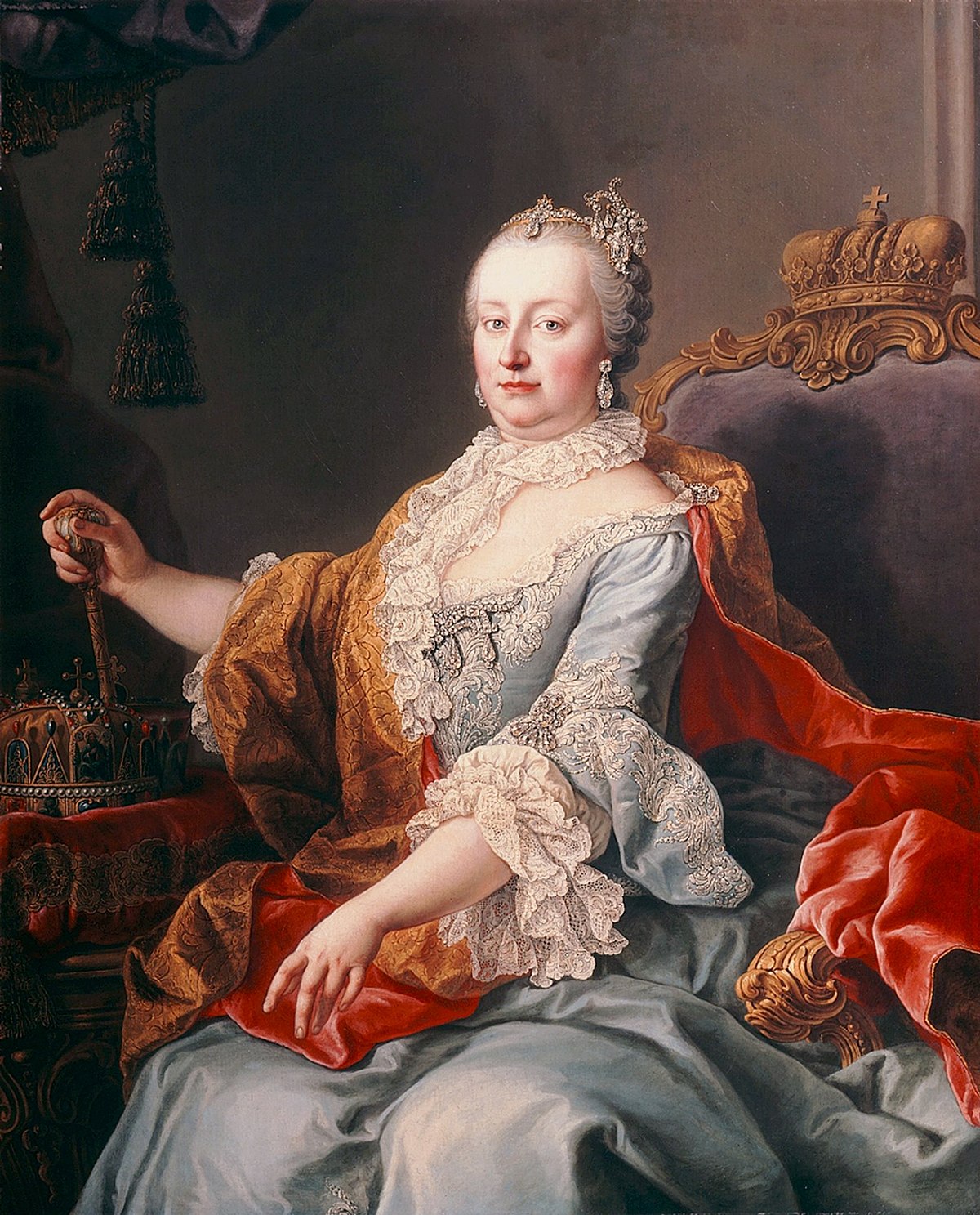
Maria Theresa
Former Holy Roman EmpressWikipedia
311
MENTIONS
71
EPISODES
61
PODCASTS
Search complete. 311 mentions across 71 episodes found for "Maria Theresa".
Sep 22, 2026

Julia EbnerSOUNDBITE_SPEAKER
And they also have an offline presence in most of the bigger European countries where they launch very sophisticated hybrid campaigns both online and offline.
Julia EbnerSOUNDBITE_SPEAKER
They often do media stunts in order to gain the media's attention, so they would do something very provocative like staging a fake terrorist attack in the heart of Vienna or putting a burka on the statue, on the statue of, uh, Maria Theresa.
Julia EbnerSOUNDBITE_SPEAKER
They were using very gamified strategies.
Julia EbnerSOUNDBITE_SPEAKER
Still are, actually.

speaker_5NARRATOR
And the mere fact that there was a third party, who had the right to intervene as an arbitrator, immediately after the partitions of Poland, roused great sympathies and hopes for the Austrian rulers with the Ukrainian population.
speaker_5NARRATOR
the first rulers maria theresa and joseph the second acquired so much merit by their liberal reforms in favor of the peasantry that the memory of their rule is still living with the ukrainian people This is why the Ukrainian population afterwards too stood faithfully by the side of the Austrian rulers, although the latter soon changed the system.
speaker_5NARRATOR
When in 1846 the Polish Republic of Krakow was incorporated in the Austrian monarchy, the Poles claimed that West Galicia should be united with East Galicia into one crown province and that they should be entrusted with the rule of the whole country.
speaker_5NARRATOR
against this claim the ukrainians solemnly protested and in eighteen forty eight demanded that galicia should be divided into two crown provinces and that the administration of east galicia should be left to the ukrainian people in the period of the absolute reign of the emperor francis joseph i eighteen fifty eighteen sixty galicia remained divided into two administrative districts the administrative districts of lemberg and cracow this division was adjusted mainly to the frontiers of the two peoples living in galicia the ukrainians and the poles as late as eighteen sixty seven after the disastrous war with germany the austrian constitution created a far-reaching autonomy of the provinces with special privileges of the dietz by this constitution the wish of the poles was complied with and the whole of galicia hence the polish as well as the ukrainian part of the country were united into an administrative union under polish rule it is true that the constitution of eighteen sixty seven proclaimed equality of rights for all peoples in school office and public life But the Austrian government delivered up the Ukrainians to the Polish majority in Galicia, and thus a new political war was kindled between the two peoples, in which the Poles were intent on more firmly establishing and extending their provincial autonomy, while the Ukrainians continued to protest against the Polish autonomy and to demand the division of Galicia into two provinces, according to the territories of settlement of the two peoples.

Claire DonaldHOST
But the Austrian Habsburg keeps going.
Claire DonaldHOST
And in 1740, 23-year-old Maria Theresa inherits the Austrian Habsburg land after her father dies without a surviving son.
Claire DonaldHOST
Stick with me, because this Maria Theresa, you might recognize her.
Claire DonaldHOST
So...
Claire DonaldHOST
She marries Francis Stephan of Lorraine, and they have a casual 16 children.

Jonathan NorthGUEST
Ferdinand has a wife who's Austrian, Maria Carolina.
Jonathan NorthGUEST
She's the daughter of Maria Teresa.
Jonathan NorthGUEST
So you can see these families are still kind of very tight-knit, very controlling, and they're still dominating much of Italy, but especially Naples.
Jonathan NorthGUEST
And it's It's probably important to mention that Naples and Sicily are two different kingdoms, even though we call them the same thing.

James HauserHOST
Like, there's no Cassus Belli here.
James HauserHOST
The Habsburg throne had just passed to a 23-year-old woman named Maria Theresa.
James HauserHOST
Friedrich assumed she'd be easy prey, and he grabbed Silesia because he wanted it and he thought he could get away with it.
James HauserHOST
But he had underestimated his opponent.
James HauserHOST
Maria Theresa was one of the toughest, most competent rulers the Habsburgs ever had, a woman who held the empire together through sheer will when everyone expected her to crumble.
James HauserHOST
Even Friedrich was eventually forced to respect her sheer determination.
James HauserHOST
Maria Theresa never forgave Friedrich for stealing her province.
James HauserHOST
She became his arch-nemesis and would lead Austria into three wars to recapture Silesia from the Prussians.

Miroslav MusilGUEST
Actually, the story started already when he was still in Hungary, in Slovakia, because the husbands of his sisters had made complains against him because they wanted to get the family property.
Miroslav MusilGUEST
That's why he was even condemned by Maria Theresa, who was the queen of Hungary, and he had to escape.
Miroslav MusilGUEST
So he left Hungary, a kingdom without her permission.
Miroslav MusilGUEST
That's why he was like a criminal.
Miroslav MusilGUEST
He was very fortunate because when he came back to Paris, there was the King Louis XVI, whose wife was Marie Antoinette.
Miroslav MusilGUEST
Mm-hmm.
Miroslav MusilGUEST
daughter of Maria Theresa.
Miroslav MusilGUEST
And thanks to this connection, she obtained not only the pardon of Maria Theresa, but he promoted him from baron to count with this very important device in adversities and prosperity.

Yabo VersingNARRATOR
Generally speaking, peasants still formed part of the stock on lands, as they had done during the Middle Ages.
Yabo VersingNARRATOR
Nearly all the soldiers in the armies of Maria Theresa and Frederick were absolute serfs.
Yabo VersingNARRATOR
In seventeen eighty-eight, the general rule with regard to German peasants was that they should not leave the seigniory, and if they did, that they should be brought back by force.
Yabo VersingNARRATOR
They were subject to dominical courts and by them punished for intemperance and idleness.

Lawrence ReedGUEST
That hurt her right from the beginning.
Chris BakerHOST
The daughter of Maria Theresa, the French, the Austrian Empress, yes.
Lawrence ReedGUEST
And she also had a taste for the high life.
Lawrence ReedGUEST
Maybe some of that that has come down to us is a bit exaggerated, but she loved the massive, fancy, expensive hairdos and expensive cuisine and the lavishness of the French court, which she only made ever more lavish.

Pamela NagamiNARRATOR
Led by Pulteney and Wyndham, the attacks on the government never ceased.
Pamela NagamiNARRATOR
It was pointed out, that austria a country without colonies or a fleet and since sixteen eighty eight closely connected with england was the true ally of this country and that france and spain were our real foes In return for a promise to guarantee the pragmatic sanction, an instrument assuring to Maria Teresa, Charles VI's daughter and heiress, the possession of all the Habsburg dominions, the emperor consented to withdraw his troops and to allow Don Carlos to enter into possession of Parma and Piacenza.
Pamela NagamiNARRATOR
in seventeen thirty two the second treaty of vienna concluded by the emperor with england holland and spain settled all the difficulties which had disturbed europe for many years and seemed to ensure the continuance of peace In spite, however, of the more settled foreign outlook, and in spite of the apparently strong position of the government at home, the year 1733 saw the ministry shaken and Europe involved in a great war.
Pamela NagamiNARRATOR
Walpole had long wished to conciliate the country gentleman by lowering the land tax.
12 MINS LATER
Pamela NagamiNARRATOR
Walpole ought to have resigned in 1739 on the outbreak of the war with Spain, which he described as unjust, impolitic, and dishonorable.
Pamela NagamiNARRATOR
And though in 1741 he wisely urged a pacification between Frederick the Great and the Empress Queen, his counsels no longer carried weight.
Pamela NagamiNARRATOR
Before circumstances compelled Maria Teresa to adopt Walpole's views, that minister's political career had closed.
Pamela NagamiNARRATOR
After the general election of 1741, Walpole's majority was reduced to 16, and on February 2, 1742, the ministry was defeated on a motion on the Chippenham election petition.

Yabo VersingNARRATOR
Generally speaking, peasants still formed part of the stock on lands as they had done during the Middle Ages.
Yabo VersingNARRATOR
Nearly all the soldiers in the armies of Maria Theresa and Frederick were absolute serfs.
Yabo VersingNARRATOR
In seventeen eighty-eight, the general rule with regard to German peasants was that they should not leave the seigniory, and if they did, that they should be brought back by force.
Yabo VersingNARRATOR
They were subject to dominical courts and by them punished for intemperance and idleness.
61 more episodes mention Maria Theresa.
Create an account to see the whole feed, search across every transcript, and follow the entities you care about.