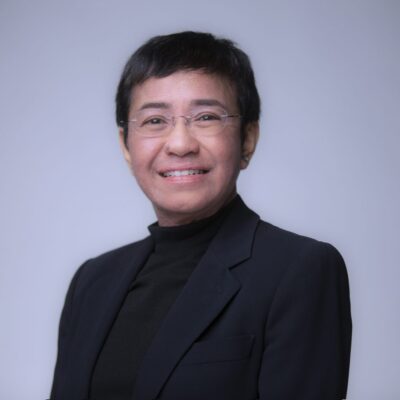
Maria Ressa
CEO of Rappler
20
APPEARANCES
17
PODCASTS
Oct 7, 2026


Paul HenleyHOST
He asked her how she characterized the threats to democracy and freedom around the world and how serious she thought that threat was.

Maria RessaGUEST
Critical, existential, and you've heard that word existential from the tech bros, [chuckles] you know, the, the CEOs of the tech companies, the top six that literally control our lives because the design of social media spreads lies faster than facts.
Maria RessaGUEST
If you can't tell the difference between fact and fiction, there are cascading failures.
James MenendezHOST
Because I was gonna ask you if the lawyer's been in touch over [laughs] that description.
James MenendezHOST
Because I was gonna ask you have the lawyers been in touch over [laughs] that description.
Maria RessaGUEST
What I did in 2017, we were in California, and I invited him to come to the Philippines because I didn't think he understood how powerful Facebook was, and I said, "You know, Mark, 97% of Filipinos on the internet are on Facebook.
Maria RessaGUEST
There's tremendous power for it to do good." And then he was frowning, and I was trying to figure out why he's frowning, and then he, he asked me a question that really made me think.
Maria RessaGUEST
He said, "Maria, where are the other 3%?" And so look at my two dictators, right? The, the reason I say Facebook, because it was on Facebook where these bottom-up attacks, an average of 90 hate messages per hour.


Shalini RanderiaHOST
Do you think some of your early enthusiasm and optimism could still be relevant for the younger generation, which is using digital media and mobilizing on these new platforms when they are protesting, say, Nepal, Bangladesh, Sri Lanka? And could you also talk about your highly negative experiences, especially when you warned Facebook and they failed to heed your warnings?
Maria RessaGUEST
I think first that this is not the same technology that we were working with in 2016, which is the presidential elections that elected Duterte.
Maria RessaGUEST
That was the first time that I saw information operations, the repetition of a lie online.
Maria RessaGUEST
And when people cannot tell the difference between the lie and a fact, that disintegrates our societies, right? The three sentences I've said over and over since 2016, and this is based on data.
6 MINS LATER
Shalini RanderiaHOST
how could one come to a different design and a different governance of a system which as you say is predicated on the promotion of lies of hatred and is predatory and extractive by its very


Ravi AgrawalHOST
I want most of this conversation to be about solutions, but very quickly, just make the case.
Maria RessaGUEST
Okay, so first let's define it, right? What is it that we're talking about? Artificial intelligence has been around for 70 years and it has gone mass base, right? It has gone to the entire world in three phases.
Maria RessaGUEST
We literally talked about the dangers and the harms of what that was, right? So the first was social media.
Maria RessaGUEST
Then artificial intelligence came in and took all of our clones and that was micro-targeting.
12 MINS LATER


Maria RessaGUEST
The mood in the room was actually really fascinating and the kind of consensus that you see among many of the nation states.
Maria RessaGUEST
First, let me tell you about the thematic brief that my co-chair that the panel came out with on Monday, which showed you exactly what it was.
Maria RessaGUEST
Question number one was, what actually happened? Question number two is, what trend does that show? And then number three, what do we not know? And number four is, what would be completely irresponsible if we do not act? This is to help policymakers deal with this.
Maria RessaGUEST
That's part of what this independent panel is supposed to do, to give you the facts.
Maria RessaGUEST
And along with those tech CEOs who all have their own interests, you also had Yoshua Bengio, who's my co-chair, speaking there.

Amy GoodmanHOST
Tonight, a major state dinner with heads of the tech billionaires, the CEOs of these companies.

Maria RessaGUEST
The mood in the room was actually really fascinating and the kind of consensus that you see among many of the nation states.
Maria RessaGUEST
First, let me tell you about the thematic brief that my co-chair that the panel came out with on Monday, which showed you exactly what it was.
Maria RessaGUEST
Question number one was, what actually happened? Question number two is, what trend does that show? And then number three, what do we not know? And number four is, what would be completely irresponsible if we do not act? This is to help policymakers deal with this.
Maria RessaGUEST
That's part of what this independent panel is supposed to do, to give you the facts.
Maria RessaGUEST
And along with those tech CEOs who all have their own interests, you also had Yoshua Bengio, who's my co-chair, speaking there.
Amy GoodmanHOST
Tonight, a major state dinner with heads of the tech billionaires, the CEOs of these companies.

Maria RessaGUEST
The mood in the room was, was actually really fascinating and, and the kind of consensus that you, that you see among many of the nation states.
Maria RessaGUEST
First, let me tell you about the, what, the thematic brief that the, that my co-chair and I, uh, that the panel came out with on Monday, which showed you exactly what it was.
Maria RessaGUEST
Question number one was, you know, what actually happened? Question number two is, what trend does that show? And then number three, what do we not know? And number four is, what would be completely irresponsible if we do not act? This is to help policymakers deal with this.
Maria RessaGUEST
That's part of what this independent panel is supposed to do, to give you the facts.
Maria RessaGUEST
And along with those tech CEOs, who all have their own interests, you also had Yoshua Bengio, who's my co-chair, speaking there, right? And the, what's the consensus among the majority of it? It seems like everyone knows that AI is now the rogue AI, including the Secretary General saying again this week that it is out of our control.
Amy GoodmanHOST
What kind of regulations? You have Xi right now meeting with President Trump in Washington, DC tonight, a major state dinner with heads of the tech billionaires, the CEOs of these companies.

Maria RessaGUEST
The mood in the room was actually really fascinating and the kind of consensus that you see among many of the nation states.
Maria RessaGUEST
First, let me tell you about the thematic brief that my co-chair and I are that the panel came out with on Monday, which showed you exactly what it was.
Maria RessaGUEST
Question number one was, what actually happened? Question number two is, what trend does that show? And then number three, what do we not know? And number four is, what would be completely irresponsible if we do not act? This is to help policymakers deal with this.
Maria RessaGUEST
That's part of what this independent panel is supposed to do, to give you the facts.
Maria RessaGUEST
And along with those tech CEOs who all have their own interests, you also had Yoshua Bengio, who's my co-chair, speaking there.
Amy GoodmanHOST
If you can talk about, you know, the fact that China has more regulations in place than does the United States, what kind of regulations? You have Xi right now meeting with President Trump in Washington, D.C., tonight a major state dinner with heads of the tech billionaires, the CEOs of these companies.


Hamish MacdonaldHOST
And there's a whole range of other tech that the government might want to try and regulate, and so you're seeing this struggle between sovereign states and tech giants.
Maria RessaGUEST
Because it can't just be one country alone, right? It's the same way that in nuclear, how did...
Maria RessaGUEST
There was an IPCC for nuclear weapons and nuclear power, right? This scientific panel on AI gives you a baseline of the facts.
Maria RessaGUEST
Australia alone, the US, the US alone has had an impact on all of us, but there are 193 countries.
Maria RessaGUEST
At the UN last year, we re- we had 43 Nobel laureates supporting something called Democracia Siempre.
7 MINS LATER

Maria RessaGUEST
And then we were a combination of old and young, if you know what I mean, right? The four of us who were the co-founders were probably mid-40s to late 40s.
13 MINS LATER
Tim ElliottHOST
Having to remain that, you know, that level of vigilance and cortisol must have been very damaging actually to you.


Francesca MerloHOST
She told Vatican Radio what she hopes the impact of this conference will be.
Maria RessaGUEST
Eighty years ago, that was when the world decided that it needed to work together to stop from destroying ourselves, right? And then now we're at another similar moment.
Maria RessaGUEST
This is actually far easier because there's no hardware here, right? This is in your phone.
Maria RessaGUEST
Cognitive warfare, cognitive dissonance, cognitive surrender, narrative warfare is manipulating people at scale.
Maria RessaGUEST
So what I hope to come out of this, number one is I co-chair the scientific panel on the, the one the UN pulled together.
Maria RessaGUEST
It's in an independent international scientific panel on artificial intelligence.
Francesca MerloHOST
What do you think about it now, a month after its publication? What has been its impact and also outside of the church?

Matt SchisslerGUEST
And at one point, one of the people was like, "Well, you know, who are we to choose? If people in Myanmar are saying they like this kind of content, shouldn't that be the consumer's choice as to what they get to see on Facebook? That's not up to us to decide." And I was like, "Uh, that's gotta have some limits."
Maria RessaGUEST
The tech companies have been very successful in framing this of, as a freedom of speech issue.
26:01

Here's how Nobel Prize winner Maria Ressa said it when I interviewed her.
Maria RessaGUEST
It's a safety issue, right? Because if you're a civil engineer, you can be held personally liable if you build a bridge that collapses.

Maria RessaGUEST
All of that has happened, and that now is normal, right? And you can, whether it's in the physical world or in the virtual world, and then the judiciary, what's...
Maria RessaGUEST
I watched the same thing happen here that happened to us, which is the individual judges and justices become targeted, and holding up rule of law becomes that much more... that much harder.
Maria RessaGUEST
Silicon Valley is American after all, right? How can you have rule of law if you don't have facts?
12 MINS LATER
Maria RessaGUEST
We just kept doing our jobs, we just kept putting one foot in front of the other.
Maria RessaGUEST
And what we did, which got us targeted, was we maintained and showed when it was rolled back and showed how much further it was rolled back.
11 MINS LATER
Maria RessaGUEST
Human rights groups kept working, right? I think the signal it sent on March 11 is that impunity ends, that you can, at some point, feel a sense of justice.
Maria RessaGUEST
To see Rodrigo Duterte arrested for alleged crimes against humanity, the first Filipino president to have ever been charged with this, and then to see him at The Hague-
Amy GoodmanHOST
... um, all of these institutions, when they fight back, uh, yes, uh, Trump blinks.
Maria RessaGUEST
So first, I think the biggest lesson we learned is that you are at your most powerful at the beginning of the attacks.
Maria RessaGUEST
Every day you do not fight back, you lose just a little bit more of your rights.
Maria RessaGUEST
We normalize just a little bit more of this kind of pseudo-democracy, right? We are...
Maria RessaGUEST
I, I think the, the first is that, uh, what are the steps, right? Uh, social media was used to attack us.
Maria RessaGUEST
And it's like fertilizer, saying you're the enemy of the press, then lets people believe y- that's astroturfing.
7 MINS LATER


Ari MelberHOST
It's a negotiating position." Is there a risk in not taking a repressive leader seriously when they tell you they're being serious?
Maria RessaGUEST
I don't know how much more evidence you want in terms of vindictiveness and action, right? If you don't take it seriously when you're facing an instance like today, you wind up losing your rights every step of the way.
Maria RessaGUEST
There isn't a red line where, is it democracy? Is it not democracy? You just get weaker over time.
Maria RessaGUEST
And if you don't act while you're still strong enough to protect your rights, then you voluntarily given up your rights.


Jon StewartHOST
It is, it is a delight, as always. Uh, Maria, uh, your experience, uh, throughout you being in the Philippines and, and going through, uh, the trials and tribulations that they put you through for the crime of saying things you think... You know, uh, they're terrible, Maria. I don't know if you know that. Terrible, terrible crime to commit by saying things you think. Uh, as you're watching things unfold in the United States right now, how are you processing all this?
Maria RessaGUEST
I mean, this is the second time I've gone through it in my two countries, right? And it's very familiar. I mean, we saw this first in the elections, even in the way, the, the speed of the elections, but then this death by 1,000 cuts. And I think what's worse is, it's accelerated. Um, so, you know, in the Philippines, in 2016, under President Rodrigo Duterte, he consolidated power. We, the Philippines has a constitution just like the United States. Three branches of government, a bill of rights, freedom of the press enshrined in that, freedom of expression. And what he did after he took office, very similar to this, within a month or so, he went to Beijing and then he pivoted. He just announced, without telling our, our Department of Foreign Affairs, he pivoted from the United States to China and Russia. Shocked the entire country, and then after that, what happened is within six months, the checks and balances of the three branches of government collapsed, and Rodrigo Duterte became the most powerful leader the Philippines has ever had. And he probably would've stayed in power if the military had gone with him. So to see this happening again...
48 MINS LATER
Maria RessaGUEST
That cannot be in the real world, so the Matrix Protocol allows us to actually have a shared reality, and we rolled it out, uh, at December 2023. We're getting ready. Our community is now on this chat app, and what we're looking at is a global federation of news organizations. I think this is the only way we'll survive. You know, having said that, again, I call on democratic nations, where is your public tech stack? You build libraries but you don't protect us. It's like putting lead in the paint again. It's a safety issue. And then, sorry, the, the last one, you asked, "So, so what do we do?" Building now is painful because events are moving so quickly. Are we gonna fall off the cliff, right? Will what is happening to America... It's transforming the entire world already, and Americans have to really decide, and this is where it goes to what can you do, right? When, when the tech has allowed geopolitical power to manipulate at the cellular level of a democracy, meaning you listening, you, Jon Stewart, can be specifically targeted.


Nicolle WallaceHOST
I, I just think, quickly, (clears throat) our mission in this moment is to have our eyes wide open and cut right to the bone of the truth. And the truth is, if you're against these 10 things, you're against the rule of law, and that's what's at the FBI right now.
Maria RessaGUEST
Absolutely. I mean, the two things you've said, facts and law, that's the foundation of every institution of every democracy, right? And I think as the FBI has come under attack, kudos to Special Agent Dennehy for his position. He's a whistleblower, as are all the others who have resigned, and I think our task as journalists is going to be to dig deep. What forced them to resign in principle, on principle? This was something we didn't have in the Philippines. We had al- you know, a president in 2016 who just pulled loyalty and was able to, within a short period of time, move the Philippines from allying with the United States to China and Russia, without telling our, our ministry, our Secretary of Foreign Affairs and our Foreign Affairs Department. But I think this is- for America today, it's exactly what you said, Nicole. What we're seeing is the utter transformation of institutions that are getting weaker by the second as men and women resign, who are standing by facts and rule of law.
Maria RessaGUEST
I mean, look, eh, I pointed out in the Philippines in- under Duterte, uh, when he became president in 2016, within six months... So the Philippines has, uh, a constitution patterned after the United States, three branches of government, checks and balances, freedom of the press, the Bill of Rights, the same thing. And within six months, the president had- was able to use fear and violence, uh, and then in terms of the media, I talked about the three Cs, corrupt, coerce, co-opt. And by the sixth month, he was the strongest leader we had ever known. Our institutions had collapsed. I am so worried that that can happen faster in the United States, and the impact of that is global. Right? But the ep- the things that we have seen, especially on Friday, right? You asked that question right before the break. Uh, this is impunity. So the question there is, uh, if you normalize impunity, you lose democracy, and I think that's what we need to protect, every citizen. In How To Stand Up To A Dictator, I wrote, I asked one question, it was the question I wanted every Filipino to ask, and now every American must ask. What are you willing to sacrifice for the truth? If you don't stand up and demand that now, you could lose it.


Amna NawazHOST
Let me ask you about a few individual things. We've seen, you've obviously seen the president go after specific news networks. He's also opened a probe into PBS, we should note. He's also blocked access for the Associated Press, know- known as the AP, for, um, their refusal to call it just the Gulf of America, as he wants. They call it the Gulf of Mexico and say he wants to change the name. Now, the AP, we should note, serves thousands of news organizations. They have a reporter in every single state house in America, hundreds of countries, rather, over 100 countries across the world. What does it say to you that he's going after the AP? What's at stake in their lawsuit against the president here?
Maria RessaGUEST
It's, it's not just press freedom that's at stake, right? And again, let me ground it first in what happened in the Philippines. Um, our president then went after the largest newspaper, the largest television station, and then online, we were the largest. We were number three. But go big, go fast, take 'em down quickly, make an example, and I was the example of a journalist. Um, I had had, oh my gosh, uh, a long career. I had headed the largest network in the Philippines after almost 20 years with CNN, and then, when the charges came, so first social media, that tax came bottom-up. You say a lie a million times, it becomes a fact, and it was that journalist equals criminal. Two years the- before I was actually arrested, they trended that, the network that was created online, so the propaganda. Then a year later, we had the first criminal charges, 21 of them, and then by two years later, by 2019, I was arrested, and then it was 10 criminal charges in a little over a year. Look, um, (laughs) what you're seeing is death by 1,000 cuts of democracy. This is exactly what I had written about in the book, and originally, I was s- speaking to Filipinos, but it is a cautionary tale for every democracy, where technology is the spark that allows populism to become authoritarianism and to shift over. I think we're seeing this now.
Amna NawazHOST
And so if the press is under attack here, Maria, as an observer watching this all unfold, what do you make of the way that the press has responded, in particular the fact that there's been a major news organization in ABC that's already settled a lawsuit with the president? It's reported that CBS would likely do the same. What do you make of that?
Maria RessaGUEST
Don't voluntarily give up your rights, right? The, I mean, again, in, I'll give you our example in the Philippines, where, uh, the first, the newspaper gave up, the television station gave up, largest, it lost its franchise or license to operate, and guess what? It never regained it, even after the time of Duterte. Little Rappler, with about 100, 120 people, we stood up, and you know, it was difficult. It was frightening. Uh, but we're still here, right? A point in time when I faced over a century in jail, but I'm still here, and after 2021, I had lost some of my rights. I wasn't allowed to travel, for example, but now, here I am. I'm in New York City teaching at Columbia University, right? So, so I guess what I'm saying is, "hold the line" is the phrase we use because it's connected to the rights that you deserve as a citizen, and if you do not hold the line at this crucial moment, this is the moment when you are strongest, it will only, you will only get weaker over time, and it isn't just the journalists, 'cause journalists are the front lines in this, but the question is to every single citizen in America. It's the question I threw in the book, How to Stand Up to a Dictator, and that question is simple. What are you willing to sacrifice for the truth? Because if you don't have facts, you cannot, and I've said this over and over since 2016, without facts, you can't have truth. Without truth, you can't have trust. Without these, we have no shared reality. You can't solve any problem, let alone existential ones like climate change. You can't have journalism. You can't have democracy, and in a system like that, only a dictatorship wins.


Fareed ZakariaHOST
Uh, in your experience, what role has fact-checking played, uh, in, you know, in dealing with, uh, stuff that appears on Facebook? Give us like a- an example or two so we understand what we're, what, what fact-checking is doing in your view.
Maria RessaGUEST
Uh, you know, I was concerned and lived through the harms that Facebook could, that Facebook created.
Maria RessaGUEST
Um, online violence is real-world violence, right? People think of, you know, just one lie, but imagine a lie repeated a million times when people can't tell what's real and what's not real, what's a lie.
Maria RessaGUEST
And so what we saw happen in the Philippines was essentially, uh, an alternate [laughs]-- it also happened in the United States, didn't it? Alternate realities, um, false information on Facebook, and what fact-checking did was to, to-- it's the first layer to actually, actually frankly Facebook should have been the one to be a fact-checker, right? You and I, if we say a lie, we're held responsible for it so people can trust us.
Maria RessaGUEST
Well, Facebook made a system where the lie is repeated so often that people can't tell.
Fareed ZakariaHOST
And finally, um, what do you make of the argument, uh, that Zuckerberg and of course, uh, others have made that the fact-checking inevitably has a political slant, and fact-checkers tend to be left of center and that inevitably this means that there is going to be a subconscious, uh, at the very least, sometimes conscious tilt to the fact-checking process?