Marfan syndrome
Genetic disorderWikipedia
33
MENTIONS
13
EPISODES
12
PODCASTS
Search complete. 33 mentions across 13 episodes found for "Marfan syndrome".
Sep 17, 2026

Hank GreenHOST
She was 31 years old.
Hank GreenHOST
Hyman's initial cause of death was thought to be a heart attack, but an autopsy revealed that she died from a tear in her aorta, caused by an undiagnosed condition known as Marfan syndrome.
Hank GreenHOST
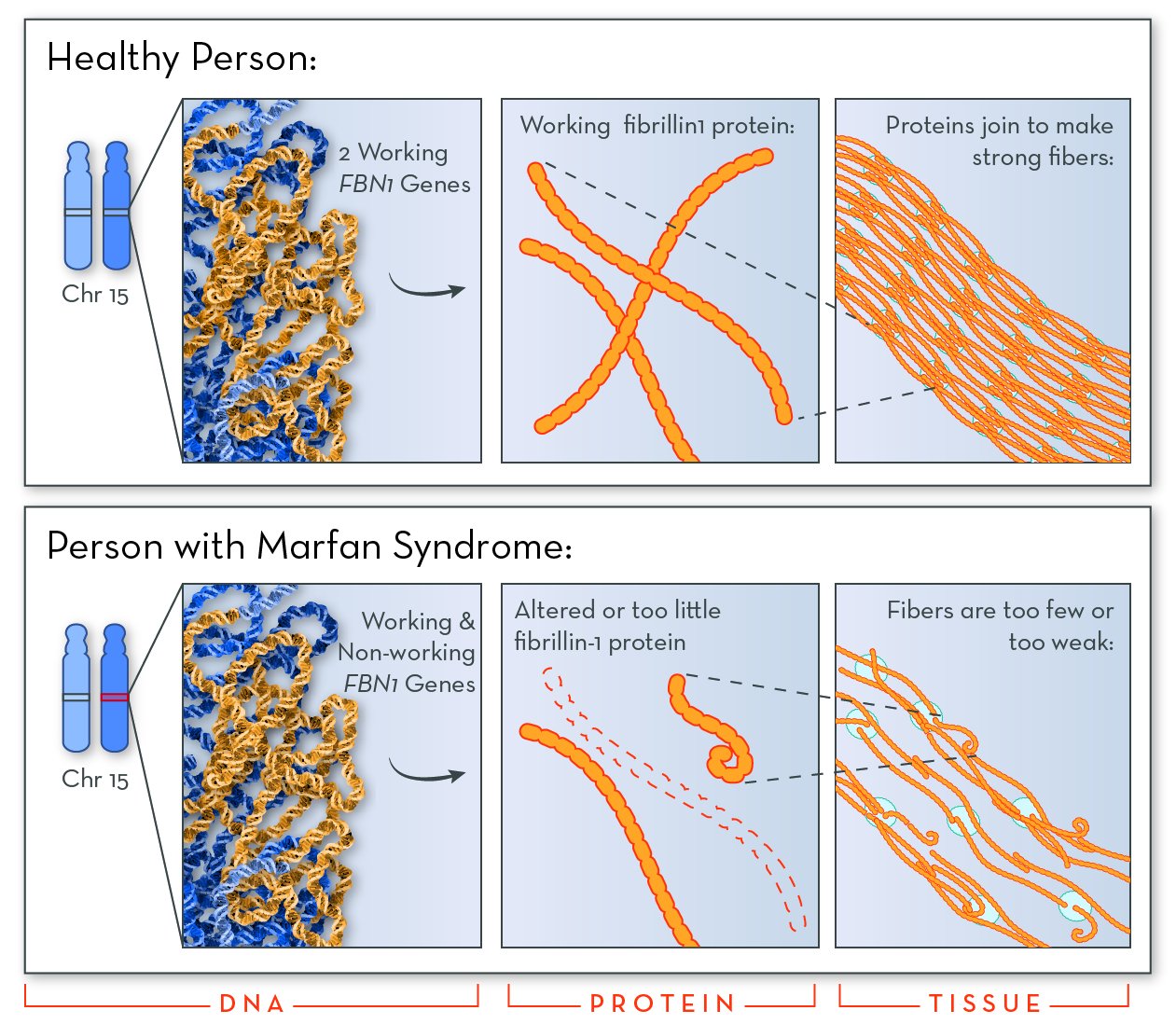
Marfan syndrome is a genetic disorder of the connective tissue.
Hank GreenHOST
People suffering from it have a defect in their connective tissue that substantially weakens it over time.
Hank GreenHOST
And you've got connective tissue pretty much everywhere in your body, so it could cause some big problems.
Hank GreenHOST
Outwardly, those with Marfans tend to be especially tall and thin, like Flo Hyman, with loose, flexible joints and noticeably longer limbs and fingers.
Hank GreenHOST
Those long fingers and bendy joints have actually helped some athletes and musicians do things that the rest of us can't.
Hank GreenHOST
Famous blues guitarist Robert Johnson, piano virtuoso Sergei Rachmaninoff, and Italian violinist Niccolo Paganini are all believed to have had Marfan syndrome.

Justin GrantGUEST
There's the question of, you know, like, what's my ApoA? It was almost undetectable, so it's not like I have, you know, that risk factor.
Justin GrantGUEST
I obviously don't have Marfan's or anything like that.
Justin GrantGUEST
So when we've looked into, you know, the reasons why, I just-- we keep coming back to we don't yet have an answer.
Justin GrantGUEST
And that's been part of my journey on this is, you know, I really wanted an answer, um, and I'd still love to have one, but for a while, that was one of my biggest struggles is if I had an answer, maybe I could then have a way to help prevent it in the future.

Omar LunenGUEST
There's a lot of...
Omar LunenGUEST
Marfan's isn't not the only...
Omar LunenGUEST
Condition that we've got to worry about.
Omar LunenGUEST
My dude from Stranger Things.

Jessica EcclesGUEST
You also may have one of the very first papers that linked hypermobility to what was then called Asperger's syndrome, talked about ligamental laxity and also about a condition called Marfan's.
Jessica EcclesGUEST
People who either have Marfan syndrome, which is one of the hypermobility syndromes, or are Marfanoid, they often have not only the long, thin fingers, but they also may have a long, thin face.
Jessica EcclesGUEST
Once I gave an amazing talk.
Jessica EcclesGUEST
I thought it was an amazing talk, not an amazing talk, a talk at an amazing conference called the International Association for Dance Medicine Science.

Ina StephensGUEST
We're getting medical students rotations.
Ina StephensGUEST
We're getting into their first and second years into the classroom, teaching them about, you know, all the connective tissue disorders, not just EDS, but all the other connective tissue disorders, including Marfan's and Loeys-Dietz, where maybe they had one sentence about this in their entire four years, or maybe, maybe two.
Ina StephensGUEST
I, I, I'm not even too sure.
Ina StephensGUEST
But they [chuckles] you know, they have to be taught this.

Richard HorowitzGUEST
What are the four major causes of POTS? Lyme disease, Bartonella, long COVID, which at the time when I saw her, COVID wasn't even around, and mold.
Richard HorowitzGUEST
Those are the four major cause that usually cause postural orthostatic tachycardia, although Ehlers-Danlos syndrome and Marfan's and other things with, as you know, with hypermobility syndrome can be affected.
Richard HorowitzGUEST
Yeah, my daughter has it.
Richard HorowitzGUEST
Right, can be affected by it.

Caleb SlaterHOST
And I think, not to throw shade on a certain population, but I think chiropractors more so than anybody are the ones out there diagnosing people with cranial cervical instability.
Caleb SlaterHOST
Unless you had trauma, unless you have an underlying condition like rheumatoid arthritis, Down syndrome, Marfan's, Ehlers-Danlos, some type of connective tissue disorder, it's unlikely.
Caleb SlaterHOST
It's just unlikely.
Caleb SlaterHOST
And again, that's not the way our body works.

MartinHOST
You have too many.
MartinHOST
Marfan the Marfan.
MartinHOST
What else? There's other ones.
MartinHOST
I can't remember.

Arush KalraGUEST
So, you know, super great worker, like very dedicated to his craft.
Arush KalraGUEST
But at some point, we realized that my mom had Marfan's with a bilitered aortic valve.
Arush KalraGUEST
And, you know, her aorta was sort of growing bigger.
Arush KalraGUEST
Consequentially, it was up to like 49 millimeters.
6 MINS LATER
Arush KalraGUEST
still procedure free.
Arush KalraGUEST
Yeah.
Arush KalraGUEST
She's Marfan.
Arush KalraGUEST
Okay.

Charlotte BurrowsGUEST
We think it was a genetic cause, albeit that we've never narrowed it down as to what that actually was.
Charlotte BurrowsGUEST
They've looked at Marfan's and some of the other kind of regular sort of the usual suspects and they've all been ruled out.
Charlotte BurrowsGUEST
But I'd just turned 40 and obviously I'm female.
Charlotte BurrowsGUEST
And, yeah, I presented with pains in my, well, at first I thought it was kind of heartburn type symptom and I ignored it.
3 more episodes mention Marfan syndrome.
Create an account to see the whole feed, search across every transcript, and follow the entities you care about.