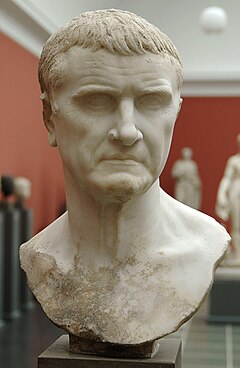
Marcus Licinius Crassus
Roman general and statesmanWikipedia
940
MENTIONS
116
EPISODES
90
PODCASTS
Search complete. 940 mentions across 116 episodes found for "Marcus Licinius Crassus".
Sep 17, 2026

Mark HarringtonNARRATOR
Sallust, though vastly inferior as a man to either of the optimate leaders, was extraordinarily successful in seizing the thread of events.
Mark HarringtonNARRATOR
The chapters on politics in Rome in the year which succeeded the Gracchan revolution, and again after the consulship of Pompey and Crassus in B.C. 70, can hardly be too highly praised, especially when we consider how soon after the events narrated they were written.
Mark HarringtonNARRATOR
Sallust indeed, except when speaking of the dictator himself, never allowed his Caesarean sympathies to carry him away, and it is difficult to understand how Professor Mommsen could permit himself to speak of the Catiline and Jugurtha as partisan pamphlets.
Mark HarringtonNARRATOR
If Sallust was a party writer, then Defoe himself must yield him the palm for cleverness in concealing his real object, and one could almost wish Mommsen's theory correct, for the ingenuity of the elaborate contrast which Sallust draws between Caesar and Marcus Cato, the one man for whom the dictator entertained an uneasy hate, would then be without a parallel.
Mark HarringtonNARRATOR
The elaborate care bestowed on the style, the recurring pompousness, the affectation of an extraordinary virtue, all betray the vanity of a man who wrote with Thucydides' to be an everlasting possession ringing in his ears, and who probably esteemed his own work little less lightly than that of Caesar.
Mark HarringtonNARRATOR
Over passages in the latter's career which he might not care to have revived, Sallust was sufficiently prudent to draw a veil.
Mark HarringtonNARRATOR
The different manner in which he alludes to the rumors of the complicity of Caesar and of Crassus in Catiline's conspiracy is an instance of this, and, certainly, we should never have learnt from our author how close was the political connection of Catiline and Caesar down to the end of sixty-four.
Mark HarringtonNARRATOR
But, when not dealing with the dangerous subject of the dictator's conduct, it is difficult to find any trace of partiality in Sallust.

Adam BielkaVOICE_ACTOR
Flaminius despised the Auguries, with the result that Lake Trasimus was swollen and died with Roman blood.
Adam BielkaVOICE_ACTOR
Crassus mocked at and justly incurred the curses of the theories with the result that we had to reconquer our standards from the Parthians.
Adam BielkaVOICE_ACTOR
I omit numerous instances in ancient history.
Adam BielkaVOICE_ACTOR
I say nothing about the songs of the poets on the births, gifts, and favors of the gods.

Alexandra SillsHOST
It is just me again, guys, but I hope that you don't mind.
Alexandra SillsHOST
Today's episode is all about the humiliating death of one of the key players in the final years of the Roman Republic, Marcus Licinius Crassus.
Alexandra SillsHOST
In 53 BCE, he was leading an army into Parvia, which culminated in a mortifying defeat at the Battle of Carrhae.
Alexandra SillsHOST
Crassus never made it home, but his death did become the literal stuff of legends.
Alexandra SillsHOST
Now, hopefully we will be doing a deep dive episode into Crassus's entire biography, and we definitely have an episode on the Battle of Karai itself coming up in series two.
Alexandra SillsHOST
But for this episode, I want to talk about his death specifically.
Alexandra SillsHOST
But before we get into all of the myths surrounding it, we should probably just quickly run through a little bit about who he was first and how he got to Karai in the first place.
Alexandra SillsHOST
And he's also quite famous for being the richest man in Rome, prototype billionaire.

Mark HarringtonNARRATOR
Sallust, though vastly inferior as a man to either of the optimate leaders, was extraordinarily successful in seizing the thread of events.
Mark HarringtonNARRATOR
The chapters on politics in Rome in the year which succeeded the Gracchan revolution, and again after the consulship of Pompey and Crassus in B.C. 70, can hardly be too highly praised, especially when we consider how soon after the events narrated they were written.
Mark HarringtonNARRATOR
Sallust, indeed, except when speaking of the dictator himself, never allowed his Caesarean sympathies to carry him away, and it is difficult to understand how Professor Mommsen could permit himself to speak of the Catiline and Jugurtha as partisan pamphlets.
Mark HarringtonNARRATOR
If Sallust was a party writer, then Defoe himself must yield him the palm for cleverness in concealing his real object, and one could almost wish Mommsen's theory correct, for the ingenuity of the elaborate contrast which Sallust draws between Caesar and Marcus Cato, the one man for whom the dictator entertained an uneasy hate, would then be without a parallel.
Mark HarringtonNARRATOR
The elaborate care bestowed on the style, the recurring pompousness, the affectation of an extraordinary virtue, all betray the vanity of a man who wrote with Thucydides's to be an everlasting possession ringing in his ears, and who probably esteemed his own work little less lightly than that of Caesar.
Mark HarringtonNARRATOR
Over passages in the latter's career which he might not care to have revived, Sallust was sufficiently prudent to draw a veil.
Mark HarringtonNARRATOR
The different manner in which he alludes to the rumors of the complicity of Caesar and of Crassus in Catiline's conspiracy is an instance of this, and, certainly, we should never have learnt from our author how close was the political connection of Catiline and Caesar down to the end of 64.
Mark HarringtonNARRATOR
But, when not dealing with the dangerous subject of the dictator's conduct, it is difficult to find any trace of partiality in Sallust.

Paul McGannHOST
The entire Roman universe is to be governed in executive fashion by just three men.
Paul McGannHOST
Caesar famously was the architect of the First Triumvirate, an arrangement between three generals come statesmen, himself, Pompey, and Crassus.
Paul McGannHOST
But there is a crucial difference second time around.
Paul McGannHOST
Again, a case of Octavian not wishing to repeat his predecessor's mistakes.

Genevieve ManionNARRATOR
He led a bloody revolt with the poor and enslaved.
Genevieve ManionNARRATOR
Then Crassus had them crucified along the Appian Way.
Genevieve ManionNARRATOR
Our gladiator was shredded and left to molder and decay.
Genevieve ManionNARRATOR
In his second life, he funneled the church's riches to the poor, so Emperor Valerian had him seared over coals.

Juan NaulaNARRATOR
This came to a head when a new generation of statesmen and warlords emerged, led by Pompey the Great and Julius Caesar.
Juan NaulaNARRATOR
The wealth, popularity, and power concentrated on these men turned Rome into an effective oligarchy in the 50s BC, with the emergence of the first triumvirate featuring Pompey and Caesar, alongside Marcus Crassus, the wealthiest man in Rome.
Juan NaulaNARRATOR
It was perhaps inevitable that such ambitious men would turn on one another and that the Senate would fight to reassert its influence.
Juan NaulaNARRATOR
The spark came with Caesar's campaign in Gaul , where his stunning and brutal successes garnered him unparalleled fame and admiration in Rome and saw him possess an immensely powerful army that was deeply loyal to their leader.

Thomas CopelandNARRATOR
Part one, chapter four, one, how Pantagruel went to sea to visit the oracle at Babuke, alias the holy bottle.
Thomas CopelandNARRATOR
In the month of June, on Vesta's holiday, the very numerical day on which Brutus, conquering Spain, taught its strutting dons to chuckle under him, and that niggardly miser Crassus was routed and knocked on the head by the Parthians, Pantagruel took his leave of the good Gargantua, his royal father.
Thomas CopelandNARRATOR
The old gentleman, according to the laudable custom of the primitive Christians, devoutly prayed for the happy voyage of his son and his whole company, and then they took shipping at the port of Thalassa.
Thomas CopelandNARRATOR
Pantagruel had with him Panurge, Friar John des Entremurs, alias of the funnels, Epistemon, Gymnaste, Eusthenes, Rhizotome, Carpelan, cum multis alis, his ancient servants and domestics.

speaker_0NARRATOR
The despotisms of Cinna and Sulla were brief.
speaker_0NARRATOR
The rules of Pompeius and of Crassus soon yielded before Caesar.
speaker_0NARRATOR
The arms of Lepidus and Antonius before Augustus, who, when the world was wearied by civil strife, subjected it to empire under the title of prince.
speaker_0NARRATOR
But the successes and reverses of the old Roman people have been recorded by famous historians, and fine intellects were not wanting to describe the times of Augustus, till growing sycophancy scared them away.
2 HRS 4 MINS LATER
James ChristopherNARRATOR
The barbarians too welcomed him with rejoicing, as is usual with new rulers.
James ChristopherNARRATOR
Soon they felt shame at Parthians having become degenerate, at their having sought a king from another world, one too infected with the training of the enemy, at the throne of the Arsacids now being possessed and given away among the provinces of Rome.
James ChristopherNARRATOR
Where, they asked, was the glory of the men who slew Crassus, who drove out Antonius, if Caesar's drudge, after an endurance of so many years' slavery, were to rule over the Parthians? Vonones himself too further provoked their disdain, by his contrast with their ancestral manners, by his rare indulgence in the chase, by his feeble interest in horses, and by the litter in which he was carried whenever he made a progress through their cities, and by his contemptuous dislike of their national festivities.
James ChristopherNARRATOR
They also ridiculed his Greek attendants and his keeping under seal the commonest household articles.

SteveHOST
Um, and then at the same time, if you want to take it up to a higher level, the main thing that you have here is, is Adam driver's character, Caesar Catalina.
SteveHOST
And, um, his uh just kind of like beef with John Voight's Crassus and uh Voight's nephew Claudio played by Shia LaBeouf and then this over this thing too with with Esposito as the mayor so you've got Voight and LaBeouf are basically like MAGA chud people Esposito is your standard Democrat.
SteveHOST
And then Adam Driver is like the visionary artist.
Adam MyrosHOST
But he's the libertarian.
106 more episodes mention Marcus Licinius Crassus.
Create an account to see the whole feed, search across every transcript, and follow the entities you care about.