Maquis
15
MENTIONS
9
EPISODES
9
PODCASTS
Search complete. 15 mentions across 9 episodes found for "Maquis".
Oct 20, 2026

JeffHOST
Yeah, yeah.
JeffHOST
I wish they had included the Maquis as well.
RickHOST
Well, they're under...
RickHOST
Partisans.

Victor SterlingNARRATOR
For full access to our archive, visit patreon.com slash oldtimeretroradio.
Victor SterlingNARRATOR
In occupied northern France in 1944, American OSS agents Duke and Hill parachute behind enemy lines to organize a small Maquis force and disrupt German transport and supply routes ahead of the Allied invasion.
Victor SterlingNARRATOR
This is Escape, Episode 2, Operation Fleur-de-Lys, first heard on CBS July 14, 1947.
Victor SterlingNARRATOR
Jack Webb plays Duke, with Elliott Lewis as Hill and Harry Bartell as Alcine.
Victor SterlingNARRATOR
William N. Robson adapted the drama from a contemporary story by Stuart Alsop and Thomas Braden.
Victor SterlingNARRATOR
The action begins in London and moves into rural Maquis territory near Grandmont, where a security breach threatens the local resistance network.
Victor SterlingNARRATOR
And now, the original broadcast.
Elliott LewisVOICE_ACTOR
Escape.

Mike CunhaHOST
According to author Brian Moynihan in his book Forgotten Soldiers, Darnand's best friend was a witness at his execution.
Mike CunhaHOST
Father Bruckberger was another old soldier who'd fought with Darnand in 1940 and had later fought against the Milice as a Maquisard in the Resistance.
Mike CunhaHOST
Father Bruckberger, quote, bore his old comrade no malice, end quote.
Mike CunhaHOST
Questions, comments, or concerns? Please don't hesitate to contact me at VerdunPodcast at gmail.com.

Harry BartellVOICE_ACTOR
Yes, Alcine Dutant.
Harry BartellVOICE_ACTOR
He's leader of the local Maquis.
Harry BartellVOICE_ACTOR
He's expecting you.
Elliott LewisVOICE_ACTOR
Mm-hmm.

John HagedornHOST
Paris was trembling on the edge of liberation.
John HagedornHOST
The Nazis were retreating, the Allies were advancing, and Papa Hemingway, armed with a press pass, a stubborn streak, and a small band of Maquis fighters, decided he wasn't going to wait for permission to enter the city.
John HagedornHOST
He had a mission of his own.
John HagedornHOST
He wanted to save the Paris Ritz.
John HagedornHOST
After day one, they were still only 50% sure.
John HagedornHOST
Once he was on land, Hemingway was, of course, given strict orders to follow all the rules that correspondents had to live by, those being not to carry a gun, to stay with the group he was assigned to, and to follow orders from anyone who outranked him.
John HagedornHOST
Determined to fight his way all the way to Paris for the express purpose of liberating the Ritz bar, which held years of memories for him, Papa Hemingway used his bluster and personal powers of persuasion to surround himself with a volunteer cadre of independent warriors, including a colonel in the OSS, two military historians, two seasoned resistance fighters, and a dozen or so Maquis guerrilla fighters, men who had escaped the Vichy government and fled to the hills to fight Nazis.
John HagedornHOST
Then he loaded a motorcycle and sidecar with whiskey and weapons and headed toward Paris.

James TaubGUEST
I should also say that when the French forces do land, and, and after Operation Dragoon, the Allies become very well established across France.
James TaubGUEST
French army goes through what they call the blanchissement, the literally the whitening, and this is where they send many of the African, particularly sub-Saharan, but also some Algerian soldiers back to Africa, and they integrate the French resistance members, the Maquis members, into the French army.
James TaubGUEST
And it is, it is, uh, still a very interesting coin in the end.
James TaubGUEST
The native troops, the, uh, Maghrébins, the Senegalese, still I don't think have gotten their due, especially in English language history, let alone in, in French language history, because they make up a vast part of the Free French forces, uh, throughout the war.

Ava MillerGUEST
And lots of young men said, "Well, stuff that.
Ava MillerGUEST
I'm not doing that." And they literally disappeared into the forests, into the mountains all over France to join up with groups who had already perhaps been arrested or who were on the run and were hiding out from the German authorities and became what was known as the Maquis.
Ava MillerGUEST
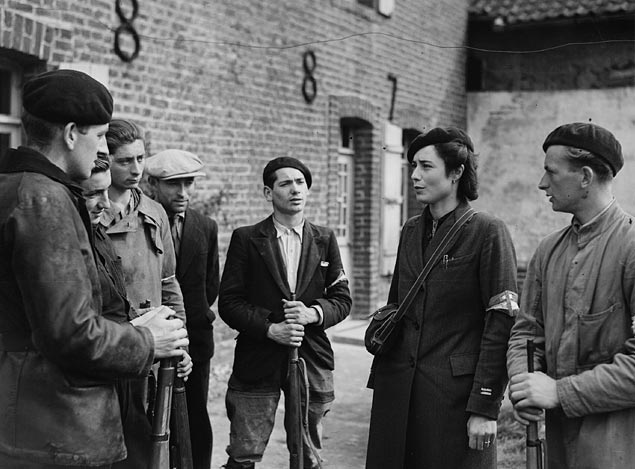
So the Maquis was the beginnings of the French Resistance, which was a lot of young men particularly, and eventually a lot of young women too, who were either on the run or were avoiding forced labor and created their own fighting force in the forest.
Ava MillerGUEST
And they, they became extremely important throughout the war and also particularly when D-Day happened and the Allied forces were moving across France, who received a lot of help from the Resistance.
Ava MillerGUEST
So that's, that's the process that we see happening in the novel on the ground amongst these four friends.

Robert TombsGUEST
Yes, facilitate D-Day, and, and what happened after D-Day, and also the, the, the, the invasion of Provence as well.
Robert TombsGUEST
So the, the, the Maquis had, had been armed m- mainly by the British, I mean, they were ... and organized and were ready to come out into the open.
Robert TombsGUEST
So, you know, what they'd been doing before then was, was good for French morale and, uh, pa- perhaps bad for German morale, I don't know.
Robert TombsGUEST
It probably n- didn't make all that much difference, but, you know, producing underground newspapers, um, having radio broadcasts, all that helps to keep spirits up.

Greg JacksonHOST
And that brings us full circle because the Allies are actually working directly with the French Resistance.
Greg JacksonHOST
British and American operatives from the two nations' brand new espionage organizations, the United Kingdom's Special Operations Executive and the United States Office of Strategic Services, created in 1940 and 1942 respectively, are parachuting into France, bringing arms, radios, and other needed supplies to the Maquis to help them harass the Germans from behind the lines, weakening the occupation and preparing the fallen Republic to rise anew and fight the moment that the Allies take those daring and deadly first steps on Normandy's beaches.
Greg JacksonHOST
Roughly one-third of OSS agents are women.
Greg JacksonHOST
And one in particular will go to extreme lengths in service to her country.
Greg JacksonHOST
When her first stint of wartime espionage as an SOE agent ended in her needing to hightail it across the Pyrenees and into Spain, Virginia did it, hobbling her way over the mountains.
Greg JacksonHOST
Now she's back in France as an operative of her own nation's even newer OSS.
Greg JacksonHOST
As for the cows and the cheese, look, Virginia's a fine farmhand, but it's all an excuse to scope out fields as potential parachute zones, to sell delectable dairy products to Nazi soldiers while eavesdropping with her perfect German, to help the Maquis, and finally, to radio her intel back to London in preparation for Operation Overlord.
Greg JacksonHOST
But Virginia has to be careful.