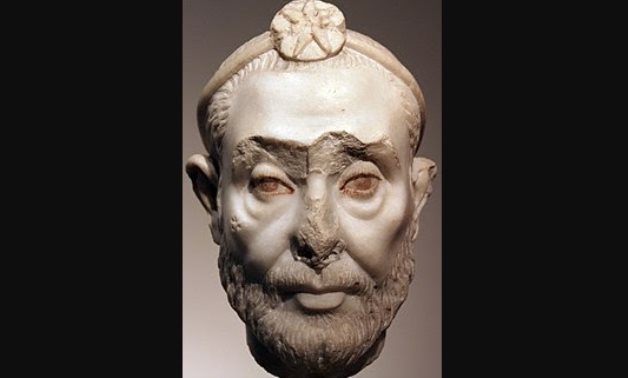
Manetho
Egyptian priestWikipedia
268
MENTIONS
22
EPISODES
22
PODCASTS
Search complete. 268 mentions across 22 episodes found for "Manetho".
Sep 22, 2026

Darryl CooperGUEST
You know, you read Tacitus, the Roman writing about them.
Darryl CooperGUEST
You read Manetho, various Greek writers writing about Jews.
Darryl CooperGUEST
And you kind of see that there is a running theme.
Darryl CooperGUEST
that comes up again in europe you know that uh in in uh a society like feudal europe was uh in traditional you know traditionalist aristocracy different estates with different rights and privileges and everybody kind of nobody really questioned that that was the way things ought to be put together you know the idea of universal human rights that apply to everybody equally was just not a thing and so you know the fact that you had this sort of self-contained semi-autonomous self-governing community of people who weren't really quite part of the community but they performed certain vital that was okay um in a society you know where where you didn't words like things like the rule of law like we're not uh nobody really thought that something like that should be applicable to uh you know like a peasant should be able to bring a suit against a king or something nobody

MarianneNARRATOR
Not indeed of those who have written in the Egyptian language, which it is impossible for me to do.
MarianneNARRATOR
But Manetho was a man who was born an Egyptian, yet he made himself master of the Greek learning, as is very evident, for he wrote the history of his own country in the Greek tongue, by translating it, as he saith himself, out of their sacred records.
MarianneNARRATOR
He also finds great fault with Herodotus for his ignorance and false relations of Egyptian affairs.
MarianneNARRATOR
Now this Manetho, in the second book of his Egyptian history, writes concerning us in the following manner.
MarianneNARRATOR
I will set down his very words, as if I were to bring the man himself into a court for a witness.
MarianneNARRATOR
There was a king of ours whose name was Timaeus.
MarianneNARRATOR
For that Hyk, with the aspiration in the Egyptian tongue, again denotes shepherds, and that expressly also.
MarianneNARRATOR
And this to me seems the more probable opinion, and more agreeable to ancient history.

Darryl CooperGUEST
You know, you read Tacitus, the Roman writing about them.
Darryl CooperGUEST
You read Manetho, various Greek writers writing about Jews.
Darryl CooperGUEST
And you kind of see that there's a running theme.
Darryl CooperGUEST
that comes up again in europe you know that uh in in uh a society like feudal europe was uh in traditional you know traditionalist aristocracy different estates with different rights and privileges and everybody kind of nobody really questioned that that was the way things ought to be put together you know the idea of universal human rights that apply to everybody equally was just not a thing and so you know the fact that you had this sort of self-contained semi-autonomous self-governing community of people who weren't really quite part of the community, but they performed certain vital.

speaker_4NARRATOR
In fact, we can trace the two histories almost contemporaneously, and see how remarkably the one sheds light upon the other.
speaker_4NARRATOR
In general, our knowledge of Egyptian history is derived from the monuments, of which we have already spoken, from certain references in Greek historians, which are not of much value, and especially from the historical work of Manetho, an Egyptian priest who wrote about the year 250 BC.
speaker_4NARRATOR
At that time the monuments of Egypt were still almost intact.
speaker_4NARRATOR
Manetho had access to them all.
speaker_4NARRATOR
He was thoroughly conversant with the ancient literature of his country, and he wrote under the direction and patronage of the then monarch of the land.
speaker_4NARRATOR
Unfortunately, however, his work has been lost, and the fragments of it preserved exist only in the distorted form which Josephus has given them for his own purposes, and in a chronicle written by a learned Christian convert of the 3rd century, Julius Africanus.
speaker_4NARRATOR
Such are the difficulties before the student.
speaker_4NARRATOR
On the other hand, both Africanus and Eusebius gathered their materials in Egypt itself, and were competent for their task.

ScottGUEST
Um, so you, you kinda have to take the high chronology, which is the original idea of the, of the timeline of Egypt based on their own king's list, which is also kind of itself late.
ScottGUEST
That's by a, a Egyptian historian named Manetho.
ScottGUEST
Um, so if you take that high chronology and you take the early exodus date from, based on the date of the temple, then you end up at 1446.
ScottGUEST
You end up with a pharaoh named Amenhotep II, who's the pharaoh of the exodus in that case.
21 MINS LATER
ScottGUEST
It, it, it doesn't have much spiritual meaning to it, right? It's just kind of plain, which is why I think most people kind of read past it and don't really realize it's something special.
ScottGUEST
Well, fast-forward a little bit.
ScottGUEST
There's this guy named Manetho, who I mentioned a minute ago.
ScottGUEST
Um, he has a history of the, of the Egyptian kings, and we have our dynasties mainly primarily because of Manetho, 'cause he put them into dynasties.

speaker_5NARRATOR
Section 14 I shall begin with the writings of the Egyptians, not indeed of those who have written in the Egyptian language, which it is impossible for me to do.
speaker_5NARRATOR
But Manetho was a man who was born an Egyptian, yet he made himself master of the Greek learning, as is very evident, for he wrote the history of his own country in the Greek tongue, by translating it, as he saith himself, out of their sacred records.
speaker_5NARRATOR
He also finds great fault with Herodotus for his ignorance and false relations of Egyptian affairs.
speaker_5NARRATOR
Now this Manetho, in the second book of his Egyptian history, writes concerning us in the following manner.
speaker_5NARRATOR
I will set down his very words, as if I were to bring the man himself into a court for a witness.
speaker_5NARRATOR
There was a king of ours whose name was Timaeus.
speaker_5NARRATOR
Now in another copy it is said that this word does not denote kings, but on the contrary denotes captive shepherds, and this on account of the participle Hyk, for that Hyk, with the aspiration in the Egyptian tongue, again denotes shepherds, and that expressly also.
speaker_5NARRATOR
And this to me seems the more probable opinion, and more agreeable to ancient history.

Marianne SpiegelNARRATOR
Not indeed of those who have written in the Egyptian language, which it is impossible for me to do.
Marianne SpiegelNARRATOR
But Manetho was a man who was born an Egyptian, yet he made himself master of the Greek learning, as is very evident, for he wrote the history of his own country in the Greek tongue, by translating it, as he saith himself, out of their sacred records.
Marianne SpiegelNARRATOR
He also finds great fault with Herodotus for his ignorance and false relations of Egyptian affairs.
Marianne SpiegelNARRATOR
Now this Manetho, in the second book of his Egyptian history, writes concerning us in the following manner.
Marianne SpiegelNARRATOR
I will set down his very words as if I were to bring the man himself into a court for a witness.
Marianne SpiegelNARRATOR
There was a king of ours whose name was Timaeus.
Marianne SpiegelNARRATOR
For that Hyk, with the aspiration in the Egyptian tongue, again denotes shepherds, and that expressly also.
Marianne SpiegelNARRATOR
And this to me seems the more probable opinion, and more agreeable to ancient history.

Collin ConkwrightGUEST
But anyway, I would say, you know, the broad window I'm very comfortable putting the Corpus Hermeticum in is like 2nd century BC through 2nd century AD.
Collin ConkwrightGUEST
Because there were Hermetica, you know, even Manetho, I believe a 2nd or 3rd century Egyptian priest, even he mentioned a plethora of writings under the name Hermes Trismegistus.
Collin ConkwrightGUEST
So, you know, we don't have those, right? We don't necessarily have all of those writings.
Collin ConkwrightGUEST
And so I think it's silly to say from the dates of the writings we do have, none of the ones before that ever existed.
27 MINS LATER
Collin ConkwrightGUEST
It's really hard to peace out.
Collin ConkwrightGUEST
But that group definitely existed.
Collin ConkwrightGUEST
And if you can use like Manetho and Zosimus of Panopolis to sort of fill in the gaps, you realize that there probably is this link between them and the Greco-Hermetic cult that everyone's sort of looking for and that we get in the writings of the Corpus Hermeticum.
Collin ConkwrightGUEST
I would argue that Clement of Alexandria gave us a pretty good outward depiction of one of their processions.

Heather M. ByeNARRATOR
The boulder was subsequently concealed under the southern side of the city wall, and as fragments of inscribed papyrus coeval with the sixth dynasty have been discovered in the immediate neighborhood, on one of which mention is made of this domain of Pepi II, it would seem that the town of Elephantine must have been founded between the period of the fourth dynasty and that of the sixth.
Heather M. ByeNARRATOR
Manetho is therefore justified in making the fifth and sixth dynasties of Elephantine origin.
Heather M. ByeNARRATOR
It is in Babylonia, however, that the most startling discoveries have been made.
Heather M. ByeNARRATOR
At Tello, M. de Sarzac has found a library of more than 30,000 tablets, all neatly arranged, piled in order one on the other, and belonging to the age of Judea, B.C. 2700.
6 HRS 17 MINS LATER
Heather M. ByeNARRATOR
They divided this interminable succession of often problematical personages into dynasties, following in this division rules of which we are ignorant, and which varied in the course of ages.
Heather M. ByeNARRATOR
In the time of the Ramessides, names in the list which subsequently, under Lagides, formed five groups, were made to constitute one single dynasty.
Heather M. ByeNARRATOR
Manetho of Sebenitus, who wrote a history of Europe for the use of Alexandrine Greeks, had adopted, on some unknown authority, a division of thirty-one dynasties from Menes to the Macedonian conquest, and his system has prevailed.
Heather M. ByeNARRATOR
Not, indeed, on account of its excellence, but because it is the only complete one which has come down to us.

speaker_5NARRATOR
Section 14 I shall begin with the writings of the Egyptians, not indeed of those who have written in the Egyptian language, which it is impossible for me to do.
speaker_5NARRATOR
But Manetho was a man who was born an Egyptian, yet he made himself master of the Greek learning, as is very evident, for he wrote the history of his own country in the Greek tongue, by translating it, as he saith himself, out of their sacred records.
speaker_5NARRATOR
He also finds great fault with Herodotus for his ignorance and false relations of Egyptian affairs.
speaker_5NARRATOR
Now this Manetho, in the second book of his Egyptian history, writes concerning us in the following manner.
speaker_5NARRATOR
I will set down his very words as if I were to bring the man himself into a court for a witness.
speaker_5NARRATOR
There was a king of ours whose name was Timaeus.
speaker_5NARRATOR
For that Hyk, with the aspiration in the Egyptian tongue, again denotes shepherds, and that expressly also.
speaker_5NARRATOR
And this to me seems the more probable opinion and more agreeable to ancient history.
12 more episodes mention Manetho.
Create an account to see the whole feed, search across every transcript, and follow the entities you care about.