Manchukuo
StateWikipedia
49
MENTIONS
31
EPISODES
26
PODCASTS
Search complete. 49 mentions across 31 episodes found for "Manchukuo".
Sep 28, 2026

JoeHOST
They were overwhelmingly ethnically Chinese.
JoeHOST
And we talked about this before as well, but there's also a pretty large population of what are known as white Russians in Manchukuo.
JoeHOST
These are variously understood as anti-Bolshevik Russians who fled the Soviet Union.
JoeHOST
Yeah.
JoeHOST
A lot of these guys had some form of professional military education going back to the Tsarist military, or were soldiers during that period, or were children of those people.
JoeHOST
Though the Japanese didn't conscript the Russians.
JoeHOST
There's a lot of weird racial dynamics going on in Manchukuo.
JoeHOST
For example, Manchukuo is where Unit 731 is.

Aaron BennettNARRATOR
With the Western nations in the depths of an industrial depression, Japan began a series of aggressions against the Chinese in Manchuria.
Aaron BennettNARRATOR
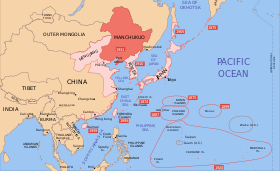
The gains were consolidated in a puppet state known as Manchukuo, comprising a fertile and populous area as large as California.
Aaron BennettNARRATOR
China was unable to offer much resistance, and Soviet Russia could not risk a major war in the Far East.
Aaron BennettNARRATOR
Even so, some of the Soviet border clashes with the Japanese in time of peace were actually battles fought with tanks and planes.

Wei ChenHOST
I decide to start the day at the Museum of the Imperial Palace of the Manchu State, known locally as the Wei Huang Gong.
Wei ChenHOST
It is a place of heavy history, built during the years when Japan controlled this region through their puppet state of Manchukuo.
Wei ChenHOST
The architecture is a strange fusion of traditional Chinese styles and Western influences, reflecting the confused identity of the era.
Wei ChenHOST
As I walk through the gates, The rain makes the red walls seem darker, more solemn.

Stephen K. BannonHOST
Yeah
Jack PosobiecGUEST
... that pushed Japan out of Manchuria, out, out of, uh, Manchukuo, a- as the Japanese had called it.
Jack PosobiecGUEST
Then they took that industrial base, the Japanese industrial imperial war base that they had built up in Manchuria, and they handed all the weapons to Chairman Mao.
Jack PosobiecGUEST
And once Mao got his hands on that, they immediately launched a, with the Battle of Beijing, they launched attacks on the Nationalists.

Nick BrightHOST
Except that he doesn't.
Nick BrightHOST
As he rises up in status in the navy, he is named the main purchasing agent in China for the Japanese navy, and he uses his position to plunder goods from the Japanese puppet state of Manchukuo to hawk and peddle them back in Japan at an enormously high profit margin.
Nick BrightHOST
he also was able to build a quite successful opium and narcotics empire.
Nick BrightHOST
With the success of these two enterprises, at the end of the war in 1945, he was said to be worth the equivalent of 175 million US dollars.

Jack PosobiecGUEST
And there was a senator by the name of Joseph McCarthy who called this all out in real time and said we have been infiltrated our state department's been infiltrated steve i've been writing about this i've been reading about this learning about this for 20 years at this point it is the biggest bald-faced lie that uh the chinese communist party fought the japanese in world war ii and that they somehow defeated japan that's where they teach all the people in china by the way it's not what happened it's not true at all it was the soviet union that pushed japan out of Manchuria.
Jack PosobiecGUEST
out of Manchukuo, as the Japanese had called it.
Jack PosobiecGUEST
Then they took that industrial base, the Japanese industrial imperial war base that they had built up in Manchuria, and they handed all the weapons to Chairman Mao.
Jack PosobiecGUEST
And once Mao got his hands on that, they immediately launched the Battle of Beijing.
Wei ChenHOST
Returning to the city, I head towards Erdao District, where the Museum of the Imperial Palace of the Manchu State stands as a monument to a complicated and painful chapter of history.
Wei ChenHOST
The palace, or Weihuang gong, was the residence of Pu'i, the last emperor of China, who was installed by Japan as the puppet ruler of Manchukuo.
Wei ChenHOST
Walking through the gates feels like stepping into a frozen moment of nineteen thirty-two, where the architecture blends traditional Chinese motifs with Western styles, a visual contradiction that mirrors the political reality of the time.
Wei ChenHOST
The ticket is around seventy yuan, a small price to pay for the privilege of witnessing such a charged space, and the silence inside the exhibition halls is profound, broken only by the soft footsteps of other visitors.

BrewHOST
It can be traced all the way back to Abe's grandfather, Nobusuke Kishi.
BrewHOST
Kishi was once a high-ranking official in Manchukuo, a Japanese puppet state established in northwestern China that existed from 1932 to 1945.
BrewHOST
After the Second World War, he was arrested in 1945 as a Class A war crime suspect, but then was later released when US authorities decided that right-wing anti-communist figures like Kishi could help steer post-war Japan in a pro-Western direction.
BrewHOST
He then went on to broker the founding of the country's Liberal Democratic Party, LDP, in 1955, and became Prime Minister two-

Peter BoyleGUEST
During his lifetime, my father was respected for being honest and reliable, for speaking precisely without hyperbole or embellishment.
Peter BoyleGUEST
And thanks to his impeccable reputation, he'd survived the Manchukuo period, the Civil War, and the communist regime, largely unscathed.
Peter BoyleGUEST
But after smoking opium, his face would relax, all the wrinkles soften, and he'd tell us magnificent stories of various scholars' supernatural encounters with gorgeous ghosts and foxy spirits, and tragic love affairs, unfulfilled or fulfilled only by death, resurrection or reincarnation.
Peter BoyleGUEST
As he leaned back on the husk-filled pillows, engrossed in storytelling, with the children surrounding him all transfixed, my mother was sewing or darning, seemingly listening, never saying a word.

Toby ReynoldsGUEST
And they morph into their own kind of freelance resistance cell to the Japanese occupation, which is taking place in the late 1930s, 1940s.
Toby ReynoldsGUEST
So for listeners who weren't aware, Japan basically tried to annex most of China during the sort of gradually starting in Manchuria or Manchukuo, as they tried to call it, in 1937.
Toby ReynoldsGUEST
And it became into open warfare with both the Chinese communists and the Chinese nationalists So there's a sort of three-way fight going on between these powers.
Toby ReynoldsGUEST
So Japan is very much an occupying force, and that's in the background all the time, especially in the mise-en-scene of the film.
21 more episodes mention Manchukuo.
Create an account to see the whole feed, search across every transcript, and follow the entities you care about.