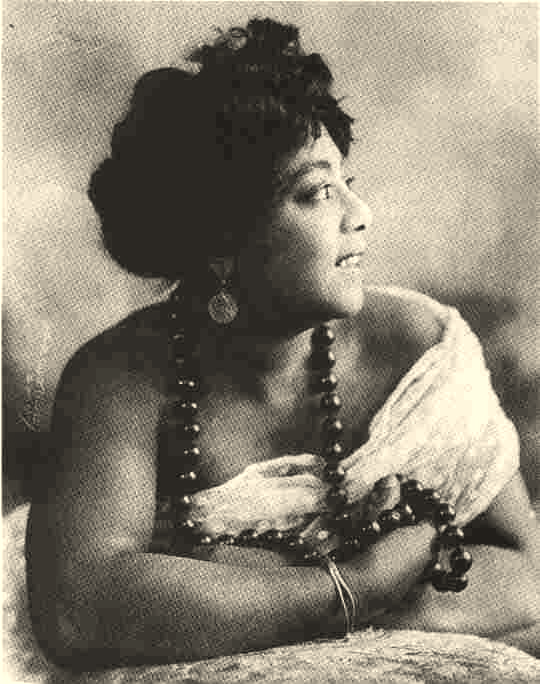
Mamie Smith
American singerWikipedia
16
MENTIONS
7
EPISODES
3
PODCASTS
Search complete. 16 mentions across 7 episodes found for "Mamie Smith".
Oct 6, 2026

Jack NortonHOST
Well, you're listening to Jack Norton's Old Time Radio Show.
Jack NortonHOST
If you'd like to learn more about the show, uh, you can find me over at jacknortonmusic.com. And if you have a song or artist request, well, just email me, hello@jacknortonmusic.com. Coming up, I've got one of the greatest blues shouters of all time, Mamie Smith.
Jack NortonHOST
She's gonna be doing a tune called The Lure of the South, and then after that we're gonna hear Ella Mae Morse with Freddie Slack and his Orchestra, Get on Board Little Children.
speaker_8SOUNDBITE_SPEAKER
See that steamboat coming, coming round the bend.

Nate WilcoxHOST
Dorsey's doing this at a point when it's just kind of out of time, out of sync with what's going on.
Nate WilcoxHOST
But then a big meteorite, a comet lands [clears throat] in the form of Mamie Smith's Crazy Blues, [clears throat] which is one of the first, it's not the first recording of a blues song, but it's the first recording of a blues song by a Black performer, and it's a massive seller, and immediately changes everything.
Nate WilcoxHOST
Suddenly there's a big market for this old-timey blues.
Nate WilcoxHOST
There's big interest in the cities.
Nate WilcoxHOST
Um, people like Mamie Smith are soon, she's soon followed up by people like Bessie Smith and Ma Rainey, who actually hires, Dorsey ends up getting hired by Ma Rainey and becoming her bandleader and, and a music arranger.
Nate WilcoxHOST
He gets this gig 'cause he, he's, gets some work at Paramount Records.
Nate WilcoxHOST
I'm kind of compressing the timeline 'cause we've already used half of our time and got a lot to cover.
Nate WilcoxHOST
And that was something he recorded for OK Records.
Nate WilcoxHOST
And obviously, the big record that they recorded in this period was Mamie Smith's Crazy Blues, which was the first time that an African-American artist had been paired with not technically a blues song, but something from the blues vernacular called a blues that was an enormous success and sort of epitomized the hit them where they ain't strategy that OK Records and Ralph Peer would build big careers on.
Nate WilcoxHOST
But before we get to any of that and before we get to his background, I have one big question, and this is the address in the book.
Nate WilcoxHOST
It's interesting to me that commercial recording really takes off in the 1890s, and yet this great body of American vernacular music doesn't really start getting recorded until the 1920s.
11 MINS LATER
Barry MazorGUEST
She said, seemed like whatever song I didn't like, what he said to do would be our biggest sellers.
Nate WilcoxHOST
Let's backtrack a little bit, though, because there's a really, really big song, and I mentioned it earlier when we played our first song snippet, that sort of defines the beginnings of, Ralph Pierce career, this is really where the starting line, starting gun is fired.
Nate WilcoxHOST
And I'm talking about Crazy Blues by Mamie Smith.
Nate WilcoxHOST
And Peer's role in that recording and the decision to record Mamie Smith and the decision to record that song has been much disputed.
Nate WilcoxHOST
... as a radio performer for a couple years before Ralph Peer comes along.
Nate WilcoxHOST
And, and I think it's just classic that Ralph Peer is the same guy who kicked off the Black blues craze with Crazy Blues and Mamie Smith.
Nate WilcoxHOST
He's the guy who discovered Louis Armstrong.
Nate WilcoxHOST
This was just another underserved ethnic market to him at a time when radio's capital cannibalizing, you know, the, the shellac market, the record market, and he stumbles across Fiddlin' John Carson, doesn't think he's gonna sell.
Nate WilcoxHOST
That does sell.
Nate WilcoxHOST
Okeh Records is in, in the business.
Nate WilcoxHOST
[lip smack] Ralph Peer then breaks away, goes switches to Victor Records and goes to Bristol, Tennessee looking for talent and, you know, the guy, this is the guy who discovered Louis Armstrong a little later after Mamie Smith, and he says, "You know, lightning was in a bottle," and boom, boom.
Nate WilcoxHOST
Not once, but twice, the Carter Family-
Nate WilcoxHOST
Fiddle and John Carson out of Atlanta, that there was a significant selling record that we would call country music today.
Nate WilcoxHOST
And then that didn't exactly open the floodgates, but between the success of Fiddle and John Carson and the much bigger success of Mamie Smith and Crazy Blues and the discovery that African Americans would buy records and white people would buy records made by African Americans, then they go all in on all kinds of ethnic groups.
Nate WilcoxHOST
And Southern whites are one of the ethnic groups that they recorded.
Nate WilcoxHOST
And they discovered pretty quickly that other white people all around the country would buy country records.
Nate WilcoxHOST
Yeah, and you start with the date February 14th, 1920, when, and this is sort of, I guess, one of the instances where they discovered a principle you call record it and see if it sells.
Nate WilcoxHOST
And, and so, uh, a Black singer named Mamie Smith had recorded a couple of tracks, sold a few hundred thousand, or, like, almost 100,000 copies of the first record, and they went back and recorded something called Crazy Blues that sold 75,000 copies of a month-
Ed WardGUEST
Right
Nate WilcoxHOST
... and a million copies in a year.
Nate WilcoxHOST
Ed just gave you the numbers, 75,000 sold in a month, a million in a year.
Nate WilcoxHOST
So let's hear what America was actually buying in 1920.
Nate WilcoxHOST
Mamie Smith, Crazy Blues on Okeh, produced by Perry Bradford.
Nate WilcoxHOST
Listen to it as a piece of pop music or jazz or blues, because that's what it is, and hold onto that.

speaker_0HOST
It is greatly appreciated.
speaker_0HOST
First up, though, on this date in 1946, iconic blues singer and vaudeville performer Mamie Smith passed away at the age of 63 from an illness.
speaker_0HOST
She went down in history as being the first Black American artist to record vocal blues, paving the way for future generations with her iconic 1920 track Crazy Blues.
speaker_0HOST
In 1959, television and radio personality Dick Clark kicked off his very first Caravan of Stars concert tour in Bluefield, West Virginia.