Malachi 1
ScriptureWikipedia
105
MENTIONS
28
EPISODES
23
PODCASTS
Search complete. 105 mentions across 28 episodes found for "Malachi 1".
Sep 19, 2026

speaker_3NARRATOR
Sermon 1 of Malachi by Charles Simeon Sermon 1 The sovereignty of God's grace.
speaker_3NARRATOR
Malachi 1, verses 2 and 3.
speaker_3NARRATOR
I have loved you, saith the Lord.
speaker_3NARRATOR
Yet ye say, wherein hast thou loved us? Was not Esau Jacob's brother, saith the Lord? Yet I love Jacob, and I hated Esau.
15 MINS LATER
speaker_3NARRATOR
from Hori Homiletiki by Charles Simeon.
speaker_3NARRATOR
This LibriVox recording is in the public domain.
speaker_3NARRATOR
Relative Duties to God and Man Malachi 1 verse 6 A son honoureth his father, and a servant his master.
speaker_3NARRATOR
If then I be a father, where is mine honour? And if I be a master, where is my fear? saith the Lord of hosts.

annm2705HOST
Okay, let's try to go back.
annm2705HOST
God declared that Edom would be a wasteland occupied only by wild animals in Malachi 1, 2 through 5.
annm2705HOST
This began to come to pass when Edom was pushed out of their land and taken over by the Nabateans.
annm2705HOST
God dealt justly with the Edomites because of their actions and attitude toward Israel.

Garry VanderveenHOST
And these words remind us that God keeps his promises in history, that God answers his people's cries in history, that God completes his story in history, in time, in space.
Garry VanderveenHOST
Well, who in the world is this Herod guy? And you may be wondering why I read Malachi 1, why we read that this morning.
Garry VanderveenHOST
Anyone think about that? Okay, we have one gentleman here.
Garry VanderveenHOST
This is good.

speaker_0NARRATOR
Today's Bible teacher is Chuck Missler, connecting the Bible to your life and the world around you.
speaker_0NARRATOR
In today's study, Chuck begins his teaching on the book of Malachi, chapter 1.
Chuck MisslerHOST
We did a survey of Malachi over a year ago, but I think it's a book that warrants us going into a little more depth, so we're going to jump in to the book of Malachi, the Italian book of the Old Testament.
Chuck MisslerHOST
And, of course, I'm kidding.
Chuck MisslerHOST
is generally regarded by most people familiar with the Bible as the end of the Old Testament.
Chuck MisslerHOST
That's actually not quite right.
Chuck MisslerHOST
We're going to discover some things that the Old Testament didn't really end with Malachi, but I'll leave that for another session.
Chuck MisslerHOST
But Malachi is a very short little book, but very rich in the issues that it deals with.

Matthew HalsteadHOST
Uh, today's episode assumes, uh, some of the things that we discussed in the last episode, so you'll wanna check that out.
Matthew HalsteadHOST
In this episode, we're looking at a very strange passage, verses two through five.
Matthew HalsteadHOST
It's in this passage where we encounter a very strange text where God says, "Jacob have I loved, Esau have I hated." All right, so what exactly is going on here with this language of divine hatred? Does God actually hate Esau? And should we read into this passage the idea of eternal reprobation with respect to salvation, the salvation specifically of this individual, Esau? Well, we're gonna be looking at all of those questions and more, and I'm eager to get into this text because quite frankly, this- how we interpret this Bible passage has a lot of not only theological implications, but pastoral ramifications and pastoral consequences.
Matthew HalsteadHOST
If we don't get this text right, I fear that we could do a lot of damage and cause a lot of fear in people, and so we wanna make sure that we interpret this text fairly and accurately.
Matthew HalsteadHOST
Before we do, I want to say a word of thanks to our Patreon supporters.
Matthew HalsteadHOST
All right, well, yeah, I say we just jump in.
Matthew HalsteadHOST
There's, there's a lot here.
Matthew HalsteadHOST
This passage is very strange because of a, of a, of that, uh, verse where it talks about God hating Esau.

William StevesHOST
We can operate only by the grace of our Savior.
William StevesHOST
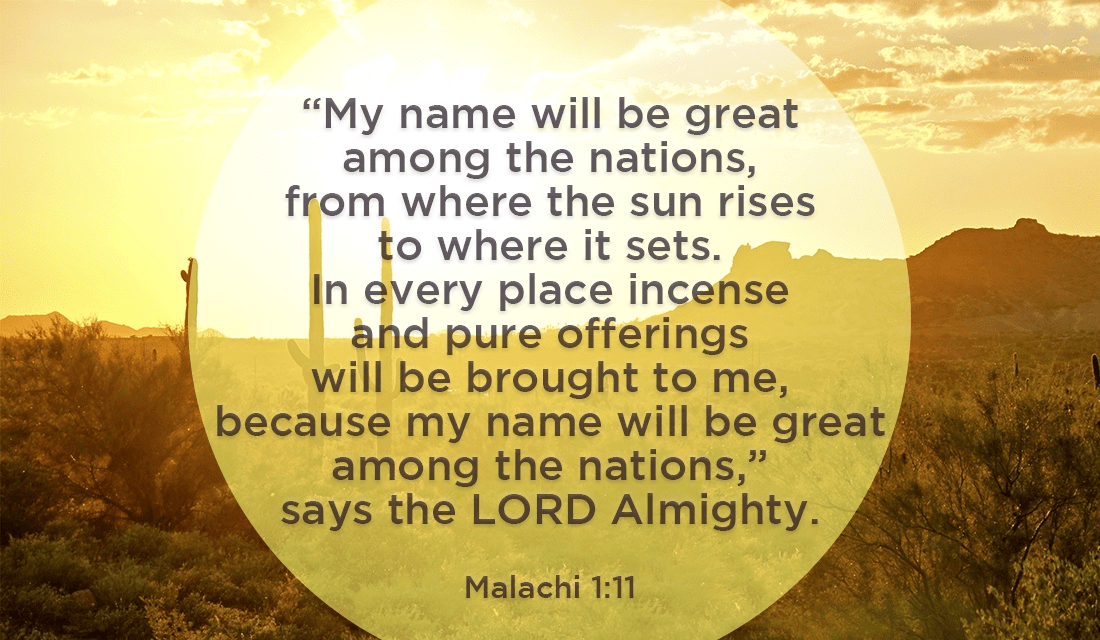
Malachi 1.11 For from the rising of the sun, even unto the going down of the same, my name shall be great among the Gentiles.
William StevesHOST
And in every place incense shall be offered unto my name at a pure offering, for my name shall be great among the heathen, saith the Lord of hosts.
William StevesHOST
What a wonderful picture of the worthiness of our Lord for worship.

William AlbrechtGUEST
It will continue in a different manner.
William AlbrechtGUEST
In fact, we're told in Malachi 1:11, "From the rising of the sun to its setting, in every place incense is offered to my name and a pure offering." Now, as you know very well, Edgar, certain things did change.
William AlbrechtGUEST
That cannot be talking about the Old Covenant sacrifices, because those were restricted to Jerusalem, and Malachi is rebuking the Levitical priests because of their defective sacrifices.
William AlbrechtGUEST
So he's talking about a future coming age where there will be one pure sacrifice offered among the Gentiles in every place.
William AlbrechtGUEST
I daresay that fits the New Covenant Eucharist perfectly.
William AlbrechtGUEST
That is why as early as the ADs, 80 AD, in the first century, the early Christians were already interpreting Malachi 1:11 to be referring to the Holy Eucharist.
Edgar LujanoHOST
And if people, when you read that verse, if you go to mass every Sunday, you recognize those words.
Edgar LujanoHOST
How can, how can you not?
William AlbrechtGUEST
It will continue in a different manner.
William AlbrechtGUEST
In fact, we're told in Malachi 1.11, from the rising of the sun to its setting, in every place, incense is offered to my name.
William AlbrechtGUEST
and a pure offering.
William AlbrechtGUEST
Now, as you know very well, Edgar, certain things did change.
William AlbrechtGUEST
So he's talking about a future coming age where there will be one pure sacrifice offered among the Gentiles in every place.
William AlbrechtGUEST
I dare say that fits the New Covenant Eucharist perfectly.
William AlbrechtGUEST
That is why as early as the 80 AD, in the first century, the early Christians were already interpreting Malachi 1.11 to be referring to the Holy Eucharist.
Edgar LujanoHOST
And if people, when you read that verse, if you go to Mass every Sunday, you recognize those words, how can you not? Because they read them every time you go to Mass in preparation for the Eucharistic sacrifice.
Chuck MisslerHOST
Uh, let's jump into chapter one of the Book of Malachi, last book in the Old Testament as, as it's presented in the English Bible.
Chuck MisslerHOST
Malachi 1:1, "The burden of the word of the Lord of Israel by Malachi." The word burden, or massah, is a message of rebuke rather than comfort or encouragement.
Chuck MisslerHOST
Now, it can be comfort, encouragement, but the, the term burden, it's an ominous term.
Chuck MisslerHOST
It suggests in its weight impending judgment.

Adonica Howard-BrowneHOST
What is a tithe? If you're new to this, 10% of your income.
Adonica Howard-BrowneHOST
Before or after tax? Do you want him to help you with your tax bill? Malachi 1 and verse 8 speaks about bringing God, don't bring God blind, lame, and sick offerings because that's evil.
Adonica Howard-BrowneHOST
So we don't bring him animals, but in a sense that would be our leftovers, our dregs.
Adonica Howard-BrowneHOST
after we've paid all the bills, hear the pennies dropping, as the old religious song goes.
18 more episodes mention Malachi 1.
Create an account to see the whole feed, search across every transcript, and follow the entities you care about.