Magellanic Clouds
15
MENTIONS
10
EPISODES
9
PODCASTS
Search complete. 15 mentions across 10 episodes found for "Magellanic Clouds".
Oct 5, 2026

LeonHOST
And now sort of the Milky Way is moving towards that sort of western sky after sunset.
LeonHOST
And the way you know you're looking at the Milky Way is you can make out the constellations of Scorpius, which, you know, that famous hook shape that we keep talking about.
LeonHOST
Mm-hmm.
LeonHOST
And then if you're really good, you can make out Sagittarius as well, which kind of looks more like a spaghetti mess, but it is there.
LeonHOST
And those two constellations kind of identify the brightest parts of the Milky Way.
LeonHOST
And yeah, just most notably, it's kind of shifted towards the western sky a little bit this month.
LeonHOST
But if you're out in a dark sky, you will definitely be able to see that.
LeonHOST
That's actually exactly where the name comes from.

Arif HodzicNARRATOR
The Strait of Magellan isn't the only thing to be named in his honor.
Arif HodzicNARRATOR
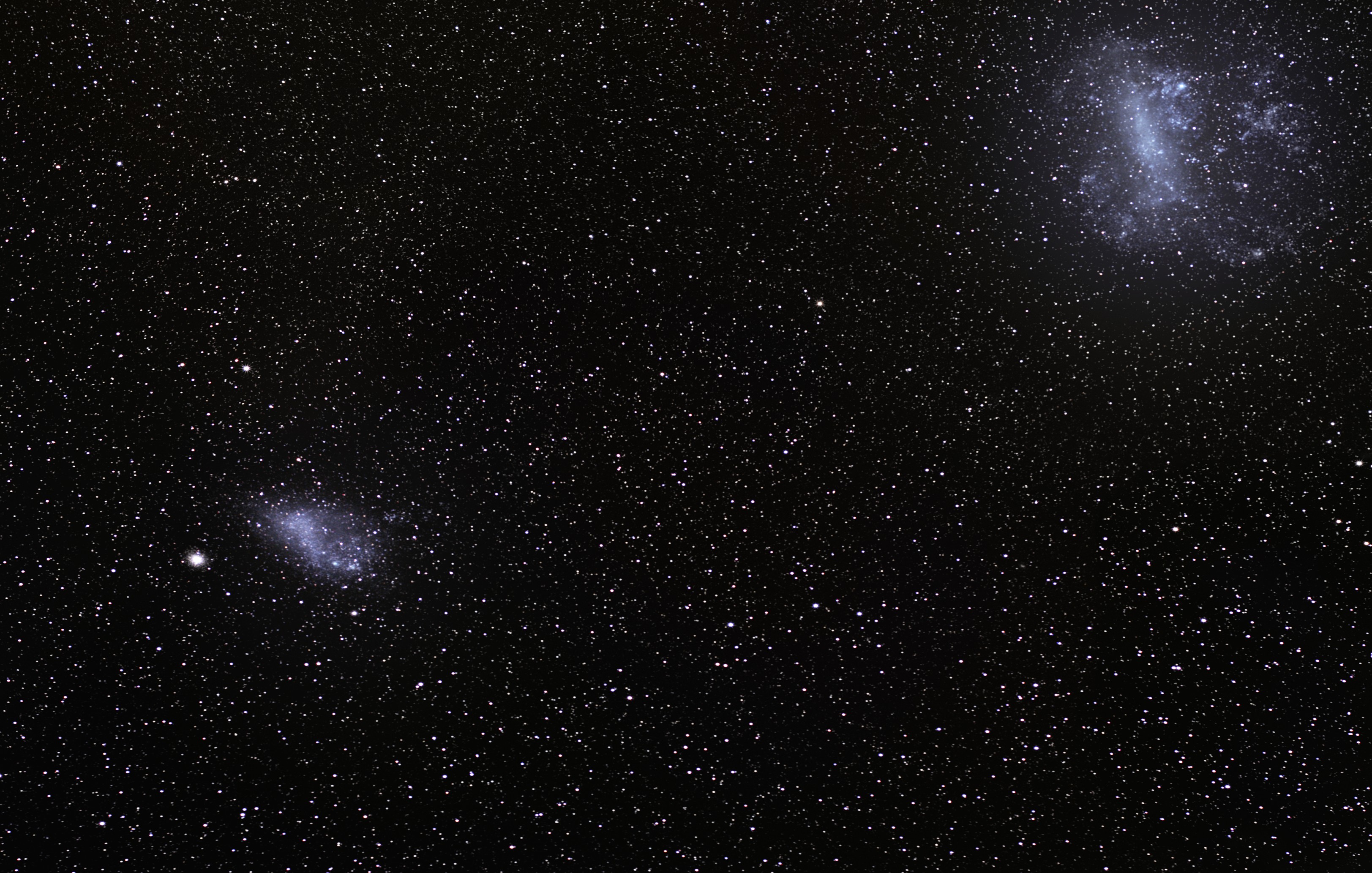
Two dwarf galaxies visible in the southern hemisphere are known as the Magellanic Clouds.
Arif HodzicNARRATOR
And in the 1980s, NASA named a spacecraft after Magellan.
Arif HodzicNARRATOR
Magellan and his crew might be considered the space explorers of their day.

Barry EadsNARRATOR
Indeed, I was very favorably impressed with it, and it seems to be by far the most conspicuous figure in the southern sky.
Barry EadsNARRATOR
Another curious phenomenon to be seen on this side of the line are the Magellan clouds, three nebulae composed apparently of an inconceivable number of stars.
Barry EadsNARRATOR
They look like detached spots of the Milky Way, though the stardust seems to be much finer and more minute than the latter.
Barry EadsNARRATOR
I had always thought of the Magellan clouds as vapor and similar to other clouds.
Barry EadsNARRATOR
It never occurred to me that they were small nebulae or luminous spots.
Barry EadsNARRATOR
They are, of course, in the southern sky and begin to be visible from a point somewhat farther to the northward than we are now.

Billy HenryNARRATOR
They can stretch and pull the galaxies around them, rip them apart, and even gobble them up.
Billy HenryNARRATOR
A case in point is the Magellanic Clouds, the largest satellite galaxies of the Milky Way.
Billy HenryNARRATOR
The Large Magellanic Cloud is about 165,000 light years away.
Billy HenryNARRATOR
It's about a third as wide as the Milky Way, and perhaps one-tenth as massive.

speaker_1NARRATOR
It was just a thing that happened.
speaker_1NARRATOR
Leavitt got assigned to study these variables in the Magellanic Clouds, two fuzzy patches visible from the southern hemisphere.
speaker_1NARRATOR
They look like detached pieces of the Milky Way, floating nearby.
speaker_1NARRATOR
We now know they're satellite galaxies.

Barry EadsNARRATOR
Indeed, I was very favorably impressed with it, and it seems to be by far the most conspicuous figure in the southern sky.
Barry EadsNARRATOR
Another curious phenomenon to be seen on this side of the line are the Magellan clouds, three nebulae composed apparently of an inconceivable number of stars.
Barry EadsNARRATOR
They look like detached spots of the Milky Way, though the stardust seems to be much finer and more minute than the latter.
Barry EadsNARRATOR
I had always thought of the Magellan clouds as vapor and similar to other clouds.
Barry EadsNARRATOR
It never occurred to me that they were small nebulae or luminous spots.
Barry EadsNARRATOR
They are, of course, in the southern sky and begin to be visible from a point somewhat farther to the northward than we are now.

Barry EadesNARRATOR
Indeed, I was very favorably impressed with it, and it seems to be by far the most conspicuous figure in the southern sky.
Barry EadesNARRATOR
Another curious phenomenon to be seen on this side of the line are the Magellan Clouds, three nebulae composed apparently of an inconceivable number of stars.
Barry EadesNARRATOR
They look like detached spots of the Milky Way, though the stardust seems to be much finer and more minute than the latter.
Barry EadesNARRATOR
I had always thought of the Magellan clouds as vapor and similar to other clouds.
Barry EadesNARRATOR
It never occurred to me that they were small nebulae or luminous spots.
Barry EadesNARRATOR
They are, of course, in the southern sky and begin to be visible from a point somewhat farther to the northward than we are now.
speaker_1NARRATOR
The Southern Cross is overhead, its four main stars arranged in the compact asymmetric pattern that has guided navigation in the Southern Hemisphere for centuries.
speaker_1NARRATOR
The Magellanic Clouds, the two satellite galaxies of the Milky Way, visible only from the Southern Hemisphere, are clearly visible as fuzzy patches of light, each one an entire galaxy, each one containing billions of stars visible to the naked eye from this place where the air is clear enough and the darkness deep enough to reveal them without any optical aid.
speaker_1NARRATOR
On some nights, the sky is so clear and the atmosphere so stable that the zodiacal light is visible, a faint triangular glow along the ecliptic caused by sunlight scattering off interplanetary dust particles that orbit the Sun in the plane of the Solar System.
speaker_1NARRATOR
This glow is almost never visible for populated areas.

speaker_10NARRATOR
The surveys study the distribution of galaxies and galaxy clusters, help unravel the mysterious nature of dark matter and dark energy, and look for rare objects — all the way from tiny but dangerous near-Earth asteroids out to the most remote quasars in the early Universe.
speaker_10NARRATOR
Our own Milky Way galaxy and its neighbours the Magellanic Clouds also receive their own surveys.
speaker_10NARRATOR
VISTA generates several hundred gigabytes worth of data during each night of observing, comparable to all the other VLT instruments put together.
speaker_10NARRATOR
These data flow into ESO’s archive system at its headquarters in Germany and are sent for further processing in the UK.

speaker_2NARRATOR
The Southern Cross is overhead, its four main stars arranged in the compact asymmetric pattern that has guided navigation in the southern hemisphere for centuries.
speaker_2NARRATOR
The Magellanic Clouds, the two satellite galaxies of the Milky Way, visible only from the southern hemisphere, are clearly visible as fuzzy patches of light, each one an entire galaxy, each one containing billions of stars visible to the naked eye from this place where the air is clear enough and the darkness deep enough to reveal them without any optical aid.
speaker_2NARRATOR
On some nights the sky is so clear and the atmosphere so stable that the zodiacal light is visible, a faint triangular glow along the ecliptic caused by sunlight scattering off interplanetary dust particles that orbit the sun in the plane of the solar system.
speaker_2NARRATOR
This glow is almost never visible for populated areas.