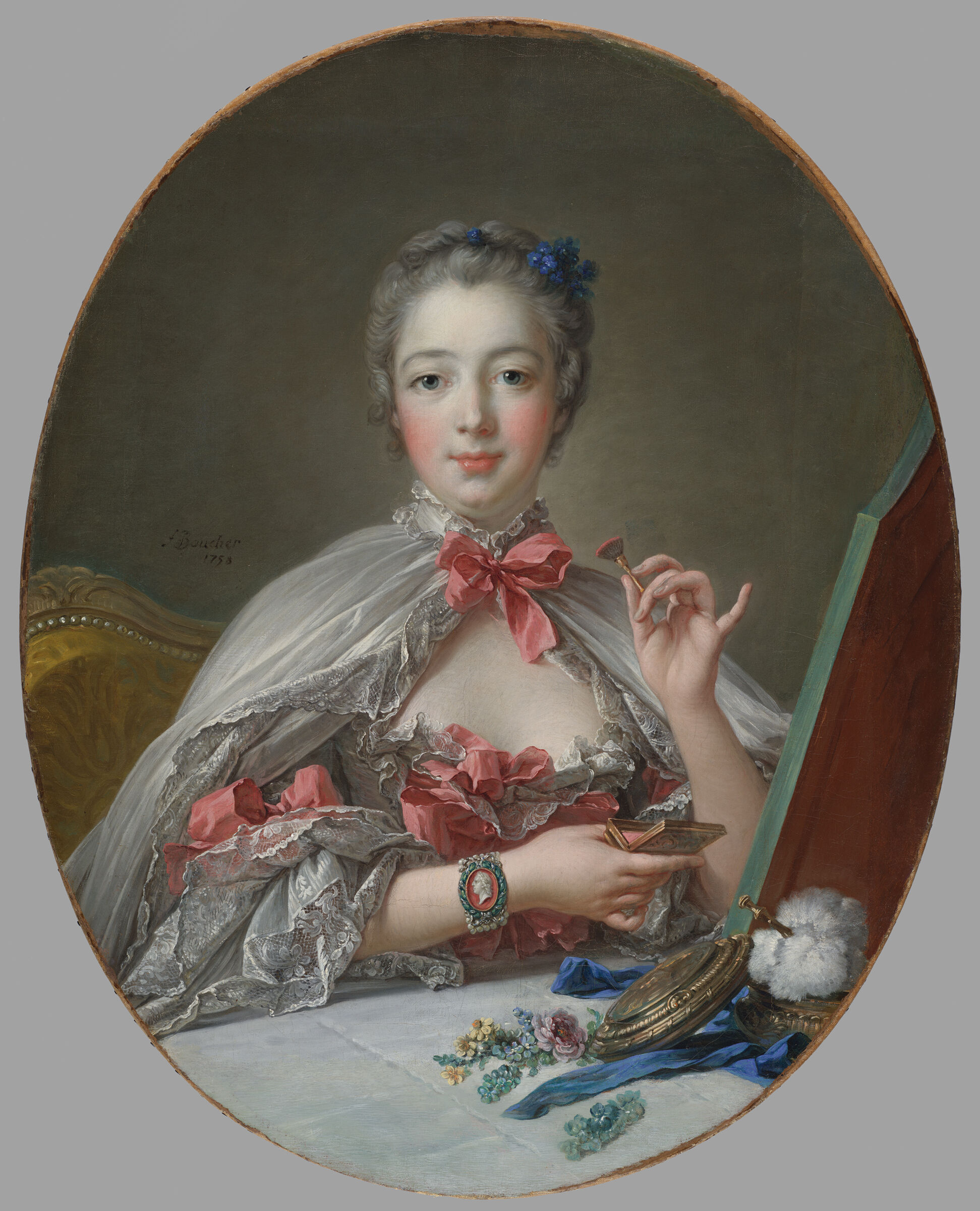
Madame de Pompadour
Former Marquise de PompadourWikipedia
35
MENTIONS
24
EPISODES
20
PODCASTS
Search complete. 35 mentions across 24 episodes found for "Madame de Pompadour".
Nov 26, 2026

Thomas CopelandNARRATOR
This section took in the whole east side of the Faubourg Saint-Denis, whereas the present number sixty-three is on the west side.
Thomas CopelandNARRATOR
After Georgie, spelled G-E-O-R-G-E-I-T, or Georget, spelled G-E-O-R-G-E-T, had been arrested, Paine was left alone in the large mansion, said by Rickman to have been once the hotel of Madame de Pompadour, and it would appear by his account that it was after the execution, October 31st, 1793, of his friends the Girondins and political comrades that he felt his end at hand and set about his last literary bequest to the world, The Age of Reason, in the state in which it has since appeared, as he is careful to say.
Thomas CopelandNARRATOR
There was every probability during the months in which he wrote, November and December 1793, that he would be executed.
Thomas CopelandNARRATOR
His religious testament was prepared with the blade of the guillotine suspended over him, a fact which did not deter pious mythologists from portraying his deathbed remorse for having written the book.

speaker_0GUEST
And luckily he was right, because Sevres had had this inextricable link with the wives and mistresses, particularly of the French royal family.
speaker_0GUEST
So they had been patronized by people like Madame de Pompadour and Marie Antoinette, and the director at Sevres would have known that Josephine wanted to link into this history, and so by depicting her plants from Redoutte's engravings on Sevres porcelain, it's a perfect marriage of her interests, and he was really right to create this.
speaker_0GUEST
It was really a calculated risk, but it paid off, and each piece is hand-painted with different grasses and lilies.
speaker_0GUEST
The service is sometimes called the Les Liliacées service after Redoutte's original book, And you can see here, I think, so this is one of Redoute's engravings.

Kae MillsNARRATOR
What exactly is he trying to do? Bring back the Dauphin? Guy shook his head.
Kae MillsNARRATOR
Madame de Pompadour? No.
Kae MillsNARRATOR
Not the Queen.
Kae MillsNARRATOR
I wouldn't think he'd risk his soul for her.

Rebecca KesbyHOST
Coming up later in the programme, we're going to be hearing more about a new book all about the role of the US First Lady and no two are the same.
Azadeh MoshiriGUEST
She was a First Lady in the model of, you know, Madame de Pompadour, a French high court mistress or queen who saw that, you know, the American public from the First Lady wants something akin to royalty and wants the kind of almost spiritual essence around that.
Azadeh MoshiriGUEST
And she created that with how she presided over her dinners and how she presided over the end too.
Azadeh MoshiriGUEST
More
30 MINS LATER
Azadeh MoshiriGUEST
I mean, she, of course, was this international fashion icon.
Azadeh MoshiriGUEST
She was de facto minister of culture.
Azadeh MoshiriGUEST
And she memorialized that along the way and at the very end with an eye to history, with an eye to the theater around his funeral, her black veil, the procession, She was a first lady in the model of, you know, Madame de Pompadour, a French high court mistress or queen who saw that, you know, the American public from the first lady wants something akin to royalty and wants the kind of almost spiritual essence around that.
Azadeh MoshiriGUEST
And she created that with how she presided over her dinners and how she presided over the end, too.
Azadeh MoaveniGUEST
And she memorialized that along the way and at the very end with an eye to history, with an eye to the theater around his funeral, her black veil, the procession.
Azadeh MoaveniGUEST
She was a first lady in the model of Madame de Pompadour, a French high court mistress or queen who saw that the American public from the First Lady wants something akin to royalty and wants the kind of almost spiritual essence around that.
Azadeh MoaveniGUEST
And she created that with how she presided over her dinners and how she presided over the end too.
Rebecca KesbyHOST
That's Azadeh Mwavani there.

speaker_4NARRATOR
The influence which the bigotry of one female, the petulance of another, and the cabals of a third, footnote.
speaker_4NARRATOR
Madame de Pompadour.
speaker_4NARRATOR
The influence which the bigotry of one female, the petulance of another, and the cabals of a third, had, in the contemporary policy, ferments, and pacifications, of a considerable part of Europe, are topics that have been too often discounted upon not to be generally known.
speaker_4NARRATOR
To multiply examples of the agency of personal considerations in the production of great national events, either foreign or domestic, according to their direction, would be an unnecessary waste of time.
Justin Smith-RuiuGUEST
And of course, these ideas are being promoted by members of the aristocracy.
Justin Smith-RuiuGUEST
In a previous lecture, we discussed Madame de Pompadour, who's a very good example of someone who is hosting salons where radical egalitarian thinking is hot stuff, and she's also at the same time the mistress of Louis XV, you know, the conditions for the revolution are being fomented in part by members of the aristocracy, that is to say, people who stand to lose out as a consequence of the revolution.
Justin Smith-RuiuGUEST
What can at least be said is that the revolution is the embodiment of a certain number of Enlightenment principles.
Justin Smith-RuiuGUEST
That's clear.

Jonathan ConlinGUEST
And I think that gave her a sense of, along with the sense of kind of umbrage that she bears as someone who is aristocratic, but very much annoyed at how new types of banking interests and financial interests are, these figures are being ennobled and have much more power and authority at the court of Versailles than Then what would she see herself as more of an old school, traditional aristocrat? So she has a sense that the court's being corrupted.
Jonathan ConlinGUEST
The king himself is virtuous, but the mistress of Pompadour and other ministers around the king are kind of corrupting him.
Jonathan ConlinGUEST
But Dale knows the real king and spends much of Dale's career getting in trouble is because Dale's caught between the official boss that she's supposedly working for in an embassy, the ambassador, and the people who are running her, the sort of head of the king's secret back in Versailles.
Jonathan ConlinGUEST
And she could have managed it if she'd been a bit more supple, but she could be very stubborn and got herself in a lot of trouble that way.

Brandy XPANELIST
He was very philanthropic and gave a lot of his wealth away to people that needed it.
Brandy XPANELIST
There was a time in 1760, he was attending a soiree with the French aristocracy at the home of Madame de Pompadour, who was King Louis XV's mistress.
Brandy XPANELIST
And this elderly woman, Countess von Georgi, um, couldn't wait to see him because she said she had met him in 1710.
Brandy XPANELIST
And so when they were introduced at this party, she said, Oh, I think it was your father that I met many years ago in 1710.

Justin Smith-RuiuGUEST
And it is something that is typically spearheaded by members of the aristocracy and more particularly aristocratic women.
Justin Smith-RuiuGUEST
So there are famous 18th century salon women like Madame de Pompadour, who is the king's—what's the term?—the king's favorite.
Justin Smith-RuiuGUEST
as we say in French, but is also a driving figure in the, let's say, the promotion of the kind of enlightenment spirit that is ultimately going to lead to the revolution.
Justin Smith-RuiuGUEST
And we'll talk some more about the politics of enlightenment philosophy soon enough, but there's a very interesting kind of tension over the course of the 18th century, where you've got aristocrats getting together to talk about and to indulge the figures and ideas of Enlightenment philosophy that are willy-nilly tending towards republican revolutions.
14 more episodes mention Madame de Pompadour.
Create an account to see the whole feed, search across every transcript, and follow the entities you care about.