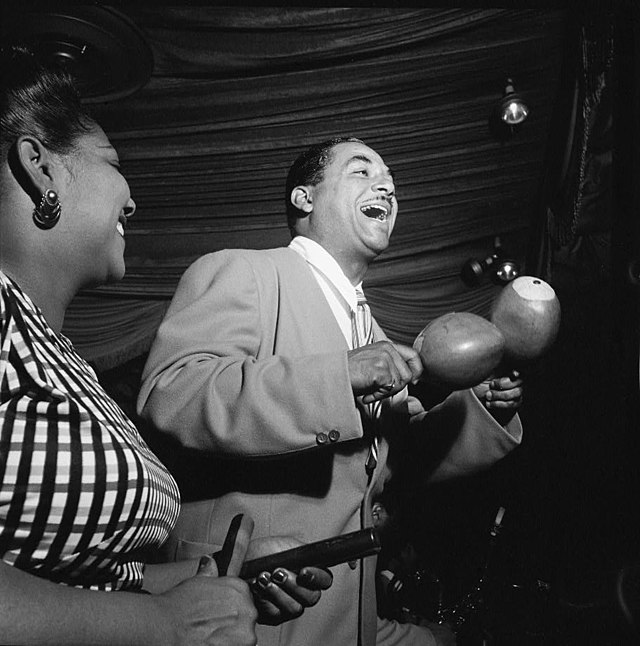
Machito
Jazz musicianWikipedia
33
MENTIONS
10
EPISODES
10
PODCASTS
Search complete. 33 mentions across 10 episodes found for "Machito".
Nov 6, 2026

Tony FletcherGUEST
He seemed to be able to take all of it in the commercial end, the real end, and realized that, um, his future lay in playing jazz and he was smart enough to become not just an important band leader but he is actually central in the discovery and I would say the success of Dizzy Gillespie and Charlie Parker as well.
Tony FletcherGUEST
I mean, that's as well as his own group, which is ultimately called Machito.
Tony FletcherGUEST
Machito's Afro-Cubans after his brother-in-law, who he brought over from Cuba to front the Afro-Cubans.
Nate WilcoxHOST
And let's go ahead and hear a little bit of music.
Nate WilcoxHOST
This is Cab Calloway featuring Dizzy Gillespie and Mario Baza in the band.
8 MINS LATER
Tony FletcherGUEST
Like I say, Bowser brought over his, uh, uh, brother-in-law, he brought over his sister and his brother-in-law.
Tony FletcherGUEST
Um, sorry, it would have been his wife, wouldn't it? His wife and his brother-in-law.
Tony FletcherGUEST
And, um, yeah, Machito was a front man, a percussionist front man, who with him, they were able to put together their own orchestra that really is the first Afro-Cuban orchestra in the States, not just because of the name, but it just literally is the first.

Jon FaddisGUEST
I spoke about his love for rhythm a little bit earlier.
Jon FaddisGUEST
Mario Bausa, whom I played with when he was in Machito's band, and Dizzy were in Cab Calloway's band together.
Jon FaddisGUEST
Mario used to take Dizzy probably to Spanish Harlem to, what was it, Alberto Sacaraz, I think was the band leader.
Jay SweetHOST
And he

Felix ContrerasHOST
But the 1950s like being the most golden, the most resonant.
Felix ContrerasHOST
José Madera is the director of the band and his father was a founding member of Machito's Afro Cubans back in, I think it was the 30s or the 40s.
Felix ContrerasHOST
He played with Tito Puente for over 30 years.
Felix ContrerasHOST
Also on Bongo is a guy named Johnny Dandy Rodriguez, who just died a few years ago.
Felix ContrerasHOST
I want to play some old stuff so you can hear where they're coming from.
Felix ContrerasHOST
This is from 1951.
Felix ContrerasHOST
Machito's Orchestra playing Donde Estabas Tu.
Felix ContrerasHOST
Check out the way they run the horns.

Felix ContrerasHOST
With the 1950s like being the most golden, the most resonant.
Felix ContrerasHOST
Jose Madera is the director of the band and his father was a founding member of Machito's Afro Cubans back in, I think it was the 30s or the 40s.
Felix ContrerasHOST
He played with Tito Puente for over 30 years.
Felix ContrerasHOST
Also on Bongo is a guy named Johnny Dandy Rodriguez, who just died a few years ago.
Felix ContrerasHOST
I want to play some old stuff so you can hear where they're coming from.
Felix ContrerasHOST
This is from 1951.
Felix ContrerasHOST
Machito's Orchestra playing Donde Estabas Tu.
Felix ContrerasHOST
Check out the way they run the horns.

Vicky SolaHOST
At 4.30 Eastern Time, we will be speaking with José Madera and Chris V. Springer about the Mambo Legends Orchestra's newly released production, No Hay Que Hablar, Nuff Said.
Vicky SolaHOST
And, of course, we'll be playing tracks for you from that new production, Right now, as we always do, we continue with Tito Puente, Machito, Tito Rodriguez, and Eddie Palmieri to round out my Mount Rushmore that started at the top with Ray Barreto.
Vicky SolaHOST
Enjoy! Thank you.
Vicky SolaHOST
Tela
16 MINS LATER
Vicky SolaHOST
And it's always an honor.
Vicky SolaHOST
We want to also say hi to Ron and Joan's daughters, Julianne and Janine and Audrey and Tito Puente Jr.
Vicky SolaHOST
We heard Machito, No Tiene Tenerangia, and that was live at the Crescendo.
Vicky SolaHOST
After that, we listened to Tito Rodriguez and Rincón.

speaker_3UNKNOWN
Thank you.
Maria Clara MontoyaHOST
I hope you've enjoyed this rhythm cocktail that was Exuberante by Machito and Dizzy Gillespie.
Maria Clara MontoyaHOST
Earlier you could hear Autumn Lives, a classic from the Bill Evans Trio, and you can really hear the chemistry between Bill Evans and Scott LaFara in there.
Maria Clara MontoyaHOST
This is Corrientazo with Maria Clara on Voices Radio, and I still got a few more tunes for you in this hour.

Sid GribetzHOST
From there we went and heard what Bird and Symphony Sid told them was just some bop in a commercial kind of groove, and Bird just said, it's just sweet music.
Sid GribetzHOST
And that was Bird with Machito and his orchestra doing Okie Doke.
Sid GribetzHOST
Then we went to the classic repetition from the Norman Grand's deluxe presentation, the jazz scene, where Neil Hefti put together a large orchestra recorded in Carnegie Hall as a studio.
Sid GribetzHOST
And Bird wandered in and laid down a flight, a fancy, a wonderful Bird solo over Hill Hefty's repetition on the jazz scene.

Skip HellerGUEST
And then there were certain things I thought, like, Yma Sumac should have done this, you know.
Skip HellerGUEST
Yma Sumac should have done a version of Asia Minor by Machito.
Skip HellerGUEST
And so we, we did that, and, uh, now, as a matter of fact, Mariel Candelario just takes a wild piano solo on that.
Skip HellerGUEST
And, and I brought a, um, I brought, uh, this clarinet player called Ben Goldberg, who plays in a group called The New Klez- or used to play in a group called The New Klezmer Trio.

Paquito D'RiveraGUEST
So, uh, I was exposed to a bunch of different type of music since a very early age.
Paquito D'RiveraGUEST
So for me, for many years, though, there was no difference between Mozart and Machito.
Paquito D'RiveraGUEST
[laughs]
Robert MillerHOST
[laughs]