LZ experiment
62
MENTIONS
23
EPISODES
21
PODCASTS
Search complete. 62 mentions across 23 episodes found for "LZ experiment".
Sep 21, 2026

speaker_0NARRATOR
When the universe is mostly invisible, even one strange flash can change the conversation.
speaker_0NARRATOR
Today, we're diving into a fascinating development from the LZ collaboration at the Sanford Underground Research Facility.
speaker_0NARRATOR
Brian Keating recently spoke with Rick Gateskull from Brown University about a dark matter result that's exciting but still unresolved.
speaker_1NARRATOR
And what's striking here is how this discussion moves from 40 years of searching to literally one event.
speaker_1NARRATOR
Gates School starts by placing LZ in the long history of direct detection, emphasizing that one event is simply a start.
speaker_1NARRATOR
In rare event physics, you need more than a headline, right? A real signal has to survive statistics, background checks,
speaker_0NARRATOR
and time.
speaker_0NARRATOR
The field has spent decades testing models that once seemed natural but turned out incomplete.

Joshua P. WarrenHOST
So getting any evidence of this is a huge deal.
Joshua P. WarrenHOST
So they say that this detector under the ground there in South Dakota, this is called the LUX-ZEPLIN event, registered a single unusual particle event that's very difficult to explain using any kind of ordinary background noise.
Joshua P. WarrenHOST
And right now, the researchers are saying there's a 99.5% chance that this came from an unknown source rather than standard physics.
Joshua P. WarrenHOST
Wow, that's a-- You don't hear a scientist say that too often.

Daniel WhitesonHOST
And they make silly jokes about the name of the experiment [laughs] which really is very mockable.
Daniel WhitesonHOST
I mean, it's called the LZ experiment, which is short for the Lux-Zeplin experiment because it's a merger of two previous experiments, both of which are their own acronyms.
Kelly WeinersmithHOST
Oh, no.
Daniel WhitesonHOST
So it's an acronym of shortened versions of other acronyms, both of which are tortured.

Brian KeatingHOST
This is a very special and urgent lecture episode featuring my friend and professor at my alma mater, Rick Gaitskell.
Brian KeatingHOST
Joining us from Brown University, uh, Rick is the spokesperson of the LZ Collaboration, which stands for Lux -Zeppelin, which is located at the, uh, Sanford Facility in America.
Brian KeatingHOST
Uh, Denny Sanford was a friend.
Brian KeatingHOST
He lived here in La Jolla.
Rick GaitskellGUEST
Um, uh, I, I, I am gonna take the opportunity always to sort of re-remind people a little bit about why we're still [chuckles], uh, uh, engaged in looking for dark matter particles, even given that we've been looking for them for forty, forty years.
Rick GaitskellGUEST
And then, of course, as you, as you said, uh, we are actually sitting on an event.
Rick GaitskellGUEST
The-- An event has shown up in, in the LZ.
Rick GaitskellGUEST
Now, as anybody who, uh, sort of follows more closely, rare event searches, you know, one has to recognize that a single event is, is, you know, simply a, um, at the start, if you like.

Chad ScottPANELIST
It's, uh, it's been life-changing for me to go back to reading physical newspapers, even though it's from a newspaper from across the country.
Chad ScottPANELIST
But the LUX-ZEPLIN detector detected, uh, dark matter.
Chad ScottPANELIST
It, this is a, a, uh, a particle, I don't know if it's a particle accelerator or some sort of interesting, uh, piece of equipment.
Chad ScottPANELIST
Like, I'm a g- I'm a geopolitics warfare guy, I'm not a scientist.

Jim CooneyHOST
Now, it's very preliminary and probably isn't right, but it's exciting nonetheless.
Jim CooneyHOST
Uh, so this took place in an experiment, uh, called the LUX-ZEPLIN experiment.
Josh CaldwellHOST
I love it.
Jim CooneyHOST
I know.
Jim CooneyHOST
Uh, and I won't work out the, uh, the, the, the acronym.
Josh CaldwellHOST
That's okay.
Jim CooneyHOST
But the X in LUX-ZEPLIN is for xenon.
Jim CooneyHOST
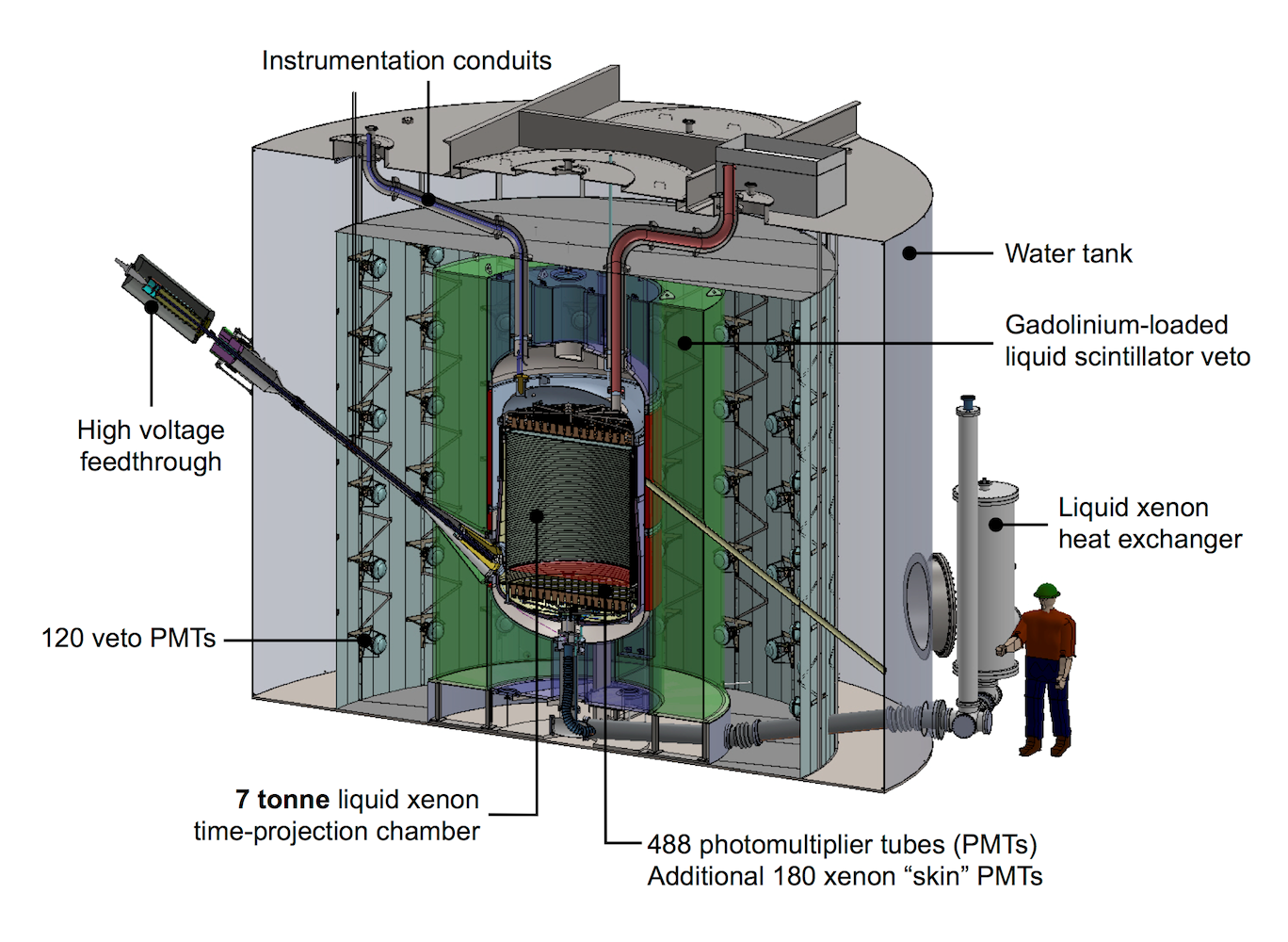
Basically, what this is, and th- this isn't the only one of these, we have a few of these running, uh, currently, but there's a, it's a big vat of xenon, liquid xenon, which is kind of cool, uh, uh, if you saw-

David BrownHOST
But a recent breakthrough provides the strongest evidence yet that the substance believed to make up 85% of the mass of the universe actually does in fact exist.
David BrownHOST
Scott Kravitz is an assistant professor of physics at UT Austin and a member of a team analyzing dark matter data for a collaboration called the LZ experiment.
David BrownHOST
He's here to explain why this dark matter discovery is so momentous.
David BrownHOST
Scott, welcome to the Texas Standard.
Scott KravitzGUEST
That's right.
Scott KravitzGUEST
It's been a real challenge detecting it here on Earth as opposed to just inferring it through its gravitational effects.
Scott KravitzGUEST
So I and a team of about 200 people have been working on this LZ experiment since about 2021, trying to detect it directly on Earth.
David BrownHOST
Has that been now accomplished? Do you have that sort of evidence? And can you tell us, for the laypersons in the audience, what is it that you have found?

Flora LichtmanHOST
And over the course of seven months or so, the researchers say they saw one very weird flash, a bump that doesn't look like it could have come from any particle we know of.
Flora LichtmanHOST
So as you might imagine, physicists are cautiously pumped about this finding, especially my next guest, Dr. Richard Gaitskell, a physicist at Brown University and the spokesperson for the LUX-ZEPLIN Dark Matter Experiment.
Flora LichtmanHOST
Richard, welcome to Science Friday.
Richard GaitskellGUEST
Thank you.

Madeleine FinlayHOST
Tell me about this experiment.
Ian SampleGUEST
This result is from what's called the LUX-ZEPLIN detector, the LZ detector, and it's one of the world's most sensitive dark matter detectors at the moment.
Ian SampleGUEST
It's built in an old gold mine in South Dakota.
Ian SampleGUEST
It's nearly a mile underground, and that's to shield it from a lot of the particle interactions, the lot of the noise that we were talking about earlier.

Tim DennisHOST
Nonetheless, scientists working at the Sanford Underground Research Facility in the US have recently revealed that they may have detected what could potentially be the first tantalizing signs of dark matter.
Tim DennisHOST
Findings come from data collected by, uh, LUX-ZEPLIN, or LZ.
Tim DennisHOST
They, they're a great cover band.
Tim DennisHOST
I don't know if you've ever heard of them before, Jessie, but they're amazing.
Jessi DoyleGUEST
That is a great cover band name, though.
Jessi DoyleGUEST
[laughs]
Tim DennisHOST
Yeah, LUX-ZEPLIN.
Tim DennisHOST
Uh, the lead singer sounds just like Plant.
13 more episodes mention LZ experiment.
Create an account to see the whole feed, search across every transcript, and follow the entities you care about.