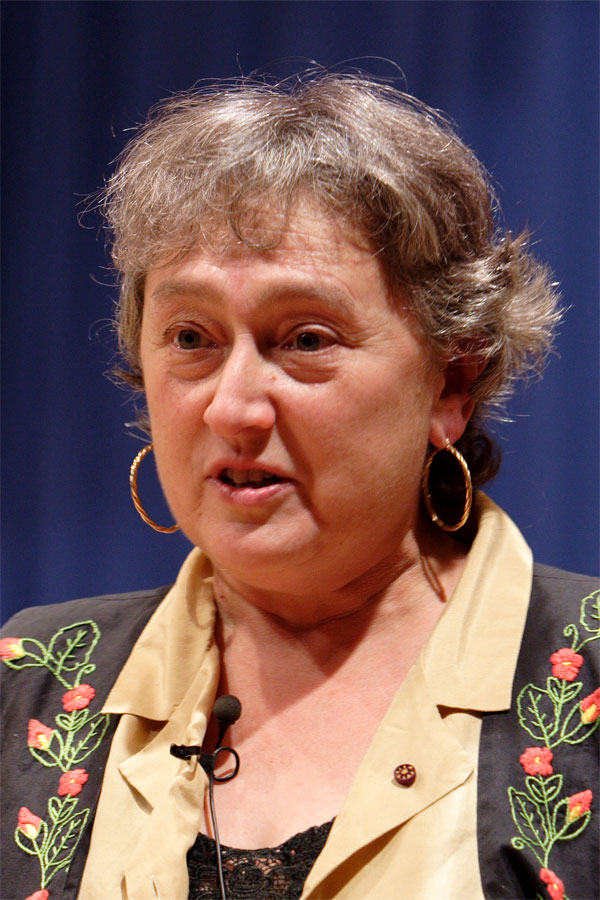
Lynn Margulis
American evolutionary biologistWikipedia
35
MENTIONS
17
EPISODES
17
PODCASTS
Search complete. 35 mentions across 17 episodes found for "Lynn Margulis".
Sep 30, 2026

HiroHOST
So there's the endosymbiotic theory, the idea that chloroplasts and mitochondria became symbionts within cells, which was the origin of complex cells.
HiroHOST
It was proposed by Lynn Margulis, a female biologist.
YatiHOST
And she's like Maria Montessori, intuitively sharp.
HiroHOST
But at the time, Darwinism was dominant in the scientific community.
HiroHOST
Endosymbiosis was proven correct.
HiroHOST
Such organisms were actually found.
HiroHOST
A bit of trivia, Lynn Margulis was the ex-wife of Carl Sagan, the astronomer and physicist who also wrote science fiction.
HiroHOST
A genius.

Jeremy RifkinGUEST
He said this.
Jeremy RifkinGUEST
And then, uh, Lynn Margulis, who I'm sure you know, who passed away recently, um, mentioned that even a single-cell organism is constantly, uh, not a substance, but a process, and it's constantly engaging, uh, with all of what's around them.
Jeremy RifkinGUEST
So this is, uh, the physicists know it, the chemists know it.
Jeremy RifkinGUEST
The biologists are a little bit behind, I must say.

Josh FixlerGUEST
Rabbi Evan Traylor at Congregation Beth Elohim in Brooklyn called on us to reconsider what declaring independence really means.
Josh FixlerGUEST
He writes that the idea of being separate and apart has taken root in our society, but the biologist Lynn Margulis notes, independence is a political, not a scientific term.
Josh FixlerGUEST
Biologically, we are not meant to be apart from other people, just as animals hunt in packs, fly in formation, and migrate in groups.
Josh FixlerGUEST
As human beings, we rely on each other for survival, for care, for support, for comfort, and for joy.

Perry MarshallHOST
The explanations were vacuous, and smoke and mirrors.
Perry MarshallHOST
And I suddenly had a epiphany when I discovered Barbara McClintock, Lynn Margulis, James Shapiro, Conrad Waddington, Evelyn Witkin.
Perry MarshallHOST
It took about two years to get there, but all of a sudden I discovered an enormous vein of literature that was very well documented that shows that organisms cut, splice, rearrange, re-engineer their DNA, respond to hostile situations at enormous speed, do merger acquisitions in real time, hours, not millions of years.
Perry MarshallHOST
And I was like, why isn't anybody talking about this? And so I ended up writing a book called Evolution 2.0, which came out in 2015.

Robyn WilliamsHOST
Who knows? Sharon Carleton will bring you their sometimes challenging stories, but let me just say a couple of were friends of mine.
Robyn WilliamsHOST
The first is or was Lynn Margulis.
Robyn WilliamsHOST
Now, if you're listening and awake, it's thanks to your mitochondria, energy organelles in your cells.
Robyn WilliamsHOST
If you're a plant, any green plant, you have chloroplasts in your cells making food for you and us.
Robyn WilliamsHOST
But soon, looking at his examples, so many were finding animal examples proving or not that traditional wives like chimps or magpies and alpha males were like that because they're still apish or cocksure.
Robyn WilliamsHOST
And so to their stories with Sharon Carleton.
Dorian SaganSOUNDBITE_SPEAKER
Lynn Margulis's science took her and us with it along for a once-in-a-lifetime ride back into the time of Earth's earliest beginnings when, as she never tired of pointing out, so very much had happened.
Sharon CarletonCORRESPONDENT
Dorian Sagan talking about his mother, Lynn Margulis.

Robin WilliamsHOST
Who knows? Sharon Carleton will bring you their sometimes challenging stories, but let me just say a couple of were friends of mine.
Robin WilliamsHOST
The first is or was Lynn Margulis.
Robin WilliamsHOST
Now, if you're listening and awake, it's thanks to your mitochondria, energy organelles in your cells.
Robin WilliamsHOST
If you're a plant, any green plant, you have chloroplasts in your cells making food for you and us.
Robin WilliamsHOST
But soon, looking at his examples, so many were finding animal examples proving or not that traditional wives like chimps or magpies and alpha males were like that because they're still apish or cocksure.
Robin WilliamsHOST
And so to their stories with Sharon Carleton.
Dorian SaganSOUNDBITE_SPEAKER
Lynn Margulis's science took her and us with it along for a once-in-a-lifetime ride back into the time of Earth's earliest beginnings when, as she never tired of pointing out, so very much had happened.
Sharon CarletonCORRESPONDENT
Dorian Sagan talking about his mother, Lynn Margulis.

Jonathan LohGUEST
So the accepted theory now... was developed over the 20th century by various people.
Jonathan LohGUEST
But the person who's famous for really nailing it was an American microbiologist called Lynn Margulis in the 1960s.
Jonathan LohGUEST
And she looked at some of these organelles like mitochondria.
Jonathan LohGUEST
under the microscope and said, you know what, these mitochondria, they actually look very much like bacteria.

Petra DavelaarGUEST
And Logan has taken this to a different level.
Petra DavelaarGUEST
He has named this the Ninem-Margulis synthesis, where it is his understanding that yes, the mitochondrial membrane is indeed glycocalyx, But the inner membrane is as a result of endosymbiosis, exactly as described by Lynn Margulis.
Petra DavelaarGUEST
And so that is his synthesis of this whole membrane story.
Petra DavelaarGUEST
Yeah, it's pretty incredible.

Rowan HooperGUEST
How can it possibly be bacteria? This is a complex cell.
Rowan HooperGUEST
They belittled people who tried to claim that the mitochondria were bacteria until finally Lynn Margulis, famously got enough evidence over the line.
Rowan HooperGUEST
So this was in the 60s in the US.
Rowan HooperGUEST
She showed enough times, enough evidence that these little tiny things really were originally bacteria that had been incorporated into this epic act of symbiosis some two billion years ago.

SammyHOST
In other words, we think that that's what led to the cells that allow bugs, bananas, and bears to exist.
SammyHOST
Scientists had long believed that this could be the case, but it wasn't until the 1960s that the idea of endosymbiosis as the origin for eukaryotic cells really took off, thanks to evolutionary biologist and zoologist Dr. Lynn Margulis.
SammyHOST
Margulis, drawing on the work of many scientists before her, hypothesized that both mitochondria and chloroplasts were descended from remnants of the prokaryotic cells that had merged in an endosymbiotic relationship.
SammyHOST
But what she had that earlier scientists didn't were the right tools, thanks to advancements in microscope technology which helped her present experimental evidence to back up the hypothesis.
7 more episodes mention Lynn Margulis.
Create an account to see the whole feed, search across every transcript, and follow the entities you care about.