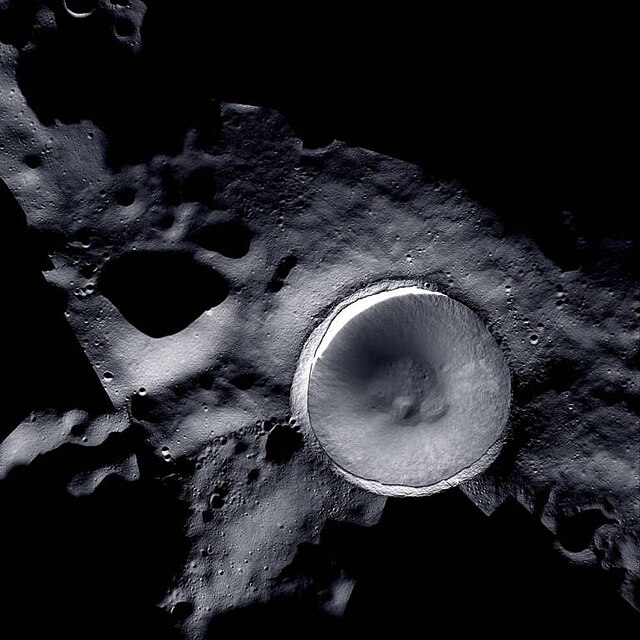
Lunar south pole
80
MENTIONS
19
EPISODES
17
PODCASTS
Search complete. 80 mentions across 19 episodes found for "Lunar south pole".
Nov 4, 2026

speaker_2NARRATOR
A lunar base located near the South Pole Near the permanently shadowed craters and their ice deposits could potentially mine its own propellant from the eternal darkness, refueling spacecraft for missions deeper into the solar system without the enormous cost of launching that fuel from Earth's deep gravity well.
speaker_2NARRATOR
This is why the South Pole of the Moon, specifically the rim of Shackleton Crater and the surrounding highland terrain near the permanently shadowed regions, is the target of NASA's Artemis program, of China's Chang'e program, and of multiple commercial lunar landers.
speaker_2NARRATOR
The South Pole is not just scientifically interesting, it is strategically valuable.
speaker_2NARRATOR
It is the first gas station on the road to Mars.

Mike WallHOST
I mean, Gimli is 2031, if all goes well, and then maybe follow up kind of exploration with this kind of other, this robot that might go into lava tubes.
Mike WallHOST
Does this timeline potentially line up with NASA's Artemis plans? I mean, and also Artemis is looking more at the South Pole.
Mike WallHOST
Do we know about... like any lava tubes in the south polar region? How does kind of Gimli mesh with what NASA already is trying to do with Artemis?
Than PutzigGUEST
Sure.

Mike WallHOST
Gimli is 2031, if all goes well, and then maybe follow-up exploration with this robot that might go into lava tubes.
Mike WallHOST
Does this timeline potentially line up with NASA's Artemis plans? Also, Artemis is looking more at the South Pole.
Mike WallHOST
Do we know about... like any lava tubes in the South Polar region? How does kind of Gimli mesh with what NASA already is trying to do with Artemis?
Than PutzigGUEST
Sure.

Mike WallHOST
I mean, Gimli is 2031, if all goes well, and then maybe follow up kind of exploration with this kind of other, this robot that might go into lava tubes.
Mike WallHOST
Does this timeline potentially line up with NASA's Artemis plans? I mean, and also Artemis is looking more at the South Pole.
Mike WallHOST
Do we know about... like any lava tubes in the south polar region? How does kind of Gimli mesh with what NASA already is trying to do with Artemis?
Than PutzigGUEST
Sure.

Orion InasekGUEST
so there's two really important sections towards the end of the moon and mars architecture definition document and those are the data gaps and the technology gaps the data gaps identify things that we don't really know enough about to even start to design solutions for right so we can't really start designing solutions for an environment if we don't know what that environment is So the data gaps spell out some of these things that NASA has identified and really the broader community of people involved in the Moon to Mars architecture have identified as things that we need to know more about before we can even start engineering solutions.
Orion InasekGUEST
Things like how much ice is in the you know, south polar region, the geotechnical properties of the regolith at the South Pole.
Orion InasekGUEST
What's the radiation environment like? What are the distribution of volatiles and other chemicals on the lunar surface itself and near the lunar surface? And a really big one for later on down the road when we get to Mars is what is the weather on Mars?
Scott ManleyHOST
So so, you know, you talked about the data gaps.
Ryan InasekGUEST
Data gaps identify things that we don't really know enough about to even start to design solutions for.
Ryan InasekGUEST
Things like how much ice is in the South Polar region, the geotechnical properties of the regolith at the South Pole.
Ryan InasekGUEST
And a really big one for later on down the road when we get to Mars is what is the weather on Mars, right? We need to be able to predict the weather in order to be able to safely move astronauts around the surface of Mars.
Scott ManleyHOST
So you've talked about the data gaps.

Steve NerlichHOST
The Chinese National Space Agency solved this problem by launching the Chihueqiao satellites.
Steve NerlichHOST
Chihueqiao-1 was in a halo orbit around the Earth-Moon Lagrange Point-2 in order to support Cheng'i-4, the far side rover mission, while Chiaoweqiao 2 was put in an ellipse orbit that keeps it mostly over the Lunar South Pole.
Steve NerlichHOST
This is because Cheng'e 6 landed much nearer the Lunar South Pole, and the planned Cheng'e 7 and 8 missions will also land there.
Steve NerlichHOST
The Earth-Moon Lagrange Point 2 gives great coverage for most of the far side, but around the poles you'll need something extra.
Steve NerlichHOST
As we've discussed, Chang'e 4 achieved the first ever soft landing on the far side of the Moon in 2019 and also germinated the first seeds on the Moon, although these did not survive past the start of Chang'e 4's first lunar night.

Christopher McFaddenHOST
that if,
Peter CabauyGUEST
let's say, China puts a nuclear reactor on the lunar surface, what happens? Well, some of those interesting places that we want to go back and mine and explore, it's in the southern pole.
Peter CabauyGUEST
And within the Southern Pole, it's probably, I don't know, 5, 10, 15 places that are prime locations.
Peter CabauyGUEST
And we say, well, why can't we all go there? I mean, international law says that no one can own a piece of the moon.
Peter CabauyGUEST
But international law also lends itself or says that we have to respect boundaries where there's safety.

Will RogersCORRESPONDENT
And finally, the Australian Space Agency and the Ruver Consortium unveiled the latest design model of Ruver, Australia's first lunar rover, at the Queensland University of Technology's Lunar Testbed and Space Lab during World Space Week on October 7, 2026.
Will RogersCORRESPONDENT
Scheduled to land at the Lunar South Pole in 2030 aboard an Intuitive Machines lander under NASA's Commercial Lunar Payload Services program, the semi-autonomous rover will collect and analyze regolith to support sustainable human exploration through the Artemis program.
Will RogersCORRESPONDENT
Designed to withstand extreme lunar temperature swings from minus 246 degrees centigrade to plus 121 degrees centigrade, the vehicle features homegrown Australian technology, including specialized treaded wheels, thermal management systems, and tools to mitigate against lunar dust and radiation.
George BowenHOST
produced by amateurs for amateurs and originating from Albany, New York.
9 more episodes mention Lunar south pole.
Create an account to see the whole feed, search across every transcript, and follow the entities you care about.