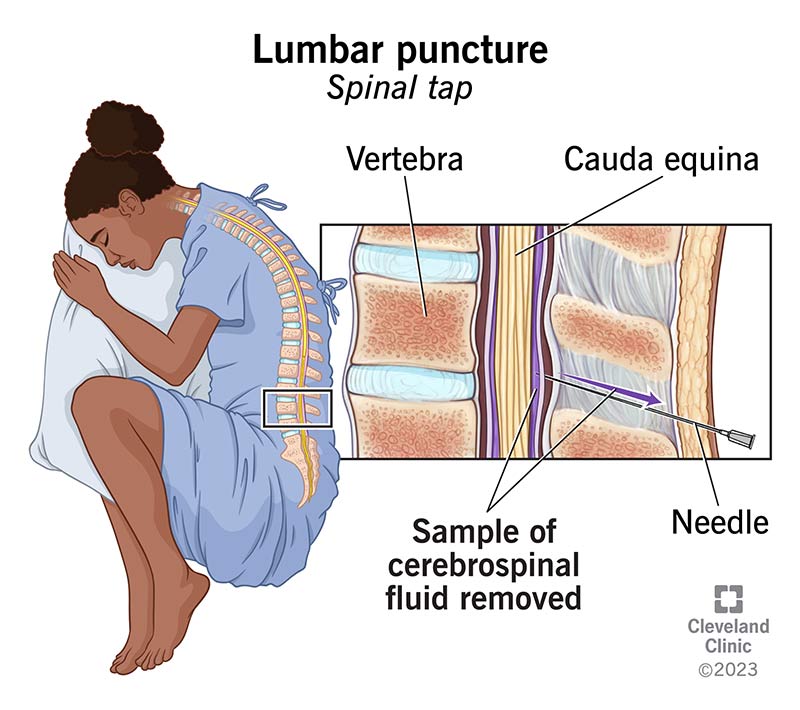
Lumbar puncture
Medical testWikipedia
17
MENTIONS
5
EPISODES
5
PODCASTS
Search complete. 17 mentions across 5 episodes found for "Lumbar puncture".
Oct 9, 2026

Professor DHOST
Okay.
Professor DHOST
The nurse is caring for a client who's scheduled for a lumbar puncture.
Professor DHOST
It would be most important for the nurse to assess the client for one, bowel bladder function, two, presence of true soul sign, three, signs of increased intracranial pressure, or four, circulation movement sensation of the legs.
Professor DHOST
And the correct answer is signs of increased intracranial pressure.
Professor DHOST
Let me tell you something, and you need to know this.
Professor DHOST
Having increased intracranial pressure, lumbar puncture is an absolute contraindication.
Professor DHOST
And here's why.
Professor DHOST
If that patient has increased intracranial pressure and now you're withdrawing fluid, you can cause cerebral deviation.

Caroline VissersGUEST
So our test, in theory, could replace aspects of it, but it's going to be a long journey in understanding how the standard of care can change because MRIs are still very important for monitoring a patient longitudinally.
Caroline VissersGUEST
And so having an initial MRI is important to understand, are there new lesions forming? Is the disease progressing over time? So I don't imagine that we would replace that initial MRI, but we potentially could replace the spinal tap.
Caroline VissersGUEST
We could replace the multiple MRIs that people go through in a short period to try to get a diagnosis.
Caroline VissersGUEST
We could replace the numerous, numerous specialty visits that are required before a diagnosis can even be given.

speaker_0HOST
So cerebrospinal fluid, as mentioned, is an essential part of the workup and diagnosis here.
speaker_0HOST
Lumbar puncture remains a great and a safe test and I find probably too often deferred for concerns over bleeding risk or even just hassle factor.
speaker_0HOST
There are British Society of Haematology guidelines that have a recommendation of performing an LP when the platelets are greater than 40 and the INR as less than 1.5, so lose your cut-offs for doing an LP.
speaker_0HOST
The guidelines suggest antiplatelets, including even dual antiplatelet therapy, should not preclude LP if urgent.

Tony TarchichiHOST
It's incomplete evaluation for sepsis or rule-out serious bacterial infection in an infant under two months of age.
Tony TarchichiHOST
So this is an infant you get who is 60 days or younger, and they have a fever, and you're doing the rule-out serious bacterial infection workup, which includes a lumbar puncture.
Tony TarchichiHOST
And what we're seeing more and more of is lumbar punctures are being missed in the emergency department, partially because we're doing less of them because our guidelines are working.
Tony TarchichiHOST
So our colleagues are getting less practice, right? I mean, if you're old enough, you remember when you were in the ER, you would do one or two LPs per shift every time.
Tony TarchichiHOST
And now that is not the case.
Tony TarchichiHOST
And now, Zach, let's get into this.
Tony TarchichiHOST
So this is more and more of an issue.
Tony TarchichiHOST
And in your paper, you talk about it really nicely in that the number, if I'm not mistaken, and I want to get this right, is 35% of lumbar puncture attempts in infants under three months of age are either unsuccessful in getting spinal fluid or return with more than 10,000 red blood cells per ml.

Jennifer RichGUEST
And similar with a neurologic workout, we want to know where the problem is stemming from so that we're doing the tests that that pet needs, but we're not doing unnecessary tests that could also cause some harm to that patient.
Jennifer RichGUEST
So doing additional MRI scans that increases anesthetic time, doing a spinal tap before an MRI where we could cause some problems to that pet's intracranial pressures.
Jennifer RichGUEST
Or if you have a dog who doesn't need an MRI at all, let's say they have some progressive weakness.
Jennifer RichGUEST
But you talk with me first or talk with any neurologist first and we guide you to doing an acetylcholine receptor antibody test first, which is a blood test for myasthenia gravis.
Amy ArmentroutHOST
These neuro cases are not all that straightforward.
Amy ArmentroutHOST
Oh, yeah.
Jennifer RichGUEST
There's a couple situations with MR, too, where absolutely a primary care vet can refer a pet for an MRI and spinal tap.
Jennifer RichGUEST
Absolutely, that is something that you can do if you're comfortable with your localization.