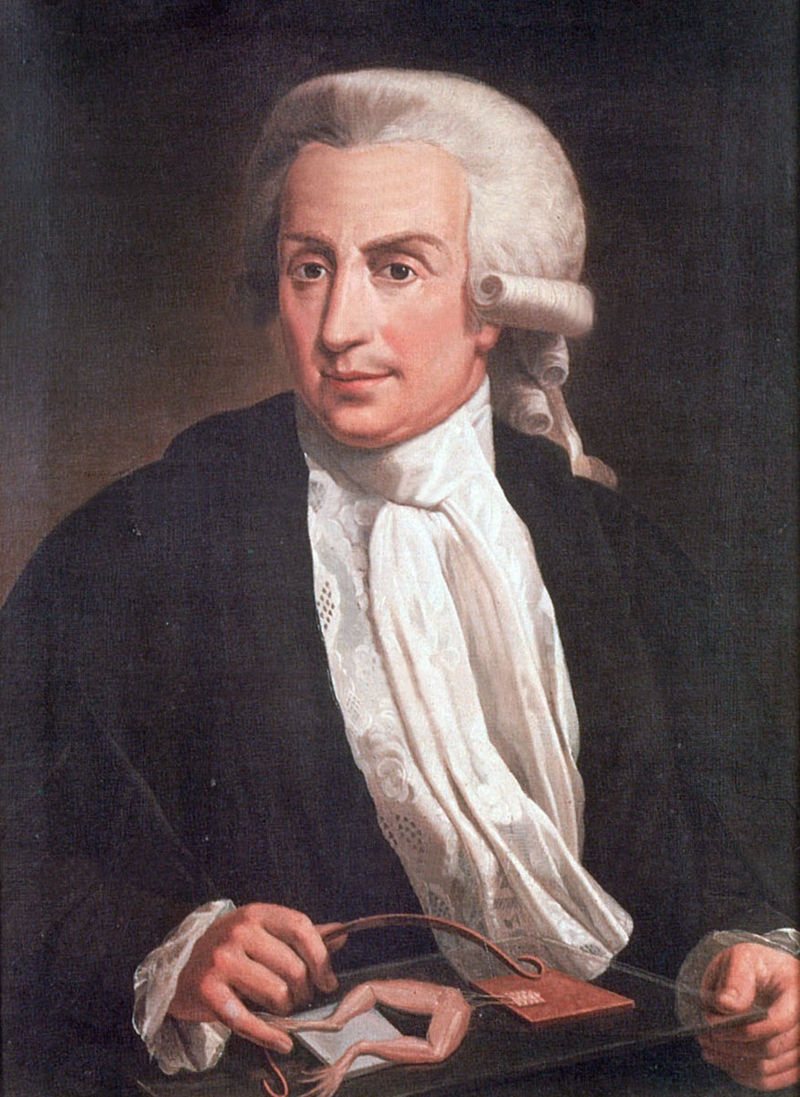
Luigi Galvani
Italian physician and physicistWikipedia
34
MENTIONS
21
EPISODES
21
PODCASTS
Search complete. 34 mentions across 21 episodes found for "Luigi Galvani".
Nov 18, 2026

Simon WhistlerNARRATOR
The observers concluded that the spasms were evidence that the body was still conscious after death.
Simon WhistlerNARRATOR
After Luigi Galvani published his findings on bioelectric magnetics in 1791, scientists started attaching electric probes to the muscles and nerves in decapitated heads to try and establish whether the person remained conscious following their execution.
Simon WhistlerNARRATOR
One of these gruesome experiments took place in Poland on the 25th of February 1803.
Simon WhistlerNARRATOR
Electrical probes were attached to the nerve endings of the freshly decapitated head of a criminal and it was then held up by an assistant while the probes were attached to a battery.

Ryan BuddsHOST
It's Gee Whiz question one.
Ryan BuddsHOST
In Pinocchio, what's the name of the old woodcarver who makes the puppet? In Pinocchio, what's the name of the old woodcarver who makes the puppet? Number two, what Greek sandwich features meat roasted on a vertical spit wrapped in pita with tzatziki? Number three, what rubber overshoes do you pull on over your shoes to keep them dry? What rubber overshoes would keep your shoes dry? Number four, what cold tomato soup comes from Andalusia in southern Spain? Number five, what outdoor treasure hunting hobby uses GPS coordinates to track down hidden containers? Number six, what word for coating steel with zinc or for shocking people into action comes from Italian scientist Luigi Galvani? Number seven, an Arthurian legend, which pure-hearted knight, son of Lancelot, finds the Holy Grail? Sir blank.
Ryan BuddsHOST
Number eight, what thick Louisiana stew, often made with okra and andouille sausage, takes its name from a West African word for okra? Number nine, what is the main male character's name in Meet the Parents? Number 10, what Eastern European country is also the name of a U.S.
Ryan BuddsHOST
state? And gee whiz, question bonus, two points at the end here.

Ben Schwab-EidelsonHOST
So let's travel to Italy in 1780.
Ben Schwab-EidelsonHOST
Luigi Galvani is a physician and anatomist at a university.
Ben Schwab-EidelsonHOST
And so he's sitting there dissecting a frog with a scalpel.
Ben Schwab-EidelsonHOST
The metal touches one of the frog's nerves and the leg kicks.
Ben Schwab-EidelsonHOST
When in fact, he just made a frog battery.
Anay ShahHOST
Hmm.
Ben Schwab-EidelsonHOST
Until after 10 more years of experiments, Galvani publishes a book about this.
Ben Schwab-EidelsonHOST
His claim is that the brain secretes this electric fluid, nerves carry it, and each muscle fiber stores this electric energy.

Addison AndersonNARRATOR
yet even the best batteries will diminish daily, slowly losing capacity until they finally die.
Addison AndersonNARRATOR
So why does this happen, and how do our batteries even store so much charge in the first place? It all started in the 1780s with two Italian scientists, Luigi Galvani and Alessandro Volta, and a frog.
Addison AndersonNARRATOR
Legend has it that as Galvani was studying a frog's leg, he brushed a metal instrument up against one of its nerves, making the leg muscles jerk.
Addison AndersonNARRATOR
Galvani called this animal electricity, believing that a type of electricity was stored in the very stuff of life.

Kyle WoodHOST
The first true electric battery was invented in 1800 to settle a scientific argument about what was causing a dead frog's legs to twitch.
Kyle WoodHOST
In the 1780s, an Italian physician named Luigi Galvani discovered that when he touched the sciatic nerve of a dissected frog leg with a steel scalpel while the leg rested on a brass hook, the muscle contracted as if it were alive.
Kyle WoodHOST
Galvani concluded that the animal tissue must have its own built-in supply of electricity, which he called animal electricity.
Kyle WoodHOST
But another prominent scientist, Alessandro Volta, doubted Galvani's theory.
Kyle WoodHOST
Within eight years, chemists like Humphrey Davy were able to break down compounds and isolate six new elements on the periodic table, including sodium, potassium, calcium, and magnesium.
Kyle WoodHOST
In 1881, the International Electrical Congress honored both rivals from that frog-leg debate.
Kyle WoodHOST
They named the unit of electrical pressure the volt, after Alessandro Volta, and the instrument used to detect small electrical currents the galvanometer, after Luigi Galvani.
Kyle WoodHOST
Number three, while modern batteries were invented in the 19th century, people in Mesopotamia built a clay jar that could generate a small electric current about 2,000 years ago.

Shelby MelansonHOST
Perhaps the component parts of a creature might be manufactured, brought together, and imbued with vital warmth.
Shelby MelansonHOST
A quick note, the term galvanism she's referring to here describes an 18th century belief based on some experiments done by an Italian doctor named Luigi Galvani.
Shelby MelansonHOST
Basically, he noticed how the leg muscles of a dead frog would twitch and contract when an electrical current was run through the animal's spinal cord.
Shelby MelansonHOST
He called it animal energy and interpreted the twitching as proof that there was an innate electrical force in living beings.

Shelby MelansonHOST
Perhaps the component parts of a creature might be manufactured, brought together, and imbued with vital warmth.
Shelby MelansonHOST
A quick note, the term galvanism she's referring to here describes an 18th century belief based on some experiments done by an Italian doctor named Luigi Galvani.
Shelby MelansonHOST
Basically, he noticed how the leg muscles of a dead frog would twitch and contract when an electrical current was run through the animal's spinal cord.
Shelby MelansonHOST
He called it animal energy and interpreted the twitching as proof that there was an innate electrical force in living beings.
11 more episodes mention Luigi Galvani.
Create an account to see the whole feed, search across every transcript, and follow the entities you care about.