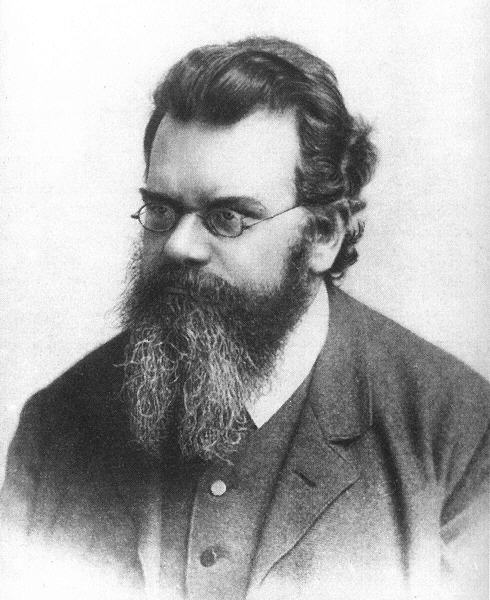
Ludwig Boltzmann
Austrian mathematician and theoretical physicistWikipedia
131
MENTIONS
34
EPISODES
28
PODCASTS
Search complete. 131 mentions across 34 episodes found for "Ludwig Boltzmann".
Sep 17, 2026

Matt O'DowdHOST
Marco Dalla Gasperina points out that the nothing can be defeated with the help of the luck dragon.
Matt O'DowdHOST
Is that a metaphor for quantum fluctuations in impossibly distant futures spontaneously generating a new Big Bang by pure chance? Or do you mean that while we're waiting through the infinite future for a new Big Bang, quantum fluctuations will produce all sorts of weird things first, like Boltzmann brains and Falcor? Valid point.
Matt O'DowdHOST
Maybe Artax will come back too.
Matt O'DowdHOST
I hope so.

Robert Lawrence KuhnHOST
I mean, these are not 100% proof.
Robert Lawrence KuhnHOST
There could be, you know, Boltzmann's brains or whatever, suddenly.
Robert Lawrence KuhnHOST
popping into existence.
Robert Lawrence KuhnHOST
So I think it's a window into a way of thinking that just needs to be more specified as people have the diverse views.

Carlo RovelliGUEST
You're right that it's a rare, um, situation among current theoretical physicists.
Carlo RovelliGUEST
Uh, I would say if you, uh, if you take away the current and if you look more widely and you look at the great, uh, physicists, in fact, the great scientists of the world, uh, then the sentence become totally wrong, right? Uh, if you think about, uh, Einstein or Maxwell or Boltzmann or Newton or, or Darwin, uh, let's get out of physics, uh, uh, and so many other major, uh, thinkers, uh, in, in strictly scientific disciplines, uh, uh, the first thing you are very surprised is that they're enormously interested in philosophy.
Carlo RovelliGUEST
Uh, I, I, I, I don't wanna go as far as say all of them because that... certainly you can find some that are completely technical and totally disi- non-interested in philosophy or even, uh, coming out with, uh, strongly disparaging comments on philosophy like Hawking, uh, Stephen Hawking, who, who, who said philosophy's dead because now we have science.
Carlo RovelliGUEST
Uh, but, but I think that's, uh, plain nonsense.

speaker_3HOST
But before we close out this exploration, I want to leave you listening with one final, deeply provocative wrinkle that builds on everything we've discussed about the fragility of consciousness and reality.
speaker_4HOST
We've talked about external threats and the breakdown of physics, but there is a concept in thermodynamics called the Boltzmann brain.
speaker_3HOST
Oh, this is a perfect place to end.
speaker_3HOST
This completely recontextualizes the whole conversation.
speaker_4HOST
The Boltzmann brain paradox suggests that given an infinite amount of time and the random quantum fluctuations of a chaotic universe, it is mathematically far more likely for a single, fully formed human brain to spontaneously assemble out of random particles in the void of space, complete with false memories of a life on Earth than it is for the entire highly structured universe to have actually evolved from the Big Bang.
speaker_3HOST
Let that really sink in for a second.
speaker_3HOST
It means that it is statistically far more probable that Earth, human history, the stars, the alien threats we've discussed, and the very podcasts you're listening to right now don't actually exist.

SamHOST
Heat cracks the clockwork universe?
AlexHOST
In the second half of the 1800s, a physicist named Ludwig Boltzmann did something that should sound impossible on its face.
AlexHOST
He built the ironclad, rock-solid laws of thermodynamics, the laws engineers still use to design real engines today, directly out of the assumption that a gas is a chaos of countless molecules whose individual paths we neither know nor track.
SamHOST
Wait, so the law that says heat flows from hot to cold, that your coffee cools down and never spontaneously reheats itself, that's not some fundamental commandment carved into the universe?
SamHOST
So the clock was already made of dice a full generation before anyone got anywhere near quantum mechanics.
AlexHOST
Physics just hadn't been forced to admit yet that the dice went all the way down.
AlexHOST
And notice what Boltzmann actually built with that.
AlexHOST
This wasn't a hand-wavy, "Eh, it's probably fine on average." Thermodynamics is engineering grade.

Grant VenerableGUEST
If God is, these attempts to address challenge by early humans posed by increasing pl- complexities resulted in unseemly behaviors and legislated actions, cult- cul- culminating in even more complexity and more misery, especially in education and social welfare.
Grant VenerableGUEST
This outcome was anticipated by the insights of 19th century physicist Ludwig Boltzmann and his equation for predicting entropy, which is another word for chaos-
Jill NicoliniHOST
Mm-hmm
Grant VenerableGUEST
... that scientists use.

Sean CarrollHOST
Daryl Cutting asks a priority question.
Sean CarrollHOST
You recently discussed how the theory of Boltzmann brains is causing some concern in theoretical cosmological physics today.
Sean CarrollHOST
I do have difficulty in conceiving how such objects could be amassed materially from the increasingly diffuse atoms in the effectively infinite future.
Sean CarrollHOST
Dark energy is causing acceleration of the expansion of the universe.
Sean CarrollHOST
Isn't it possible that the reduction in matter density will be fast enough to outstrip any possible clumping of a complex random fluctuation such as a macroscopic brain, which requires actual atoms whose protons have not yet been decayed even given infinite time? Well, that would be completely true if the world were classical, but the world is quantum mechanical, and that changes things.
Sean CarrollHOST
The point of, um, the Boltzmann brain problem is, you know, it didn't become a problem until we discovered the cosmological constant in 1998, until we discovered the acceleration of the universe.
Sean CarrollHOST
And again, it still is only a problem if it truly is a cosmological constant.
Sean CarrollHOST
If it's gonna be a temporary dark energy that decays away, then the Boltzmann brain problem goes away b- basically because the universe doesn't accelerate forever.
speaker_7HOST
It is a brilliant paradox.
speaker_7HOST
The Austrian physicist Ludwig Boltzmann cracked this in the late 19th century.
speaker_7HOST
He realized that the glass unshattering isn't violating a fundamental law of motion.
speaker_7HOST
Every atom in that reverse video is obeying Newton's laws perfectly.

Theo WrenfieldNARRATOR
In the weeks that followed, Planck worked to find a theoretical foundation for his formula.
Theo WrenfieldNARRATOR
He employed the methods of statistical mechanics, the powerful framework developed by Ludwig Boltzmann that described the behavior of matter in terms of probability and large numbers of particles.
Theo WrenfieldNARRATOR
Planck had to count the possible ways that energy could be distributed among the oscillators in his theoretical blackbody, the tiny charged particles in the walls that absorbed and emitted radiation.
Theo WrenfieldNARRATOR
And here, to make the mathematics work, Planck did something strange.

Kelly BeshearNARRATOR
In the interests of clearness it appeared to me inevitable that I should repeat myself frequently without paying the slightest attention to the elegance of the presentation.
Kelly BeshearNARRATOR
I adhered scrupulously to the precept of that brilliant theoretical physicist L. Boltzmann, according to whom matters of elegance ought to be left to the tailor and to the cobbler.
Kelly BeshearNARRATOR
I make no pretense of having withheld from the reader difficulties which are inherent to the subject.
Kelly BeshearNARRATOR
On the other hand, I have purposely treated the empirical physical foundations of the theory in a stepmotherly fashion so that readers unfamiliar with physics may not feel like the wanderer who was unable to see the forest for the trees.
29 MINS LATER
Peter EastmanNARRATOR
The assumption that this velocity of propagation is dependent on the direction in space is in itself improbable.
Peter EastmanNARRATOR
In short, let us assume that the simple law of the constancy of the velocity of light c in vacuum is justifiably believed by the child at school.
Peter EastmanNARRATOR
Who would imagine that this simple law has plunged the conscientiously thoughtful physicist into the greatest intellectual difficulties? Let us consider how these difficulties arise.
Peter EastmanNARRATOR
Of course, we must refer the process of the propagation of light, and indeed every other process, to a rigid reference body, coordinate system.
24 more episodes mention Ludwig Boltzmann.
Create an account to see the whole feed, search across every transcript, and follow the entities you care about.