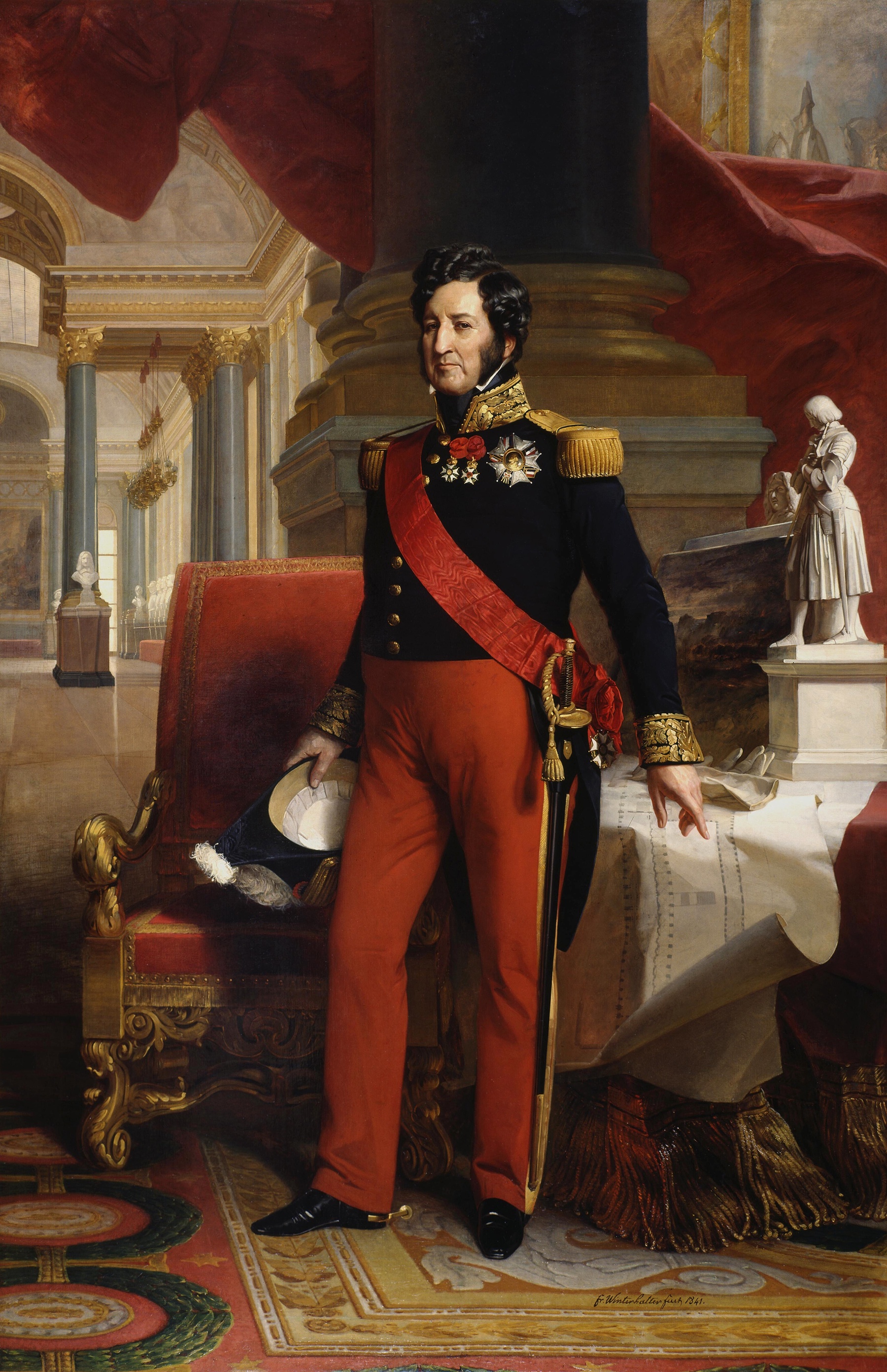
Louis Philippe I
Former King of the FrenchWikipedia
154
MENTIONS
16
EPISODES
16
PODCASTS
Search complete. 154 mentions across 16 episodes found for "Louis Philippe I".
Oct 27, 2026

Claudine HemingwayHOST
The Luxor Obelisk and its pair date back to the 13th century B.C. and was created at the request of Ramses II.
Claudine HemingwayHOST
On October 25th, 1836, 190 years ago this week, the long-awaited obelisk was erected and inaugurated by Louis-Philippe in the center of the Place de la Concorde, the virtual epicenter of Paris.
Claudine HemingwayHOST
But how did it get here and why? Well, that's what I'm here to share with you.
Claudine HemingwayHOST
It all begins with a very handsome Frenchman named Jean-François Champollion.
Claudine HemingwayHOST
The next day, France would slip into the Three Glorious Day revolution.
Claudine HemingwayHOST
Listen to the past episode number 29 for more.
Claudine HemingwayHOST
Louis-Philippe, king of the French, took the throne on August 9, 1830, and later accepted Muhammad Ali's gift, ordering its transport back to France.
Claudine HemingwayHOST
Le Bas, instrumental in the ship's construction, took charge of the land operation and the removal of the obelisk.

Pamela NagamiNARRATOR
The embodiment of the revolution, he was felt to be a potential saviour to his country, threatened with a restoration of the ancien régime.
Pamela NagamiNARRATOR
Even such calm observers of men and matters as Taillerol, and such experienced statesmen as Baron Louis, recognized, and not silently, that the substitution of Louis Philippe for Charles X was more than merely within the range of practical politics.
Pamela NagamiNARRATOR
And in face of such general opposition the government did nothing effective.
Pamela NagamiNARRATOR
A few changes in the personnel of the ministry were made, apparently with the idea of reassuring the mind of France.
8 MINS LATER
Pamela NagamiNARRATOR
A demonstration by the National Guard toward Rambouillet, where the king yet lingered, terrified the royal family, and Charles, trembling for his life, fled to the coast and thence to England, August 14th, 1830.
Pamela NagamiNARRATOR
The demonstration had been deliberately intended to produce this result and to facilitate the accession of the Duke of Orleans to the vacant throne.
Pamela NagamiNARRATOR
That this should be the issue of the revolution had not been the desire of its original authors, nor were the opponents of Charles X unanimous in their support of Louis Philippe.
Pamela NagamiNARRATOR
Cavaignac, upon whom the leadership of the movement had first devolved, was a declared republican, and his eventual acceptance of the Orleanist monarchy was due, as he himself said, to necessity and not to choice.

Brion McClanahanHOST
And the reason being is because France was able to engage and get some of the more established political order on board with them.
Brion McClanahanHOST
And that led to the citizen king, Louis-Philippe.
Brion McClanahanHOST
They ousted the monarchists, or at least the ancient monarchists.
Brion McClanahanHOST
The Bourbons were gone in 1830.

Edward ShawcrossGUEST
He's overthrown.
Edward ShawcrossGUEST
Louis-Philippe comes to power and he's slightly more exciting than the Bourbons.
Edward ShawcrossGUEST
He's meant to be a vaguely liberal constitutional monarchy.
Edward ShawcrossGUEST
But he is so uninspiring that he's just frequently referred to as the pear because he resembles a kind of rotting pear.
Edward ShawcrossGUEST
How does this happen? Yeah, so it's an astonishing journey, and we have to simplify because there's so much to get through.
Edward ShawcrossGUEST
So after that first failed coup d'etat, it's so ridiculous.
Edward ShawcrossGUEST
It's so much the king, Louis-Philippe, the pair, sees it almost like a gap year gone wrong, right? It would be absurd to put him on trial and execute him, right? This is the kind of thing that teenagers get up to, so fine.
Edward ShawcrossGUEST
Well, next time to the United States of America.

Jon WallachPANELIST
Oh, Fred, uh, I think most of us know that, uh, this is an adventure novel, uh, serial- serialized in the mid-1800s, and it's set in France during the historical events, uh, between 1815 and 1839.
Jon WallachPANELIST
The era of the Bourbon Restoration through the region of, uh, Louis-Philippe I.
Fred ToucherHOST
All right, maybe we start a little less, uh, adventurous.
Fred ToucherHOST
Maybe we go, uh-

speaker_2NARRATOR
Despite this Austrian proposal, none of the famously independent Swiss cantons were willing to grant her refuge, believing her presence there would be disruptive.
speaker_2NARRATOR
And eventually, she persuaded her cousin, Stephanie de Beauharnais, wife of the Grand Duke of Baden in the far south of Germany, to allow her to live in the town of Constance on the northern shore of Lake Constance.
speaker_2NARRATOR
During her search for a permanent residence, Hortense came upon a small castle in Switzerland on the opposite shore of the lake called Arenenberg and agreed to purchase it in February 1817, though she could only use it as a summer residence until she received consent from the Allied Powers to live there all the year round.
speaker_2NARRATOR
The same month, Hortense and Louis-Napoleon were ordered to leave Baden, and in May they made the journey to Augsburg in Bavaria, whose king was Eugène de Beauharnais' father-in-law.
6 MINS LATER
speaker_2NARRATOR
His fate would change late in 1830 during what was initially a routine winter break in Rome.
speaker_2NARRATOR
Upon arrival in Rome he found that his elder brother had become a committed revolutionary.
speaker_2NARRATOR
A few months earlier in July the unpopular Bourbon king Charles X was deposed in France in a revolution and replaced by a distant cousin, King Louis Philippe I.
speaker_2NARRATOR
While the new king confirmed a prohibition from 1816 preventing the Bonapartes from returning to France, clandestine revolutionaries were also active in Italy which remained a disunited collection of princely states.

Michael TroyHOST
He also briefly served as First Minister of State after Napoleon was removed from power, and later as Prime Minister.
Michael TroyHOST
He ended his career as Ambassador to Britain in the 1830s under King Louis-Philippe I.
Michael TroyHOST
My book recommendation is The XYZ Affair, 1797-1798 by Harold Vaughn.
Michael TroyHOST
This is a very short book, less than 100 pages, and it's an older book, first published in 1972, but it covers the issue very well.

Pamela NagamiNARRATOR
The embodiment of the revolution, he was felt to be a potential saviour to his country, threatened with a restoration of the ancien régime.
Pamela NagamiNARRATOR
Even such calm observers of men and matters as Talleyrand, and such experienced statesmen as Baron Louis, recognized, and not silently, that the substitution of Louis Philippe for Charles X was more than merely within the range of practical politics.
Pamela NagamiNARRATOR
And in face of such general opposition the government did nothing effective.
Pamela NagamiNARRATOR
A few changes in the personnel of the ministry were made, apparently with the idea of reassuring the mind of France.
8 MINS LATER
Pamela NagamiNARRATOR
A demonstration by the National Guard toward Rambouillet, where the king yet lingered, terrified the royal family, and Charles, trembling for his life, fled to the coast and thence to England, August 14th, 1830.
Pamela NagamiNARRATOR
The demonstration had been deliberately intended to produce this result and to facilitate the accession of the Duke of Orléans to the vacant throne.
Pamela NagamiNARRATOR
That this should be the issue of the revolution had not been the desire of its original authors, nor were the opponents of Charles X unanimous in their support of Louis Philippe.
Pamela NagamiNARRATOR
Cavaignac, upon whom the leadership of the movement had first evolved, was a declared republican, and his eventual acceptance of the Orléanist monarchy was due, as he himself said, to necessity and not to choice.
6 more episodes mention Louis Philippe I.
Create an account to see the whole feed, search across every transcript, and follow the entities you care about.