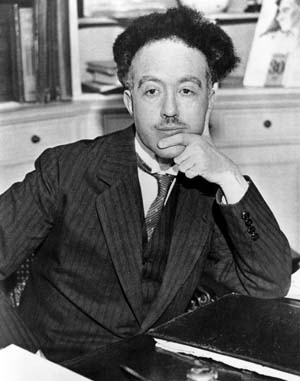
Louis de Broglie
French theoretical physicistWikipedia
58
MENTIONS
22
EPISODES
10
PODCASTS
Search complete. 58 mentions across 22 episodes found for "Louis de Broglie".
Nov 4, 2026

speaker_0NARRATOR
But a French aristocrat would come up with a creative idea that would ultimately explain why the rules worked and would pave the way for the next atomic model.
speaker_0NARRATOR
Louis Victor de Broglie was born in 1892 in Dieppe, the younger son of the 5th Duke de Broglie, in one of the oldest noble families in France.
speaker_0NARRATOR
Letters written by his elder sister described him as a lively, charming, and precocious child with a pronounced flair for the dramatic.
speaker_0NARRATOR
His sister imagined a bright future for him as a statesman, since as a child he loved history and politics.

Danny SheehanHOST
This radical materialist worldview had dominated and undergirded the entire sense of reality on the part of our Western civilization, at least, ever since 1647, even though it had been destabilized, that worldview, by the discoveries that were made between 1923 and 1927 in the realm of quantum physics.
Danny SheehanHOST
These were the discoveries that were made by Louis de Broglie, Max Planck, Niels Bohr, Max Born, Werner Heisenberg, Erwin Schrödinger, this group of people, the physicists that were, that because they had gained access to the electron diffraction apparatus, a microscope that was able to see down into the inner workings of the atomic structure of matter, that they began to discover that there were limitations on the clarity of the assertions that were being made by the scientific materialist worldview of Descartes and Newton.
Danny SheehanHOST
This earlier enlightened scientific worldview, as I say, had purportedly established as a fact that our material universe works entirely separately and distinct from any consciousness on our part, any human intentions at all, that our physical universe runs like a machine, like a clockwork machine, and it's governed exclusively by the predetermined laws of physics, and that this had provided a convincing operational systematic worldview, free of superstition and magic, and that this had lasted since actually 1687.
Danny SheehanHOST
I said 1647, it's 1687, with Newton's publication of his Principa, that this had set aside or had established the classical deterministic physics, the absolute framework for understanding the functioning of our material universe.

Rupert SheldrakeGUEST
And it wasn't just random and it wasn't just a matter of what you can observe and you can't ask any questions except for the results of the experiments, the Copenhagen thing, which says basically don't think about it.
Jesse MichelsHOST
I believe he also resuscitated de Broglie who had like a pilot wave model and
Rupert SheldrakeGUEST
wasn't...
Rupert SheldrakeGUEST
And he liked the idea of morphic fields, and we discussed it together at some length.

Matt O'DowdHOST
By the late 1920s, Einstein and Planck had already shown that light is a particle as well as a wave.
Matt O'DowdHOST
And Louis de Broglie had shown that all matter has this dual wave particle nature.
Matt O'DowdHOST
Bohr, Heisenberg, Born, Pauli, and others pieced together a mathematical description for the weird nature of subatomic particles.
Matt O'DowdHOST
Then, in 1926, Erwin Schrodinger wrote down his famous equation, the Schrodinger equation, which breathed life into this emerging model.

Arvin AshHOST
In other words, it would be impossible for atoms to be stable.
Arvin AshHOST
To resolve this conundrum, French physicist Louis de Broglie proposed a revolutionary idea.
Arvin AshHOST
Electrons aren't just particles, they behave like waves too.
Arvin AshHOST
These waves can only exist at specific discrete energy levels.
Michael RussellHOST
We won't do an official kind of a iClicker question on this one.
Michael RussellHOST
But this is a problem that involves a de Broglie wavelength.
Michael RussellHOST
Now, de Broglie, first of all, I'm very jealous of because his thesis was only seven pages long, which is just pathetic compared to the length of mine, but I'm jealous, I'll be honest.
Michael RussellHOST
But anyway, he c- c-- he took two pretty easy equations, and he found an amazing relationship.
Michael RussellHOST
And at first, you're like, "Huh, wavelength.
Michael RussellHOST
But because of this wavelength, like it would be like this as we threw it back and forth at each other, which is really a trip.
Michael RussellHOST
So, so this is pretty cool.
Michael RussellHOST
Um, when you're using the de Broglie equation, a couple of things.

Michael RussellHOST
All right.
Michael RussellHOST
Now, so in addition to all this stuff, de Broglie realized that it's more than just photons that have wavelengths.
Michael RussellHOST
So the de Broglie equation is wavelength, with same symbol, equals H over MV.
Michael RussellHOST
But why de Broglie is different is that de Broglie talks about the wavelength of a particle with mass M.
Michael RussellHOST
So you and I, if we calculated our mass, and we did our veloc-- speed, velocity in meters per second, mass has to be in kilograms, we could actually calculate a wavelength.
Michael RussellHOST
Now, all of us and our cars and everything down to the level of the proton even, doesn't-- It's an unmeasurable wavelength.
Michael RussellHOST
But for electrons, this becomes a huge factor, and you can actually measure wavelength electrons, uh, which is just crazy.
Michael RussellHOST
So in this problem, we have a, we have an electron with this mass, and it's traveling at this speed.
12 more episodes mention Louis de Broglie.
Create an account to see the whole feed, search across every transcript, and follow the entities you care about.