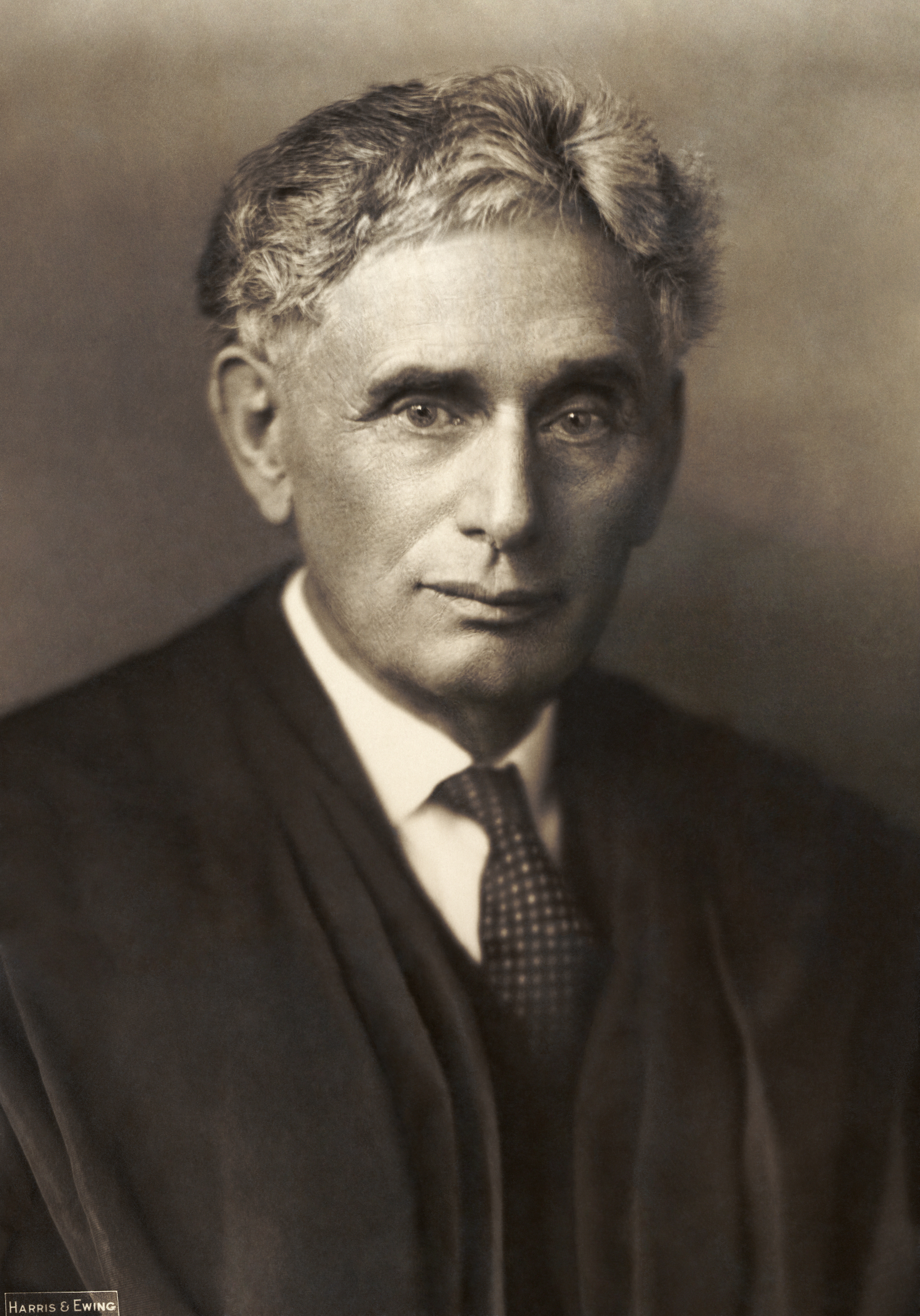
Louis D. Brandeis
Lawyer and former Associate Justice of the Supreme Court of the United StatesWikipedia
64
MENTIONS
40
EPISODES
34
PODCASTS
Search complete. 64 mentions across 40 episodes found for "Louis D. Brandeis".
Oct 30, 2026

Jiang XueqinGUEST
Crown Heights.
Jiang XueqinGUEST
The man who brought them over, his name is Louis Brandeis.
Jiang XueqinGUEST
And at that time, he is the most powerful Jew in the United States.
Jiang XueqinGUEST
He was Associate Supreme Court Justice.
Jiang XueqinGUEST
He was president of the Zionist Association in the United States.
Jiang XueqinGUEST
And one thing that he did that alienated a lot of his colleagues was he was calling for the establishment of the State of Israel, which in 1920s was extremely controversial because Jews at that time were really well established in America and in Europe, and they were afraid of being accused of dual loyalty, right? So if Israel comes into being, then people will be like, well, are you loyal to the United States or are you loyal to Israel? Which is exactly what's happening today.
Jiang XueqinGUEST
OK, so the first thing is the the man who sponsored about leverage to come to the United States and who gave them a base to work from was Louis Brandeis, a well-known, something Frank is.
Jiang XueqinGUEST
So that's one connection.

Nadine StrossenGUEST
That is not enough of a justification to censor it.
Nadine StrossenGUEST
And the first eloquent articulation of that principle came from not only a member of the Supreme Court, but the first Jewish justice on the Supreme Court, Louis Brandeis, who was unexcelled in terms of his commitment to Jewish community, Jewish safety, Jewish dignity, and Jewish equality.
Nadine StrossenGUEST
And Brandeis was the one who formulated the so-called emergency principle that I laid out earlier, that if there is time to respond to evil counsels with good ones, that is what we have to do.
Nadine StrossenGUEST
And that's the position that was also taken with brief exceptions for most of the 20th century by the American Jewish Congress, the American Jewish Committee, and the Anti-Defamation League.
Eric FingerhutMODERATOR
And let's assume they're coming week after week as these students are doing this.
Eric FingerhutMODERATOR
Now, is this incitement? What should we be doing about this case?
Nadine StrossenGUEST
So incitement, intentional incitement of imminent violence that's likely to happen imminently is just one type of speech that can satisfy this emergency concept that dates back to Louis Brandeis.
Nadine StrossenGUEST
But what you're describing, Eric, is yet another category of unprotected speech under the emergency principle, and one that many of the courts in the cases that Claire described earlier have found satisfied, and by your description of these facts, I think would be satisfied here, as it was also satisfied in the Charlottesville situation, but only after the court hearing, so I want to get back to that.

Haviv Rettig GurGUEST
And there are many, many other Zionisms.
Haviv Rettig GurGUEST
There's sort of American liberal Zionism from the days of Louis Brandeis and even earlier.
Haviv Rettig GurGUEST
And this is just within the Jews.
Haviv Rettig GurGUEST
There's also Christian Zionism that's very old.

Adam BeckerHOST
We can't have both.
Adam BeckerHOST
That's a line that goes all the way back to Louis Brandeis almost 100 years ago.
Adam BeckerHOST
And he was right then and you're right now.
Adam BeckerHOST
But, you know, one of the things that's striking, and I think I was telling you this when I saw you a few days ago, we were on a panel together in San Francisco.

Joel AndersonHOST
He just popularized it with me and his other regular readers.
Joel AndersonHOST
Laboratories of Democracy was coined and popularized by US Supreme Court Justice Louis Brandeis.
Joel AndersonHOST
who used the concept in his dissenting opinion for this.
Joel AndersonHOST
I'm reading this part.

Nadine StrossenGUEST
So I'm not good at arithmetic, but it's a very small percentage of the time between 1791 and The 1960s, which is when we first started getting consistent Supreme Court majorities actually breathing life into the promise, the paper promise or the parchment promise, to paraphrase Madison, of the free speech clause.
Nadine StrossenGUEST
And the So one of my heroes in that struggle before Douglass is Louis Brandeis.
Nadine StrossenGUEST
He and Oliver Wendell Holmes in the early 20th century were the first two who wrote wonderful dissenting opinions that ultimately became adopted by the majority of the Supreme Court.
Nadine StrossenGUEST
in the second half of the 20th century.

David JonesSOUNDBITE_SPEAKER
And you can actually drive to the state house and talk to the people who run that thing.
David JonesSOUNDBITE_SPEAKER
Very famous Supreme Court Justice Louis Brandeis said the U.S. states are the laboratories of democracy.
David JonesSOUNDBITE_SPEAKER
The Bank of America has predicted that in the next 30 years, more people are going to own a robot than a car.
David JonesSOUNDBITE_SPEAKER
They'll have personalized cancer treatments in the pipeline.

Chris WhalenGUEST
They still wouldn't be in control.
Chris WhalenGUEST
So when you have a situation like that, Julia, to pretend that you're giving them control, but you are reserving dominion, to paraphrase Louis Brandeis on the Supreme Court, is an act of fraud.
Chris WhalenGUEST
So let's not do that.
Chris WhalenGUEST
Let's clean this up, have public participation in the preferred and the debt, and have the United States as the sole shareholder.
Chris WhalenGUEST
Congress pretended to privatize the GSEs back in the Vietnam War.
Chris WhalenGUEST
They wanted to window dress the federal budget deficit, but they never relinquished control.
Chris WhalenGUEST
And that's why, again, to paraphrase Louis Brandeis, reserving dominion imputes fraud conclusively.
Chris WhalenGUEST
That's what he wrote in 1925 when he defined a true sale in a bankruptcy case.

George NobleHOST
Um, never mind as a quote, and I'm going to read it.
George NobleHOST
Justice Louis Brandeis in, I don't know, 2013.
George NobleHOST
Publicity is justly commended as a remedy for social and industrial diseases.
George NobleHOST
Sunlight is said to be the best of disinfectants.

Stephen HeinerHOST
Part of those machinations included the crafting of the Zimmermann telegram.
Stephen HeinerHOST
And three, the separate peace negotiations the Ottomans pursued with the U.S. in the person of Henry Morgenthau, Sr., former ambassador of the U.S. to the Ottomans, which was torpedoed by ardent Zionist Felix Frankfurter, who was placed on Morgenthau's team by fellow Zionist and future fellow Supreme Court Justice Louis Brandeis.
Stephen HeinerHOST
Morgenthau and his team never made it to talk to the Ottomans.
Stephen HeinerHOST
They were intercepted at Gibraltar by the British and the Zionists.
30 more episodes mention Louis D. Brandeis.
Create an account to see the whole feed, search across every transcript, and follow the entities you care about.