Lost Cause of the Confederacy
75
MENTIONS
19
EPISODES
15
PODCASTS
Search complete. 75 mentions across 19 episodes found for "Lost Cause of the Confederacy".
Sep 21, 2026

Kevin WillmottGUEST
it's absolutely you
Eric TrommaterHOST
have to have a knowledge of the lost cause narrative to laugh your ass off at the
speaker_5SOUNDBITE_SPEAKER
reversal
Eric TrommaterHOST
of the lost cause narrative in the industrial north in this film i don't think that's even an intellectual joke that's just funny no matter how much you know about history
Erin BrownPANELIST
i liked how political things tracked from the civil war forward like the republican and democrat parties were switched because early on that's what they were before they changed in the early 20th century.
Erin BrownPANELIST
I thought that was really interesting.
39 MINS LATER
speaker_6SOUNDBITE_SPEAKER
Valdosta to be exact,
Eric TrommaterHOST
I have to tell you, I think when people ask me what if the Confederacy had won the Civil War, I think they lost the battle, which was the war itself, but they won the war.

Dana GoldbergHOST
And Jeffrey Clark, Jeffrey Clark did not show up for his hearing today in federal court over-
Allison GillHOST
'Cause he doesn't have pants.
Dana GoldbergHOST
Yeah, no pants, no pants to wear.
Dana GoldbergHOST
He doesn't have his court pants.
27 MINS LATER
Michael HarriotGUEST
Yeah.
Michael HarriotGUEST
So we know, and we talk about this in the book, right? So we know that a lot of the history that we have lost or has been whitewashed, it wasn't kind of a, you know, a game of telephone where it was misinterpreted through the years, right? So we know that after the Civil War, when we were building schools, there was a group of women, white women, called the Daughters of the Confederacy, who was, who engaged in a campaign, who created the campaign to change history books.
Michael HarriotGUEST
It was called The Lost Cause.
Michael HarriotGUEST
And they were basically the, the authority through which all the history books, the textbook manufacturers and publishers had to go through to get their history books approved.

Agnes Robert BaerNARRATOR
They gave their all for a cause they followed." Clearly the count shared my aunt's views of history, those views which have made such sport for us often at Carterhaugh.
Agnes Robert BaerNARRATOR
Stout Whig as I am, there was something in the tone of the old gentleman which made me feel a certain majesty in the Lost Cause.
Agnes Robert BaerNARRATOR
"I am a Whig in blood and a Whig in principle," I said, "but I have never denied that those Scots who foiled the Cavalier were too good to waste on so trumpery a leader." I had no sooner spoken the words than I felt that somehow I had been guilty of a bête ise.
Agnes Robert BaerNARRATOR
"It may be so," said the count.

Daphna RenanGUEST
Yeah.
Daphna RenanGUEST
So who picked up on it is former Confederates that were trying to reclaim an old vision of the Constitution through a very targeted litigation strategy in, uh, culminating in the Supreme Court and also a kind of war of ideas, as one of them wrote in, in The Lost Cause that became a kind of tract that was putting forward the ideology that what we had was a, a reckless Congress because a- as the, as Reconstruction unfolds, Congress is passing the first civil rights laws, the first vote protections, the first agencies administering what they term practical freedom.
Daphna RenanGUEST
And so the, the ideology is, look, what we have is a reckless Congress.
Daphna RenanGUEST
It's, it's run amok.
Daphna RenanGUEST
So, so those become the, the politics of the nation as it is building multiracial democracy in the United States for the first time.
Leah LitmanHOST
So just want to pick up on something you said.
Leah LitmanHOST
You described how this was part of the Lost Cause movement, which of course is the movement to try to restore the former Confederacy to power.
Leah LitmanHOST
And as part of that, there were efforts to depict the former Confederacy as fighting over a cause besides slavery, you know, and it oftentimes gets chalked up to federal overreach.

Ellie AndersonHOST
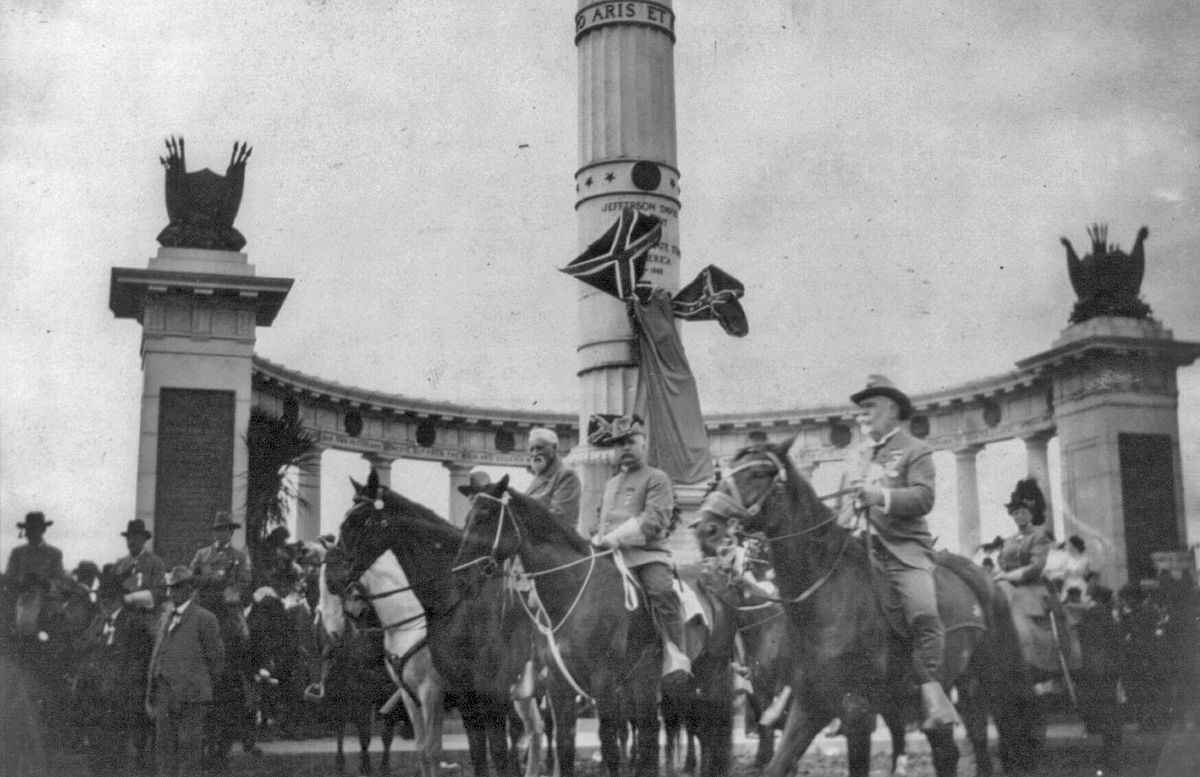
Once, Richmond was home to more Confederate statues than any other city in the US, which made it a hotbed for a pressing debate around how art commemorates American figures and which figures get to become heroes.
Ellie AndersonHOST
Confederate statues enshrine a particular narrative about how the Civil War should be remembered, like that it really wasn't about slavery and that the South only lost because the North had more resources, an idea often called the Lost Cause narrative.
Ellie AndersonHOST
And in recent decades, Confederate monuments have become symbols of an ongoing political battle over whose stories take the spotlight and what America does and should stand for.
Ellie AndersonHOST
But one artist is fighting statues with statues.

Anne Sarah RubinGUEST
And I think that's really im- an important distinction.
Don WildmanHOST
Was it then a convenient target of the Lost Cause folks?
Anne Sarah RubinGUEST
It's absolutely a convenient target of the Lost Cause, and like I said, right, Sherman goes to Atlanta in 1880, I think.
Anne Sarah RubinGUEST
He's welcomed with open arms.
Anne Sarah RubinGUEST
In 1881, Jefferson Davis publishes his Rise and Fall of the Confederate Government, and he goes hard after Sherman, and that's where you start to see the kind of cultural tide turn a little bit towards Sherman as a villain, and Sherman's March as this great evil.

Brian McClanahanHOST
We started off the week with a show on the vlogging through history nonsense.
Brian McClanahanHOST
And of course, talking about the quote-unquote lost cause and how these people really don't, I think, understand what the original meaning of that was.
Brian McClanahanHOST
I know that, you know, well, it's changed over time and all this stuff.
Brian McClanahanHOST
But at the core, right? So if you think about the lost cause and what they'll say about it, one of the things they will articulate is that, well, y'all believe secession is legal.
Brian McClanahanHOST
It's not legal.
Brian McClanahanHOST
It's not constitutional.
speaker_1ADVERTISER
K18, hair science that sees you.
speaker_1ADVERTISER
Shop Future IQ at Sephora or get 10% off your first purchase at k18hair.com with code SPOTIFY.
Brian McClanahanHOST
I do think that there are myths that are created for political advantage.
Brian McClanahanHOST
And I'm not so certain that anything that the South would say, I mean, if you want to say the Lost Cause is a myth, I mean, it's a false thing.
Brian McClanahanHOST
It's a lie, which it's not.
Brian McClanahanHOST
It's cogency in the two, which I've talked about in other places.
Brian McClanahanHOST
You've got people like Alan Nolan and David Blight and all these others.
Brian McClanahanHOST
Oh, sure it does.
Brian McClanahanHOST
It made it to where the United States, a lost cause myth came...
Brian McClanahanHOST
No, it wasn't that.
Brian McClanahanHOST
Then he blocked me.
Brian McClanahanHOST
Now, some people wanted me to go into his list and get into the Lost Cause stuff.
Brian McClanahanHOST
I'll talk about the Lost Cause in a minute.
Brian McClanahanHOST
but I can't see the image anymore, so I can't do that.
Brian McClanahanHOST
I didn't save it.
Brian McClanahanHOST
You can go and scroll to that section of the live stream or scrub over to that section of the live stream and you can get to it.
Brian McClanahanHOST
But he says something to the effect, well, I need to address this.
Brian McClanahanHOST
There's a lost cause professor out there who has a PhD who was putting me down because I don't.

David S. ReynoldsGUEST
But he was really driven by this firm principle, right? of devotion to the nation and devotion to human equality.
John BatchelorHOST
The book is Two Ships, Lincoln is Dead, The Lost Cause.
John BatchelorHOST
I'm John Batchelor.
speaker_7ADVERTISER
This episode sponsored by Ridwell.
John BatchelorHOST
There's broken hearts everywhere.
John BatchelorHOST
It's 1866.
John BatchelorHOST
And a man named Edward D. Pollard publishes a book called The Lost Cause.
John BatchelorHOST
And now we seriously begin the poison that creates the myth of the Cavaliers and their righteous cause.
9 more episodes mention Lost Cause of the Confederacy.
Create an account to see the whole feed, search across every transcript, and follow the entities you care about.