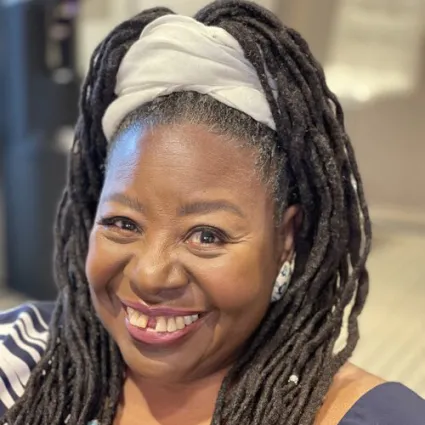
Loretta Ross
American activistWikipedia
7
MENTIONS
4
EPISODES
4
PODCASTS
Search complete. 7 mentions across 4 episodes found for "Loretta Ross".
Sep 30, 2026

Val BrownHOST
All we have to do is not drop our link in the chain.
Andrew LefkowitsHOST
As Loretta Ross told us.
Andrew LefkowitsHOST
That's
Val BrownHOST
right.

Amanda TattersallGUEST
That happens, right, in movements.
Amanda TattersallGUEST
And there's lots of interesting books that have been written exploring this challenge, right? So Loretta Ross, who is a civil rights feminist writer in America, has written a book called Calling In.
Amanda TattersallGUEST
and it speaks of a different way of having these kinds of relationships because it says
Kirrily DearHOST
look
Amanda TattersallGUEST
But in public, it's not enough to just be with people who agree with us.
Amanda TattersallGUEST
We actually kind of need to build relationships with people who might disagree with us.
Amanda TattersallGUEST
Not necessarily, I mean, look, everyone can go for what Loretta Ross did.
Amanda TattersallGUEST
Her relationships were very broad.

EmmaHOST
The provenance of the evidence is on the part of the ethics of the claim, and a case built on material taken without consent is a violation and is doing the very thing it says it's punishing.
EmmaHOST
In 2025, Loretta Ross described herself as a reformed call-out queen, and she's explicit that call-outs have their uses.
EmmaHOST
What she offers is a spectrum of responses rather than prohibition, so that the intensity of the response can be matched to the situation instead of defaulting to maximum every time.
EmmaHOST
This is the whole argument I'm making these two weeks.

Dave TomlinsonHOST
In other words, she believes that wherever possible, she believes in an engagement with one's enemies, with the hope at least, of conversion or transformation, which even if it doesn't happen, is still a process that is transformative to oneself.
Dave TomlinsonHOST
So Bonnie Greer and Loretta Ross are two black feminist activists who critique the toxic purism and dogma that lies within a lot of modern cancel culture.
Dave TomlinsonHOST
But at the same time, you know, they approached the solution with slightly different strategies, which I found creates a fascinating synergy.
Dave TomlinsonHOST
So just a brief compare and contrast of their strategies.
Dave TomlinsonHOST
rather than just flame-burning them all down.
Dave TomlinsonHOST
Both of them critique the modern tendency to flatten human beings into rigid categories, emphasizing that people are always far more complicated than the labels that we put on them.
Dave TomlinsonHOST
Loretta Ross's signature methodology, as I say, is calling in.
Dave TomlinsonHOST
The practice of pulling someone aside, if possible privately, to address harm with compassion, respect and context rather than publicly humiliating them, which I think resonates with the teaching of Jesus about confronting a person face to face before escalating an issue of conflict and making the issue public.