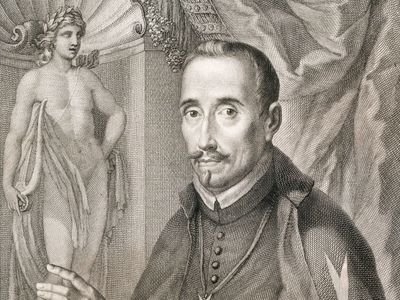
Lope de Vega
Spanish playwright and poetWikipedia
47
MENTIONS
11
EPISODES
8
PODCASTS
Search complete. 47 mentions across 11 episodes found for "Lope de Vega".
Nov 19, 2026

Noémie NdiayeGUEST
So how to choose one? I'm going to give you an example from the last chapter, the chapter that focuses on how characters from various regions of Asia find themselves inserted, interpolated into those dramaturgies based upon a black and white binary.
Noémie NdiayeGUEST
So in the section that focuses on Spanish drama, I'm looking at the work of Lope de Vega, who's the master of 17th century Spanish drama.
Noémie NdiayeGUEST
And I'm looking at this play called La Otava Maravilla, The Eighth Wonder of the World, in which he is describing the protagonist is this king of Bengal who travels to Spain and literally falls in love with Spain or a figure of Spain and ends up converting to Catholicism.
Noémie NdiayeGUEST
takes his wife and everything back to Bengal and there has the largest, most beautiful, extravagant cathedral you can think of built in the middle of Bengal.
Noémie NdiayeGUEST
And what's interesting to me about this play is how Lope de Vega, who... just a few years before writing this play, actually initiated a whole new genre known as the Black Saint play, is actually using this older pattern that he developed over the course of at least three plays of the Black Saint figure in order to frame his figure of the Muslim Bengali prince, and does so in a way that has ideological consequences.
Noémie NdiayeGUEST
Because what you find in the dramaturgy of those Black saint plays is the idea that Black people, pagan Black people, will actually make exceptionally good Catholics, you know, if you just led them, if you welcome them within the highly hierarchical, of course, structure of the church.
Noémie NdiayeGUEST
So keeping them in an enslaved status, but as part of the spiritual community of global Catholicism.
Noémie NdiayeGUEST
And so I think that this is really the resource that Lope de Vega is drawing on here in order to create this completely counterfactual fiction on Bengali prince having this cathedral erected in his kingdom in honor of the Virgin Mary.

Noémie NdiayeGUEST
I'm going to give you an example from the last chapter, the chapter that focuses on how characters from various regions of Asia find themselves inserted, interpolated into those dramaturgies based upon a black and white binary.
Noémie NdiayeGUEST
So in the section that focuses on Spanish drama, I'm looking at the work of Lope de Vega, who's the master of 17th century Spanish drama, And I'm looking at this play called La Otava Maravilla, The Eighth Wonder of the World, in which he is describing the protagonist is this king of Bengal who travels to Spain and literally falls in love with Spain or a figure of Spain and ends up converting to Catholicism.
Noémie NdiayeGUEST
takes his wife and everything back to Bengal and there has the largest, most beautiful, extravagant cathedral you can think of built in the middle of Bengal.
speaker_4ADVERTISER
And what's interesting to me about this play
Noémie NdiayeGUEST
is how Lope de Vega, just a few years before writing this play, actually initiated a whole new genre known as the Black Saint play, is actually using this older pattern that he developed over the course of at least three plays of the Black Saint figure in order to frame his figure of the Muslim Bengali prince, and does so in a way that has ideological consequences.
Noémie NdiayeGUEST
Because what you find in the dramaturgy of those Black saint plays is the idea that Black people, pagan Black people, will actually make exceptionally good Catholics, you know, if you just led them, if you welcome them within the highly hierarchical, of course, structure of the church.
Noémie NdiayeGUEST
So keeping them in an enslaved status, but as part of the spiritual community of global Catholicism.
Noémie NdiayeGUEST
And so I think that this is really the resource that Lope de Vega is drawing on here in order to create this completely counterfactual fiction on Bengali prince having this cathedral erected in his kingdom in honor of the Virgin Mary.

Noémie NdiayeGUEST
So how to choose one? I'm going to give you an example from the last chapter, the chapter that focuses on how characters from various regions of Asia find themselves inserted, interpolated into those dramaturgies based upon a black and white binary.
Noémie NdiayeGUEST
So in the section that focuses on Spanish drama, I'm looking at the work of Lope de Vega, who's the master of 17th century Spanish drama.
Noémie NdiayeGUEST
And I'm looking at this play called La Otava Maravilla, The Eighth Wonder of the World, in which he is describing the protagonist is this king of Bengal who travels to Spain and literally falls in love with Spain or a figure of Spain and ends up converting to Catholicism.
Noémie NdiayeGUEST
takes his wife and everything back to Bengal and there has the largest, most beautiful, extravagant cathedral you can think of built in the middle of Bengal.
speaker_2NARRATOR
And what's interesting to me about this play
Noémie NdiayeGUEST
is how Lope de Vega, just a few years before writing this play, actually initiated a whole new genre known as the Black Saint play, is actually using this older pattern that he developed over the course of at least three plays of the Black Saint figure in order to frame his figure of the Muslim Bengali prince, and does so in a way that has ideological consequences.
Noémie NdiayeGUEST
Because what you find in the dramaturgy of those Black saint plays is the idea that Black people, Pagan Black people, will actually make exceptionally good Catholics, you know, if you just let them, if you welcome them within the highly hierarchical, of course, structure of the church.
Noémie NdiayeGUEST
So keeping them in an enslaved status, but as part of the spiritual community of global Catholicism.

Noémie NdiayeGUEST
So how to choose one? I'm going to give you an example from the last chapter, the chapter that focuses on how characters from various regions of Asia find themselves inserted, interpolated into those dramaturgies based upon a black and white binary.
Noémie NdiayeGUEST
So in the section that focuses on Spanish drama, I'm looking at the work of Lope de Vega, who's the master of 17th century Spanish drama.
Noémie NdiayeGUEST
And I'm looking at this play called La Otava Maravilla, The Eighth Wonder of the World, in which he is describing the protagonist is this king of Bengal who travels to Spain and literally falls in love with Spain or a figure of Spain and ends up converting to Catholicism.
Noémie NdiayeGUEST
takes his wife and everything back to Bengal and there has the largest, most beautiful, extravagant cathedral you can think of
Serena WilliamsSOUNDBITE_SPEAKER
built in the middle of Bengal.
Noémie NdiayeGUEST
And what's interesting to me about this play is how Lope de Vega, just a few years before writing this play, actually initiated a whole new genre known as the Black Saint play, is actually using this older pattern that he developed over the course of at least three plays of the Black Saint figure in order to frame his figure of the Muslim Bengali prince, and does so in a way that has ideological consequences.
Noémie NdiayeGUEST
Because what you find in the dramaturgy of those Black saint plays is the idea that Black people, pagan Black people, will actually make exceptionally good Catholics, you know, if you just let them, if you welcome them within the highly hierarchical, of course, structure of the church.
Noémie NdiayeGUEST
So keeping them in an enslaved status, but as part of the spiritual community of global Catholicism.

Noémie NdiayeGUEST
So how to choose one? I'm going to give you an example from the last chapter, the chapter that focuses on how characters from various regions of Asia find themselves inserted, interpolated into those dramaturgies based upon a black and white binary.
Noémie NdiayeGUEST
So in the section that focuses on Spanish drama, I'm looking at the work of Lope de Vega, who's the master of 17th century Spanish drama.
Noémie NdiayeGUEST
And I'm looking at this play called La Otava Maravilla, The Eighth Wonder of the World, in which he is describing the protagonist is this king of Bengal who travels to Spain and literally falls in love with Spain or a figure of Spain and ends up converting to Catholicism.
Noémie NdiayeGUEST
takes his wife and everything back to Bengal and there has the largest, most beautiful, extravagant cathedral you can think of built in the middle of Bengal.
Noémie NdiayeGUEST
And what's interesting to me about this play is how Lope de Vega, who... just a few years before writing this play, actually initiated a whole new genre known as the Black Saint play, is actually using this older pattern that he developed over the course of at least three plays of the Black Saint figure in order to frame his figure of the Muslim Bengali prince, and does so in a way that has ideological consequences.
Noémie NdiayeGUEST
Because what you find in the dramaturgy of those Black saint plays is the idea that Black people, pagan Black people, will actually make exceptionally good Catholics, you know, if you just let them, if you welcome them within the highly hierarchical, of course, structure of the church.
Noémie NdiayeGUEST
So keeping them in an enslaved status, but as part of the spiritual community of global Catholicism.
Noémie NdiayeGUEST
And so I think that this is really the resource that Lope de Vega is drawing on here in order to create this completely counterfactual fiction on Bengali prince having this cathedral erected in his kingdom in honor of the Virgin Mary.
Rebecca de SouzaGUEST
But in this case, it was anyone who was descended from Morisco, anyone who was a Christian but had Muslim roots to any extent.
Rebecca de SouzaGUEST
So we do have a couple of playwrights that return to the play to kind of meditate upon that and try to, in my reading, they kind of, one of them in particular, Lope de Vega, kind of reinforces the Islamophobia of the expulsion.
Rebecca de SouzaGUEST
His play is called El Vaso del Mudara, and he's kind of obsessed with the performative nature of reality in all of his plays, Lope de Vega.
Rebecca de SouzaGUEST
The idea of the world itself being a stage, which is a massive kind of early modern preoccupation that we see even in theater and other cultural contexts.
Rebecca de SouzaGUEST
And in the play, he kind of exploits the constructive, performative nature of race and religion as a form of difference to further his critique of the nobility of social class, of the idea that nobility is just constructed.
Rebecca de SouzaGUEST
So by doing that, even though it seems like quite a progressive thing to do to suggest that all identity categories are just constructed and don't really mean anything, in his play, his protagonist Muldara, his Andalusi Muslim identity is just reduced to a costume and nothing more.
Rebecca de SouzaGUEST
So in this way, I suggest that Lope de Vega actually tacitly validates the institutional racism of the expulsion by having characters performing race and seeing it as constructed as to kind of see it as another kind of constructed social formation rather than vindicating Iberian Muslim identity or Morisco identity as a concrete kind of subject position.
Rebecca de SouzaGUEST
So it kind of denies Andalusi difference, denies historical significance.
Rebecca De SouzaGUEST
But in this case, it was anyone who was descended from Morisco, anyone who was a Christian but had roots, had Muslim roots to any extent.
Rebecca De SouzaGUEST
So we do have a couple of playwrights that return to the play to kind of meditate upon that and try to, in my reading, they kind of, one of them in particular, Lope de Vega, kind of reinforces the Islamophobia of the expulsion.
Rebecca De SouzaGUEST
His play is called El Vaso del Mudara, and he's kind of obsessed with the performative nature of reality in all of his plays, Lope de Vega.
Rebecca De SouzaGUEST
The idea of the world itself being a stage, which is a massive kind of early modern preoccupation that we see even in theatre and other cultural contexts.
Rebecca De SouzaGUEST
And in the play, he kind of exploits the constructive, performative nature of race and religion as a form of difference to further his critique of the nobility of social class, of the idea that nobility is just constructed.
Rebecca De SouzaGUEST
So by doing that, even though it seems like quite a progressive thing to do to suggest that all identity categories are just constructed and don't really mean anything, in his play, his protagonist Mudara, his Andalusi Muslim identity is just reduced to a costume and nothing more.
Rebecca De SouzaGUEST
So in this way, I suggest that Lope de Vega actually tacitly validates the institutional racism of the expulsion by having characters performing race and seeing it as constructed as to kind of see it as another kind of constructed social formation rather than vindicating Iberian Muslim identity or Morisco identity as a concrete kind of subject position.
Rebecca De SouzaGUEST
So it kind of denies Andalusi difference, denies historical significance.
Rebecca De SouzaGUEST
But in this case, it was anyone who was descended from Morisco, anyone who was a Christian but had roots, had Muslim roots to any extent.
Rebecca De SouzaGUEST
So we do have a couple of playwrights that return to the play to kind of meditate upon that and try to, in my reading, they kind of, one of them in particular, Lope de Vega, kind of reinforces the Islamophobia of the expulsion.
Rebecca De SouzaGUEST
His play is called El Vaso del Mudara, and he's kind of obsessed with the performative nature of reality in all of his plays, Lope de Vega.
Rebecca De SouzaGUEST
The idea of the world itself being a stage, which is a massive kind of early modern preoccupation that we see even in theatre and other cultural contexts.
Rebecca De SouzaGUEST
And in the play, he kind of exploits the constructive, performative nature of race and religion as a form of difference to further his critique of the nobility of social class, of the idea that nobility is just constructed.
Rebecca De SouzaGUEST
Yeah.
Rebecca De SouzaGUEST
So by doing that, even though it seems like quite a progressive thing to do to suggest that all identity categories are just constructed and don't really mean anything, in his play, his protagonist Muldara, his Andalusi Muslim identity is just reduced to a costume and nothing more.
Rebecca De SouzaGUEST
So in this way, I suggest that Lope de Vega actually tacitly validates the institutional racism of the expulsion by having characters performing race and seeing it as constructed as to kind of see it as another kind of constructed social formation rather than vindicating Iberian Muslim identity or Morisco identity as a concrete kind of subject position.

Rebecca de SouzaGUEST
But in this case, it was anyone who was descended from Morisco, anyone who was a Christian but had Muslim roots to any extent.
Rebecca de SouzaGUEST
So we do have a couple of playwrights that return to the play to kind of meditate upon that and try to, in my reading, they kind of, one of them in particular, Lope de Vega, kind of reinforces the Islamophobia of the expulsion.
Rebecca de SouzaGUEST
His play is called El Vaso del Mudara, and he's kind of obsessed with the performative nature of reality in all of his plays, Lope de Vega.
Rebecca de SouzaGUEST
The idea of the world itself being a stage, which is a massive kind of early modern preoccupation that we see even in theater and other cultural contexts.
Rebecca de SouzaGUEST
And in the play, he kind of exploits the constructive, performative nature of race and religion as a form of difference to further his critique of the nobility of social class, of the idea that nobility is just constructed.
Rebecca de SouzaGUEST
So by doing that, even though it seems like quite a progressive thing to do to suggest that all identity categories are just constructed and don't really mean anything, in his play, his protagonist Muldara, his Andalusi Muslim identity is just reduced to a costume and nothing more.
Rebecca de SouzaGUEST
So in this way, I suggest that Lope de Vega actually tacitly validates the institutional racism of the expulsion by having characters performing race and seeing it as constructed as to kind of see it as another kind of constructed social formation rather than vindicating Iberian Muslim identity or Morisco identity as a concrete kind of subject position.
Rebecca de SouzaGUEST
So it kind of denies Andalusi difference, denies historical significance.

speaker_1UNKNOWN
Gloria a ti, Señor Jesús.
PriestHOST
Esta mañana, haciendo la oración sobre este texto del evangelio de san Lucas, el milagro de la curación de los diez leprosos, recordaba un soneto que me gusta muchísimo de Lope de Vega, uno de los más bellos sonetos que escribió este genio del Siglo de Oro español.
PriestHOST
¿Qué tengo yo que mi amistad procuras? ¿Qué interés se te sigue, Jesús mío, que a mi puerta, cubierto de rocío, pasas la noche del invierno a oscuras? ¡Oh, cuántas fueron mis entrañas duras, pues no te abrí! Qué inmenso desvarío, si de mi ingratitud el hielo frío secó la llaga de tus plantas puras.
PriestHOST
Cuántas veces el ángel me decía: "Alma, asómate ahora a la ventana, verás con cuánto amor llamar porfía".
PriestHOST
Exigir es otra cosa.
PriestHOST
Pedir es reconocer que Dios es poderoso, que Dios es Dios y que nosotros necesitamos a Dios.
PriestHOST
¿Dónde está el problema entonces? Lope de Vega lo dice perfectamente: "De mi ingratitud, el hielo frío secó la llaga de tus plantas puras".
PriestHOST
En la ingratitud.
1 more episode mentions Lope de Vega.
Create an account to see the whole feed, search across every transcript, and follow the entities you care about.