Long-term potentiation
22
MENTIONS
11
EPISODES
11
PODCASTS
Search complete. 22 mentions across 11 episodes found for "Long-term potentiation".
Oct 13, 2026

speaker_6HOST
It did.
speaker_6HOST
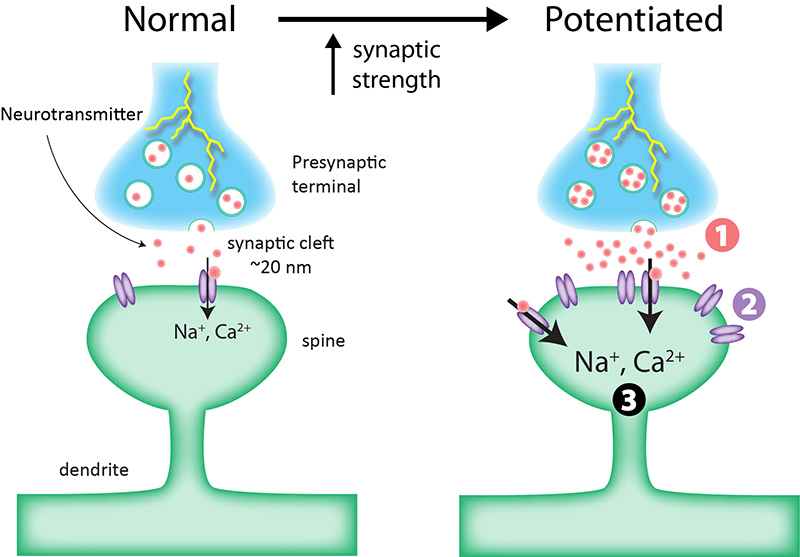
The definitive experimental proof of Hebb's theory is a process called long-term potentiation, or LTP.
speaker_5HOST
LTP.
speaker_5HOST
Got it.
speaker_6HOST
It was first described in the hippocampus of rabbits in 1973 by two researchers named Bliss and Lomo.
speaker_6HOST
A massive signal.
speaker_6HOST
The nature of that calcium flood dictates the entire fate of the synapse.
speaker_6HOST
If it's a massive, rapid rise in calcium, meaning a very strong coincidence, it triggers a massive biochemical cascade for LTP, strengthening the synapse.

Sia GullapalliHOST
So yeah, that makes sense why you would need something other than a microscope to look at it.
Sia GullapalliHOST
And additionally, your work also explores long-term potentiation, which is a process believed to play an important role in memory formation.
speaker_3UNKNOWN
So
Sia GullapalliHOST
how do physical changes in the connections between neurons help explain our ability to form and retain memories.
Masaaki KuwajimaGUEST
Right.
Masaaki KuwajimaGUEST
So long-term potentiation, like you said, is thought to be sort of underlying mechanism of memory formation and also learning.
Masaaki KuwajimaGUEST
So when I was talking about synapses getting stronger and bigger during learning, That's sort of what happens during long-term potentiation.
Masaaki KuwajimaGUEST
So it is a model in which we get to study the mechanisms of the learning process.

Amy BuesingHOST
Yeah.
Amy BuesingHOST
Have you ever heard of LTP? It's long-term potentiation, but I bet you've known this.
Amy BuesingHOST
I...
Amy BuesingHOST
This is what it's called, but you've heard if a neuron wires, fires together, it wires together.
24 MINS LATER
Viking Cat LadyHOST
[laughs]
Amy BuesingHOST
And this is a huge but, the drinking pattern that produces repeated blackouts can be damaging, and this I think we kinda know.
Amy BuesingHOST
So basically over time, drinking a lot can cha- cause changes in your neurons and white matter pathways, specifically that LTP that we talked about.
Amy BuesingHOST
So chronic alcohol misuse can affect the frontal regions, and that's executive functioning and hippocampus.

Steve PetersGUEST
What we find is that's the least effective method of getting anything into long-term memory.
Steve PetersGUEST
Creating something in the literature called LTP, uh, long-term potentiation, getting things that are super, uh, neurons, super highways in the brain.
Steve PetersGUEST
One of the worst things that we can do or the least effective way is just to drill, drill, drill, drill, drill.
Steve PetersGUEST
One, your horse likely will check out.

speaker_3HOST
And what do those do?
speaker_4HOST
These cytokines actively disrupt a fundamental neurological process known as long-term potentiation or LTP.
speaker_3HOST
Let's define LTP for the listener real quick.
speaker_3HOST
That is essentially the neurobiological correlate of learning, right? It is how synapses strengthen through repetitive electrical stimulation, which is what allows us to encode new memory.
speaker_4HOST
Exactly.
speaker_4HOST
The chemical signaling required for LTP to occur is exquisitely sensitive to inflammation.
speaker_4HOST
The cytokines interrupt the receptor signaling at the synapse, effectively preventing the brain from forming and retaining new memories.
speaker_3HOST
Okay.

HaoHOST
Now from there, from that theory, we move to, there are some terminologies that you need to be familiar.
HaoHOST
It's called the long-term potentiation, right? Long-term, which is happening a long time.
HaoHOST
Potentiation, like potential.
HaoHOST
And then short-term depression, right? Okay, again, theorists would name these words.
HaoHOST
Long-term potentiation, short-term depression.

Oliver BarnstedtGUEST
Well, I still feel like we can have a better concept of memory and we already have...
Oliver BarnstedtGUEST
I mean, since the times from the 1970s with LTP and, you know, 50s patient HMO.
Oliver BarnstedtGUEST
So we have a long history of, you know, grasping the biological roots, the underlying mechanisms that are sort of at the bottom of this.
Oliver BarnstedtGUEST
But we're still sort of, I feel now with more and more methods, in vivo methods, population dynamics methods, or so we have more and more coming away from sort of what's happening on a single synapse on a slice to, you know, what, how are memories stored across the brain? How do they give rise to behavior in an organism? So that's why I think this is really fascinating.
28 MINS LATER
Oliver BarnstedtGUEST
During initial encoding, the system produces changes along the most likely connections between neurons.
Oliver BarnstedtGUEST
And that's not just between two neurons, right? But it's happening in a lot of different brain regions, probably around the same time, and then also at different time intervals, where a lot of different connections between neurons occur.
Oliver BarnstedtGUEST
are changing you know through different synaptic plasticity mechanisms like LTP for example right or also depression of course right so basically those connections are changing so that the next time you encounter a similar stimulus then basically this activity pattern could be recreated, right? So in a way then that memory is reconstructed and that's what we call recall and basically that's memory recall.
Oliver BarnstedtGUEST
But I think we have to sort of conceptualize these things differently where on the one hand, you have a memory trace that can remain fairly stable, right? It will undergo modification throughout time.

EvelynHOST
You can stay up all night long and study all that information, and if you don't sleep for at least a good one sleep cycle, like two hours, that information is not being processed for the long term.
EvelynHOST
so you're cramming for exam one and although you do well on that one when it comes to the final exam that information has not been locked in okay this is the same trends in neuroscience journal from september of 2022 this is the section in where they're talking about the hippocampus and its response to chronic sleep disruption so a couple terms that we're going to be using here is the hippocampus we talked about that that's the part in our brain where long-term memory processing happens In this article, they were referring to LTP, which is long term potentiation, which is the primary way the brainstorms long term memories.
EvelynHOST
Episodic memory is something else we're going to be talking about here.
EvelynHOST
Episodic memory is long term memory that allows you to remember the specific personal details like the smells, the emotions.

Trevor BachmeyerHOST
Here's why it's important.
Trevor BachmeyerHOST
Neuronal membrane integrity, synaptic plasticity, both LTP and LTD formation, anti-inflammatory signaling, mitochondrial membrane composition.
Trevor BachmeyerHOST
Deficiency means that your brain literally falls apart at the cellular level.
Trevor BachmeyerHOST
2019 study, Cederholm, Lancet.
1 more episode mentions Long-term potentiation.
Create an account to see the whole feed, search across every transcript, and follow the entities you care about.