Long-term memory
80
MENTIONS
13
EPISODES
7
PODCASTS
Search complete. 80 mentions across 13 episodes found for "Long-term memory".
Oct 10, 2026
The Complex PTSD Brain, Part 8: memorization techniques
C
0:01Complex PTSD GuyHOST
Hi everybody, the Complex PTSD Guy here.
C
0:04Complex PTSD GuyHOST
I'm going to talk about some things related to long-term memory and getting things into our long-term memory in a more efficient way or even just at all, right? So when your hippocampus part of your brain is impaired, you know, it's great if you can not necessarily undo that, but if you can build techniques to improve or make life easier for yourself and remembering things, getting things into your long-term memory.
C
0:38Complex PTSD GuyHOST
So I'll start out with some basics.
C
0:41Complex PTSD GuyHOST
I always talk about exercise and walking.
6 MINS LATER
C
6:23Complex PTSD GuyHOST
What were the key points? Why was this written? What is the point of what we're reading for this class? What is the point of this book? You know, why is this book important historically or whatever? You know, blah, blah, blah.
C
6:37Complex PTSD GuyHOST
But I learned so much and I remembered like almost everything that teacher ever taught.
C
6:43Complex PTSD GuyHOST
Because he taught you how to get it into your long-term memory better.
C
6:47Complex PTSD GuyHOST
Which is very valuable.
P
Unknown podcast
Memory Models(OCR GCSE)
Oct 1 · 13 Mentions
S
1:05speaker_0HOST
The multi-store model.
S
1:07speaker_0HOST
Atkinson and Shiffrin propose that memory is made up of three separate stores: the sensory register; short-term memory, which we call STM; and long-term memory, which we call LTM.
S
1:18speaker_0HOST
Information flows through these stores in a specific sequence, and each store has its own distinct characteristics in terms of encoding, capacity, and duration.
S
1:25speaker_0HOST
Let's start with the sensory register.
S
2:38speaker_0HOST
Third, duration.
S
2:40speaker_0HOST
STM lasts approximately eighteen to thirty seconds without rehearsal.
S
2:44speaker_0HOST
After that, information is either transferred to LTM or it's lost.
S
2:48speaker_0HOST
It decays or is displaced by new information.
P
Unknown podcast
Memory(AQA A-Level)
Oct 1 · 7 Mentions
S
0:34speaker_0HOST
First, we'll explore the multi-store model of memory, the classic foundational theory by Atkinson and Shiffrin.
S
0:42speaker_0HOST
Then we'll look at the three types of long-term memory.
S
0:45speaker_0HOST
After that, we'll move on to Baddely and Hitch's working memory model.
S
0:49speaker_0HOST
Then I'll give you my top exam tips and the most common mistakes students make.
S
2:18speaker_0HOST
And the coding in STM is primarily acoustic, meaning we tend to store information as sounds in our heads, like when you repeat a phone number to yourself.
S
2:27speaker_0HOST
Short pause.
S
2:29speaker_0HOST
If you rehearse information, if you keep repeating it, it can be transferred into the third store: long-term memory, or LTM.
S
2:37speaker_0HOST
And this is where things get really impressive.
P
Unknown podcast
Cognitive Psychology(Pearson Edexcel A-Level)
Oct 1 · 6 Mentions
S
0:25speaker_0HOST
It's about being able to apply them, evaluate them, and use them to pick up every single mark the examiner is offering you, and that's exactly what we're gonna do today.
S
0:34speaker_0HOST
In the next ten minutes, we'll cover the multi-store model, the working memory model, Tulving's long-term memory types, the two key studies, Baddely nineteen sixty-six B and Schmuck et al two thousand and two, and then we'll hit exam tips, common mistakes, a quick-fire quiz, and a summary.
S
0:50speaker_0HOST
So get comfortable, maybe grab a pen, and let's get into it.
S
0:54speaker_0HOST
Let's start with the big one, the multi-store model of memory proposed by Atkinson and Shiffrin in nineteen sixty-eight.
S
1:00speaker_0HOST
The model suggests memory is made up of three separate stores, the sensory register, short-term memory, which we call STM, and long-term memory, or LTM.
S
1:10speaker_0HOST
Information flows through these stores in a linear sequence.
S
1:14speaker_0HOST
The sensory register receives all incoming information from our senses.
S
1:50speaker_0HOST
Its duration is only fifteen to thirty seconds without rehearsal, and crucially, its coding is primarily acoustic.
P
Unknown podcast
Memory(AQA GCSE)
Oct 1 · 6 Mentions
S
2:27speaker_0HOST
That's acoustic coding in STM.
S
2:30speaker_0HOST
If you rehearse information in STM, and by rehearsal the model means repeating it over and over, it can be transferred into long-term memory or LTM.
S
2:39speaker_0HOST
LTM is your permanent store.
S
2:41speaker_0HOST
It has an unlimited capacity and a potentially lifetime duration.
S
2:45speaker_0HOST
Its coding is primarily semantic, meaning information is stored by its meaning.
S
3:58speaker_0HOST
The good recall of words from the end is called the recency effect.
S
4:02speaker_0HOST
These words were still in short-term memory at the time of recall.
S
4:05speaker_0HOST
The poor recall of middle words is because they were neither rehearsed enough to reach LTM nor still available in STM.
P
Unknown podcast
How Memory Works(OCR GCSE)
Oct 1 · 5 Mentions
S
2:31speaker_0HOST
But to transfer it into the third store, you need elaborative rehearsal, making meaningful connections with what you already know.
S
2:38speaker_0HOST
The third store is long-term memory, or LTM.
S
2:41speaker_0HOST
This is your permanent memory store.
S
2:43speaker_0HOST
Its capacity is unlimited, its duration is potentially a lifetime, and encoding is primarily semantic, meaning we store information by its meaning.
S
2:52speaker_0HOST
LTM is where your memories of your childhood, your knowledge of maths, and your ability to ride a bike all live.
S
2:59speaker_0HOST
The model also describes retrieval, the process of bringing information back from LTM into STM so we can use it consciously.
S
3:06speaker_0HOST
This is a really important process to understand for AO2 application questions.
S
3:10speaker_0HOST
Now let's talk about the key study that supports the multi-store model, Murdock's 1962 free recall experiment.
P
Unknown podcast
The Multi-Store Model of Memory(AQA A-Level)
Oct 1 · 5 Mentions
S
1:01speaker_0HOST
Information flows through these stores in a linear sequence, a bit like a production line.
S
1:05speaker_0HOST
The three stores are the sensory register, short-term memory, and long-term memory.
S
1:11speaker_0HOST
Let's take each one in turn.
S
1:12speaker_0HOST
First up, the sensory register or SR.
S
3:08speaker_0HOST
He showed that people make more errors when trying to recall letters that sound similar like B, C, D, P, T than letters that look similar.
S
3:16speaker_0HOST
This tells us STM is encoding by sound, not by appearance.
S
3:20speaker_0HOST
Now, how does information move from STM to long-term memory? This is where rehearsal comes in, and this is a point that trips up a lot of candidates, so listen carefully.
S
3:31speaker_0HOST
There are two types of rehearsal.
P
Unknown podcast
Topic 2: Cognitive psychology(Pearson Edexcel A-Level)
Oct 1 · 3 Mentions
S
2:36speaker_0HOST
Now, if you rehearse information by repeating it over and over, which is called maintenance rehearsal, it stays in STM.
S
2:43speaker_0HOST
But if you rehearse it more deeply by thinking about its meaning, it can be transferred to the third store, long-term memory, or LTM.
S
2:51speaker_0HOST
Long-term memory is your permanent storage system.
S
2:54speaker_0HOST
It has essentially unlimited capacity and can hold information for a lifetime.
S
2:59speaker_0HOST
The encoding in LTM is mainly semantic, meaning we store information based on its meaning rather than its sound.
S
3:06speaker_0HOST
Within LTM, psychologists distinguish between different types.
S
3:09speaker_0HOST
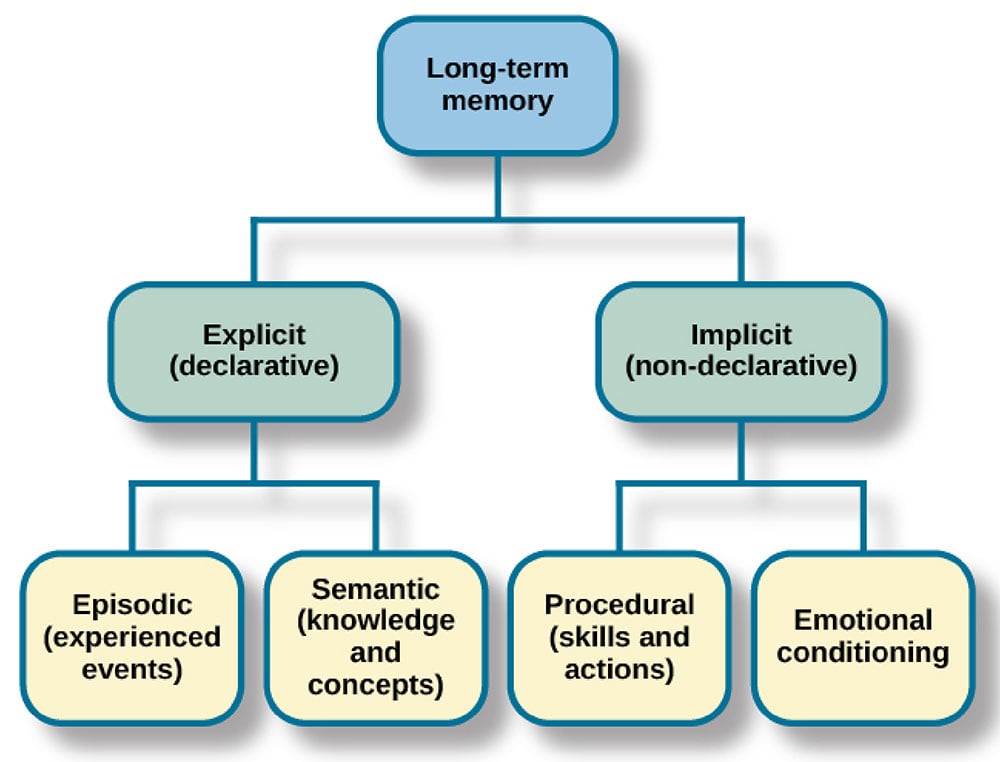
Episodic memory stores personal experiences and events, semantic memory stores facts and general knowledge, and procedural memory stores skills and how to do things, like riding a bike or tying your shoelaces.
How I Memorize the Bhagavad Gītā
N
4:59NityanandaHOST
And so the first tip is that when you're dealing with something, oftentimes you'll feel like, okay, I'm going to read the book first and then I'll go back through it and I'll like, you know, start learning things and But it's really actually dealing with the subject and applying oftentimes, sometimes type of complexity to it.
N
5:26NityanandaHOST
So if you say you're learning, you know, short-term memory, long-term memory, well, just having, okay, I'm just going to have initials, STR, LTR, or LTM, and then just writing those things down.
N
5:42NityanandaHOST
Those are not necessarily making it complex, but trying to connect it to other things and bringing in relationships and increasing the complexity.
N
5:52NityanandaHOST
Oftentimes I'll meet somebody and we meet sometimes, especially at temples, you just meet too many people.
How We Make Memories: Crash Course Psychology #13
H
7:08Hank GreenHOST
So if you weren't repeating Leonidas, you probably have forgotten it already.
H
7:12Hank GreenHOST
Because your mind, amazing as it is, can really only hold between four and seven distinct bits of information at a time, at which point the memory either decays or it gets transferred into long-term memory.
H
7:23Hank GreenHOST
Long-term memory is your brain's, like, durable and ridiculously spacious storage unit, holding all of your knowledge, skills, and experiences.
H
7:32Hank GreenHOST
Now, since the days of Atkinson and Schifrin, psychologists have recognized that the classical definition of short-term memory didn't really capture all of the processes involved in the transfer of information to your long-term memory.
H
7:43Hank GreenHOST
I mean, it's more than being able to just remember some Greek guy's name, so later generations of psychologists revisited the whole idea of short-term memory and updated it to the more comprehensive concept of working memory.
H
7:55Hank GreenHOST
Working memory involves all the ways that we take short-term information and stash it in our long-term storage.
H
9:00Hank GreenHOST
Unless you've got something unusual going on in your brain, you might not have much choice but to learn this way, like how you learned how to not put your hand into a fire.
H
9:09Hank GreenHOST
That learning would have happened pretty much automatically as soon as you first yanked your hand away from an open flame.
3 more episodes mention Long-term memory.
Create an account to see the whole feed, search across every transcript, and follow the entities you care about.