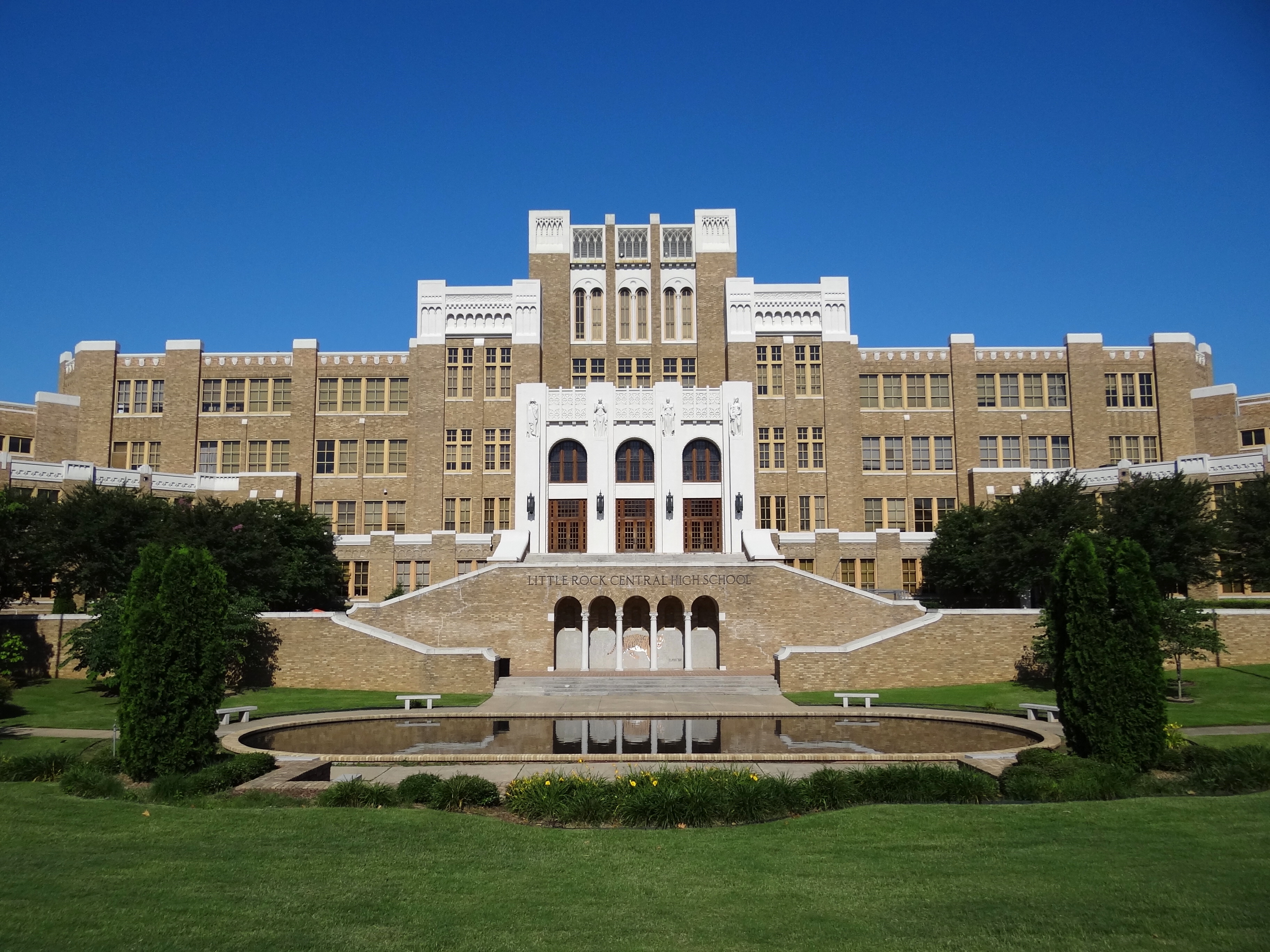
Little Rock Central High School
High school in Little Rock, ArkansasWikipedia
24
MENTIONS
22
EPISODES
18
PODCASTS
Search complete. 24 mentions across 22 episodes found for "Little Rock Central High School".
Nov 5, 2026

Leoneda IngeHOST
Tell me about her.
Marcia ChatelainGUEST
Daisy Bates is a fascinating character because she became the symbol of the fight for school integration in 1957. when she was the representative for the nine African-American students who tried to integrate Little Rock Central High School and then finally do under the protection of the National Guard.
Marcia ChatelainGUEST
And Daisy Bates is really... a case study in the celebrity culture that was also part of the civil rights movement.
Marcia ChatelainGUEST
And when I say that, it isn't just the celebrities who supported the movement like Sammy Davis Jr. and Harry Belafonte and Lena Horne.

Brian CraigHOST
Those kids were Democrats, those white kids screaming at those black kids that were the first black kids to be integrated into.
Brian CraigHOST
at Little Rock High School, those white kids were radical Democrats hurling the N-word at black Republicans, the Little Rock Nine, thank you very much, someone in the live chat.
Brian CraigHOST
You go and look at, they were Democrats, the white kids were Democrats screaming the N-word and God knows what else at those young black high school students who were Republicans who were being integrated into their school.
Brian CraigHOST
And you know, we could do this all day with the Democrats.

Margaret RutherfordHOST
I was lucky enough to have a very special experience this past week.
Margaret RutherfordHOST
I heard Dr. Terrence Roberts, who was one of the Little Rock Nine, nine black students who had the courage to enter an all-white, segregated school, Central High School in Little Rock, Arkansas.
Margaret RutherfordHOST
They had police escorts, and I'm sure it was tremendously challenging.
Margaret RutherfordHOST
scary and took a lot of courage and resilience.

Jeff NicholsGUEST
And so I would write little short stories and other things, not for any reason, not because anybody told me to, I just kind of enjoyed the process of it.
Jeff NicholsGUEST
And when 11th grade rolled around and people started talking about college, I went to Little Rock Central High.
Jeff NicholsGUEST
The idea was, what am I gonna do? You know, at that point in the mid-90s, independent cinema, especially American independent cinema, was kind of having a moment.
Jeff NicholsGUEST
I remember going to Park Plaza Mall and seeing Pulp Fiction in a mall.

Marcia ChatelainGUEST
There have been some recent publications about her that have really just been like, you know, she was a very polarizing figure for some of the reasons we would assume because of her advocacy for school integration.
Marcia ChatelainGUEST
But also for some of the ways that she moved, you know? And I remember reading a book, it might even be like 15 years now, called Elizabeth and Hazel, Two Women of Little Rock, that was about that very famous picture where Elizabeth Eckford is trying to integrate Little Rock Central High School, and there's that horrible white mob behind her, right? And she was the only one of the nine who went by herself.
Marcia ChatelainGUEST
Her family didn't have a telephone line.
Marcia ChatelainGUEST
So she didn't know the plan to all meet at Daisy Bates' house.

speaker_0HOST
These buildings, these structures, they don't belong in our timeline at all.
speaker_0HOST
At the same exact time as all of these other structures, they're also in charge of the Little Rock Central High School.
speaker_0HOST
And I remember when my town had plans to just go build palace high schools in two years.
speaker_0HOST
Those were the days.

Marcia ChatelainGUEST
There have been some recent publications about her that have really just been like, you know, she was a very polarizing figure for some of the reasons we would assume because of her advocacy for school integration.
Marcia ChatelainGUEST
But also for some of the ways that she moved, you know? And I remember reading a book, it might even be like 15 years now, called Elizabeth and Hazel, Two Women of Little Rock, that was about that very famous picture where Elizabeth, Elizabeth Eckford is trying to integrate Little Rock Central High School, and there's that horrible white mob behind her, right? And she was the only one of the nine who went by herself.
Marcia ChatelainGUEST
Her family didn't have a telephone, so she didn't know the plan to all meet at Daisy Bates' house.
Marcia ChatelainGUEST
And the white girl in the picture is 16-year-old Hazel Massery.

Kristin DiggsGUEST
It was a 1964 civil rights and voter registration campaign.
Kristin DiggsGUEST
And she said that it called to her mind an image, a particular powerful image, that she said was burned in her consciousness when she was a little girl back in 1957, which was the year of the integration of Central High School in Little Rock, Arkansas.
Kristin DiggsGUEST
The image was of a famous picture of a woman, or at the time a girl, named Elizabeth Eckford, who today is 84 years old.
Kristin DiggsGUEST
She told the story of Elizabeth Eckford, a 16-year-old black girl, among eight others.

James HakeHOST
Yeah.
James HakeHOST
With fixed bayonets confronting individuals during the desegregation crisis at Little Rock Central High School in Little Rock, Arkansas.
James HakeHOST
In September 1957, Dwight D. Eisenhower, the president, federalized the Arkansas National Guard and deployed regular troops.
James HakeHOST
from the 101st Airborne Division to enforce the federal court-ordered school integration after violent white mobs.

Walter GottliebHOST
actually.
Walter GottliebHOST
So you chose, you volunteered to be among the first black students ever to attend Central High School in Little Rock in 1957, the first school year that the Little Rock schools were desegregated.
Walter GottliebHOST
Why did you choose to do that?
Terry RobertsGUEST
Well, as I saw it, the 1954 decision, Brown v.
Walter GottliebHOST
So you knew that there would be a physical risk to your person or even your life if if you did this, what did you do in advance of September 1957 to prepare or steel yourself for that possibility?
Terry RobertsGUEST
Well, I didn't really do any special planning because we, all seven kids, learned what the reality was like.
Terry RobertsGUEST
And being attacked up at Central High School was not the first time that I had been attacked by white people in Lunarong.
Terry RobertsGUEST
So we had a history already of understanding the nature of the violence that we might be confronted with.
12 more episodes mention Little Rock Central High School.
Create an account to see the whole feed, search across every transcript, and follow the entities you care about.