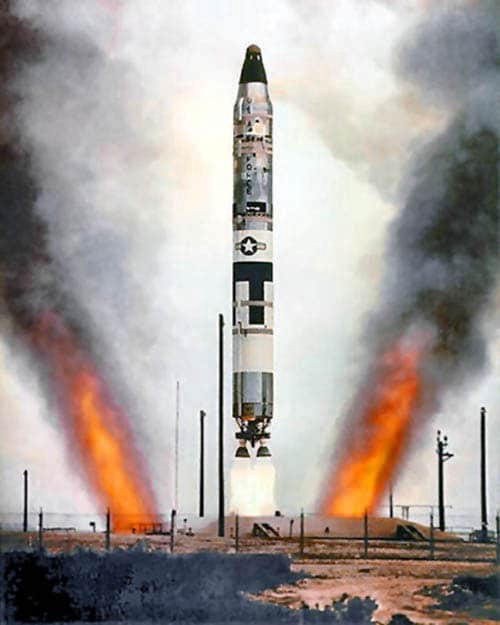
LGM-25C Titan II
Launch vehicleWikipedia
26
MENTIONS
8
EPISODES
8
PODCASTS
Search complete. 26 mentions across 8 episodes found for "LGM-25C Titan II".
Sep 14, 2026

Adam BlumenbergNARRATOR
The first is arazine-50.
Adam BlumenbergNARRATOR
It's the rocket fuel used to power the Titan II intercontinental ballistic missile, the fuel for long-range nuclear missiles.
Adam BlumenbergNARRATOR
It's probably pretty difficult to find that stuff in New York City, but I guess you never know.
Adam BlumenbergNARRATOR
She raised a second finger.

John HopkinsHOST
But below the ground, directly beneath the concrete slab at the center of the enclosure, a cavernous silo plunges 150 feet into the earth.
John HopkinsHOST
Sheathed within it is the Titan II intercontinental ballistic missile, the most powerful nuclear projectile ever built by the United States.
John HopkinsHOST
Right now, two Air Force technicians are making their way underground, passing through an intricate series of gates and secure metal access doors, descending deeper and deeper into the silo.
John HopkinsHOST
[door clanks] 21-year-old Dave Powell and 19-year-old Jeff Plum have been dispatched here to carry out some routine maintenance work on the missile.
John HopkinsHOST
These are the astonishing tales of ordinary people thrown into extraordinary situations, people suddenly forced to fight for their lives.
John HopkinsHOST
In this episode, we meet Airman Greg Devlin, a 21-year-old fuel technician in the US military.
John HopkinsHOST
Stationed at Little Rock Air Force Base, it's the job of Greg and his fellow fuel techs to sort out any fuel-related issues on board the military fleet of Titan II missiles stored in silos throughout central Arkansas.
John HopkinsHOST
On September the 18th, 1980, Greg receives an emergency call from his commanding officer informing him of a potentially catastrophic fuel leak at one of the missile sites just outside the town of Damascus.

speaker_5SOUNDBITE_SPEAKER
About 1,000 residents evacuated from the area at Damascus, Arkansas, are now returning home.
speaker_5SOUNDBITE_SPEAKER
Leaking fuel from a Titan II missile exploded in its underground silo overnight, injuring 22 Air Force personnel.
speaker_5SOUNDBITE_SPEAKER
ABC News has learned that when the explosion occurred, the nuclear warhead on top was catapulted out of the silo onto the ground nearby.
speaker_5SOUNDBITE_SPEAKER
Then it was determined that no radiation had escaped.
41 MINS LATER
speaker_5SOUNDBITE_SPEAKER
I'm Keith Berman.
speaker_5SOUNDBITE_SPEAKER
The 1,000 residents evacuated from their homes in Damascus, Arkansas, are home again.
speaker_5SOUNDBITE_SPEAKER
They're still talking about that overnight fire and explosion that rocked the Titan II missile silo, injuring 22 Air Force personnel.
speaker_5SOUNDBITE_SPEAKER
No radiation escaped, we're told.

Mark GagnonHOST
Borman's answer, "We have debris up here.
Mark GagnonHOST
This is an actual sighting." And then he confirms, "We also have the booster in sight." So the booster that they're referring to is the Titan II upper stage, which separates from the capsule when they're in space.
Mark GagnonHOST
But Borman confirmed that what they were seeing was not the booster, 'cause he's like, "I see the booster right here, and this bogey is just posted up right next to it." Now, Borman described the object as having hundreds of small particles drifting past it three or four miles out.
Mark GagnonHOST
He says, quote, "It's a brilliant body in the sun against a black background with trillions of particles on it.

Joe BaumgartenGUEST
In his 20 years of service, he was a radio operator in the Army Air Force during World War II.
Joe BaumgartenGUEST
He flew 43 combat missions as a navigator over Korea and spent the 1960s working on some of the most classified ballistic missile programs in the American arsenal: the Jupiter, the Titan I, and the Titan II.
Joe BaumgartenGUEST
He knows missiles, and he knows them better than almost anyone alive.
Joe BaumgartenGUEST
He was also due for some R&R.

Brad BirzerGUEST
And I know that especially as Americans, when we look back, we often look to Kennedy and the moonshot, but it's really Eisenhower in the '50s that gets our whole rocket program going.
Brad BirzerGUEST
And those rockets, you know, whether we're talking about the Minuteman or we're talking about the variations of the Minuteman later, the Titan II, you know, all of these missiles were being developed.
Brad BirzerGUEST
And so when Sputnik goes up, and kudos to the Soviets for getting there first, you know, when they put the first satellite in orbit in 1957, that's a huge shock to most Americans.
Brad BirzerGUEST
But people like Ray Bradbury, they've already-- They were expecting this.

NevHOST
Old 8820 John Deere header.
GreenyHOST
Uh, 88- 8820 Titan II.
GreenyHOST
This would be-
SamHOST
Titan II.
GreenyHOST
I mean, it, it's in Gympie in New South Wales, but this would be another one that would suit our man, the Tangy Drifter.
NevHOST
Mm.

WyattHOST
After a few years of waiting, Gemini 1 was launched in April of 1964.
WyattHOST
The intercontinental ballistic missile adapted by NASA for Gemini capsule launches was called the Titan II.
WyattHOST
Titan II was over 100 feet tall and weighed around 340,000 pounds.
WyattHOST
Attached to the rocket was a test Gemini capsule, though it was uncrewed for this mission.
WyattHOST
NASA aimed to validate the structure, mechanical systems, communication systems, and ground crew operations that were to be used for future missions.