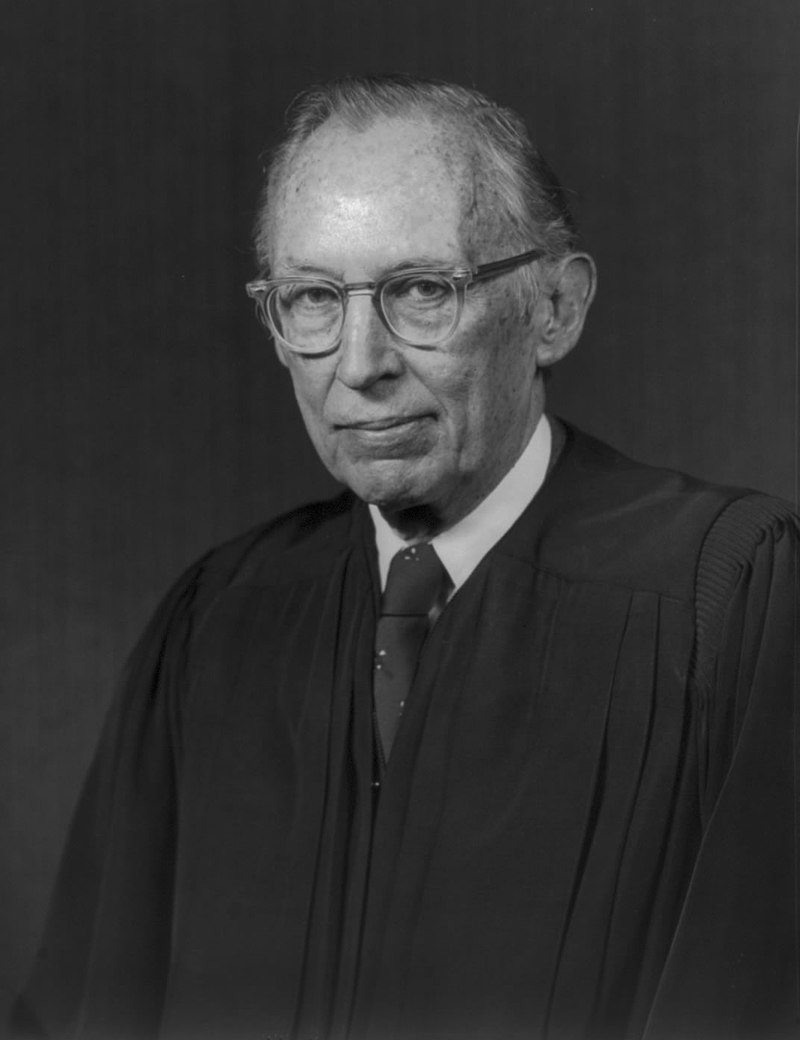
Lewis F. Powell Jr.
Lawyer and former Associate Justice of the Supreme Court of the United StatesWikipedia
28
MENTIONS
18
EPISODES
14
PODCASTS
Search complete. 28 mentions across 18 episodes found for "Lewis F. Powell Jr.".
Oct 19, 2026

speaker_1UNKNOWN
What's this? You ever
Jamie HollinHOST
heard of a guy named Lewis Powell? Oh, he's a former member of the United States Supreme Court appointed by Nixon.
Jamie HollinHOST
But before that, he's just an attorney in private practice.
Jamie HollinHOST
representing business served on many boards.
Jamie HollinHOST
And if you went back and read that memo today, it would probably set your hair on fire.
Jamie HollinHOST
It was like, Holy shit.
Jamie HollinHOST
this situation we find ourselves in in the United States, Lewis Powell wrote the fucking blueprint for it in 1971 and a memo to the United States chamber of commerce.
Jamie HollinHOST
And you hear, you hear anybody talk, talk about, you know, when did, when did our politics really, really change in a substantive way? What I'm asking, When did our politics really, really change?

MaxHOST
Within a year of his New York Times broadside, the intellectual infrastructure for a full corporate counteroffensive was being assembled.
MaxHOST
In August 1971, Lewis Powell, a corporate attorney who would be appointed to serve as an associate justice of the Supreme Court just two months later, drafted his now infamous memorandum to the US Chamber of Commerce that reads today like a founding document of the modern right.
MaxHOST
American free enterprise, Powell argued, was under systematic attack from campuses, from consumer advocates like Nader, from the media, from the government.
MaxHOST
Business needed to fight back, not issue by issue, but institutionally by funding think tanks, placing economists in universities, cultivating the judiciary, and buying the credibility of the academy itself.

Greg CarrHOST
And some of my classmates were some of the earliest members of the Federalist Societies.
Greg CarrHOST
And you've heard me talk about the Powell Memorandum, Lewis Powell working for the Chamber of Commerce and a Virginia business lawyer who would eventually come on to the Supreme Court.
Greg CarrHOST
Good morning from Macedonia, Ohio.
Greg CarrHOST
I see you, Ashley.
Greg CarrHOST
But this is when the Powell Memorandum had been written in 1987.
Greg CarrHOST
I'm sorry, 1971.
Greg CarrHOST
And Lewis Powell wrote a memorandum that talked about the intersections of capitalism, American democracy, Christianity.
Greg CarrHOST
And he said, you know, we got to have robust think tanks and create intellectual warriors to defend this thing we have built.

Roland MartinHOST
Mm-hmm.
Greg CarrPANELIST
We are in the se- we're in the sequel to slavery, and these racists, uh, racists like Lewis Powell, the author of the Bakke case, who also was the au- author, as you know, and have talked about, the Powell me- ref- uh, Powell Memorandum, which said we have to defend Christianity and capitalism, and we need think tanks, which gave birth to the Heritage Foundation, uh, a couple of years later.
Greg CarrPANELIST
Uh, they have been fighting back since the 1960s, and I think that this is a wonderful moment for us if we can seize the time, as the Black Panthers would have said in the '60s and '70s.
Greg CarrPANELIST
I say it's a wonderful time because, you know, the most recent issue of The New Yorker that just came out this week is talking about a civil war going on at The Heritage Foundation.

Leeja MillerHOST
When Reagan was given his first shot at nominating a Supreme Court justice in 1986, Bork was once again passed over in favor of his colleague, Antonin Scalia, nearly 10 years his junior and technically with less experience on the bench.
Leeja MillerHOST
Finally, Bork's time came a year later in 1987 when Reagan nominated him to replace retiring Justice Lewis Powell on the US Supreme Court.
Leeja MillerHOST
The only problem was that by that time, Democrats controlled Congress, and Bork's reputation preceded him.
Leeja MillerHOST
Not only had he proved himself willing to kowtow to the authority of the president, no matter what ethics or morals might come into play with his willingness to fire Archibald Cox 14 years prior, but in his years as a professor and academic at Yale Law School, Bork had also made a name for himself as a far-right conservative nut job who espoused deeply questionable ideals that made him an outlier.
Thom HartmannHOST
And then Ronald Reagan came into office and said, no, we're going to take that apart and we're going to do it based on the Powell memo from 1971.
Thom HartmannHOST
Lewis Powell by then was on the Supreme Court and had written the Buckley decision, the 1978 decision that said corporations are persons and money is speech.
Thom HartmannHOST
So, you know, two years after the Powell memo, you had the Heritage Foundation.
Thom HartmannHOST
You had the ALEC being formed.

Jonathan KaufmanGUEST
You know, he cut out part of that famous Powell memo, which was the kind of blueprint that conservatives relied on.
Jonathan KaufmanGUEST
This was, uh, Lewis Powell, who eventually became a Supreme Court justice, but beforehand wrote this, uh, paper for, uh, the Chamber of Commerce, which basically said, "If conservatives wanna win, we have to take over the universities.
Jonathan KaufmanGUEST
We have to be in the media.
Jonathan KaufmanGUEST
We sort of have to be everywhere.

Thom HartmannHOST
The oligarchs, however, were just getting started, just like they did during the Industrial Revolution following the Civil War that produced the first Gilded Age.
Thom HartmannHOST
As I lay out in The Hidden History of American Oligarchy, the counterattack began in 1971 when a corrupt tobacco lawyer named Lewis Powell wrote a memo, memo for the US Chamber of Commerce, urging corporate America to step up and use their great wealth to seize control of our courts, campuses, media, low media cost, low population states that could be flipped red, and Congress.
Thom HartmannHOST
The Heritage Foundation and Alec followed within two years as right-wing billionaires started buying radio stations, newspapers, and television networks, as Margaret Thatcher and Ronald Reagan turned the pro- project into government policy.
Thom HartmannHOST
The regulations and tax rates that had restrained great wealth and political corruption came down, and the money and political power of giant corporations and the morbidly rich have largely controlled both our po- politics and our economy ever since.

Richard RJ EskowHOST
Uh, the expectation was w- what, uh, you described with Ball and Cohen that, that this would gradually expand and become a universal program, and yet somewhere along the line something changed, and, uh, what was that something in your view?
Nancy J. AltmanGUEST
Well, I think there's a very important memorandum, 1971, written by Lewis Powell that not enough people know about.
Nancy J. AltmanGUEST
He was a corporate lawyer and then became a justice on the Supreme Court.
Nancy J. AltmanGUEST
Um, and he wrote, um, a, really I would call it a screed rather than a, a memo.
Richard RJ EskowHOST
Um, you also had this changing perception of the world that seemed to infect both Democrats and Republicans, perhaps varying degrees, but as Margaret Thatcher said in Great Britain, "There is no alternative." That there is only this, uh, so-called free market system that's neither free nor a market, but is called a free market system, uh, to, to guide us.
Richard RJ EskowHOST
There is only that kind of, uh, uh, capitalism and capitalism in general, that social insurance, social programs, the public sector have no place in the future of the world.
Richard RJ EskowHOST
And it seems to me, uh, um, I think if we look back over the post-war era and even before going into the Depression when Social Security was created, this was not the way, uh, many people saw the world, was it? I mean, it feels to me that a minority viewpoint, a rather extreme right-wing viewpoint, has sort of suffused the whole political, uh, and intellectual world, which I guess, you know, Lewis Powell had something to do with that too, but, uh, do, uh, do you agree with that?
Nancy J. AltmanGUEST
I agree completely, and it's- I, I mean, I don't think if we were coming up with, um, these institutions today, we would have public libraries, we would have-

SamHOST
And here's where the book gets its title, because Anderson names names.
SamHOST
The most important one is Lewis Powell, a corporate lawyer who later became a Supreme Court justice.
SophieHOST
In 1971, he wrote a confidential memo to the U.S. Chamber of Commerce.
SophieHOST
His argument was that the business community was under attack from liberal forces and needed to mount a systematic counter offensive.
8 more episodes mention Lewis F. Powell Jr..
Create an account to see the whole feed, search across every transcript, and follow the entities you care about.