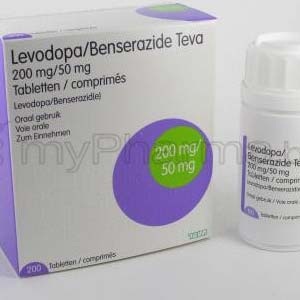
Levodopa
MedicationWikipedia
39
MENTIONS
30
EPISODES
29
PODCASTS
Search complete. 39 mentions across 30 episodes found for "Levodopa".
Nov 2, 2026

Anderson ToddGUEST
And so, you know, in a sense, this makes sense to me, right? If you have a system that has, let's call them reinforcement markers, right? So, you know, we know, for instance, that, you know, the dopaminergic system, as an example, right? You're going to reinforce the pathways that lead to something.
Anderson ToddGUEST
And if you jack up dopamine artificially, right, through L-DOPA or through an amphetamine or something, you're going to tend to reinforce pathways that, right, you're going to tend to reinforce behaviors that led to the thing in this pursuit.
Anderson ToddGUEST
Okay.
Anderson ToddGUEST
So what makes sense to me is that you also have a system that is triggered by that is triggered by negative experience and serves to kick off the breakdown of dysfunctional modeling.

Eric BergHOST
And so whether someone takes them because they're deficient in serotonin or once they take them, they become deficient, We don't know, but there's a serotonin connection.
Eric BergHOST
There's also a dopamine connection because they found that when someone takes like L-Dopa, which is a precursor to dopamine.
Eric BergHOST
there's a lower incidence of bruxism.
Eric BergHOST
And they both do also relate to the autonomic nervous system.

Paul AustinHOST
Sure, sure.
Tobias ErnyGUEST
So basically, there's this one standard medication, which is a mixture of levodopa, L-dopa and carbidopa, which are both precursors to dopamine.
Tobias ErnyGUEST
Basically.
Tobias ErnyGUEST
And the L-Dopa, Carbidopa combination, I think in the United States there's a preparation called Madopar.

Marjorie WoollacottGUEST
No, this is a real physiological effect.
Marjorie WoollacottGUEST
Even because I studied Parkinson's disease with L-DOPA, which is what we usually give people.
Marjorie WoollacottGUEST
If you give them the placebo and tell them it's L-DOPA, it will change the parts of the brain involved in the various basal ganglia nuclei that actually create And they get better and you see it physiologically and you go, oh my God, but this is the scariest part for me.
Marjorie WoollacottGUEST
They did an experiment.
Marjorie WoollacottGUEST
I think it was National Institute of Mental Health where they told, I believe in this case, it was dentists.

Tony BreuHOST
And it is certainly true that patients with Parkinson's disease have a two to six-fold increased risk of developing melanoma when you compare them to the general population.
Tony BreuHOST
Now, this connection was first made in the 1970s, and this was within 10 to 15 years of the development and rollout of Levodopa.
Tony BreuHOST
And so there was a concern at the time that this was related to Levodopa and that Levodopa was the trigger here.
Tony BreuHOST
But later studies showed that the increased risk is present even before the Parkinson's diagnosis is made.
Tony BreuHOST
And so the risk about a medication side effect, specifically again from levodopa, that's waned over time.

Iain McGilchristGUEST
in which people became frozen and almost as if they'd gone to sleep.
Iain McGilchristGUEST
And then they discovered around that time in the late 60s that using L-Dopa, using dopamine, they could actually bring these people back to experience.
Iain McGilchristGUEST
And it was beautiful for a number of reasons.
Iain McGilchristGUEST
He... was able to portray these people as individuals in their own right, not just as exemplars of something, but he was able also to see through the lens of that unique person and their life, the way in which when something changes in your body, in this case in your brain, it changes your whole way of being.

Mark BurnettGUEST
And that's why it was never noticed before.
Mark BurnettGUEST
We should point that L-Dopa was noticed in India because the local people would treat it for tremors.
Mark BurnettGUEST
In this case, this particular plant species, they had always made a hot tea out of it.
Mark BurnettGUEST
or they had cooked it.

Nathalie NiddamHOST
it.
Nathalie NiddamHOST
What's kind of like L-DOPA, right? It just doesn't...
Henry MahnckeGUEST
That's precisely correct, right? You got to, in the end, fix what's broken if you're going to kind of change outcomes here.
Henry MahnckeGUEST
And of course, that's what we're most excited about from a neuroplasticity perspective is, hey, can we fix what's broken? Right.

Leonie CorcoranHOST
And what does your medication look like, like in terms of a day to day? Yeah,
Catriona KinneveyGUEST
so I'm on Levodopa, which is kind of a standard protocol for a lot of people with Parkinson's.
Catriona KinneveyGUEST
And I take it three times a day.
Catriona KinneveyGUEST
Okay.

Dave FarinaHOST
With this ligand and less than 1 mole percent rhodium-1 precursor, Knowles obtained an enantiomeric ratio of 97.5 to 2.5 in favor of the desired S enantiomer, and an overall yield of over 99%.
Dave FarinaHOST
This allowed Monsanto to commercialize the single enantiomer version of the drug L-DOPA, which was useful against Parkinson's disease as popularized by the famous movie Awakenings with Robert De Niro and Robin Williams.
Dave FarinaHOST
Obviously, the ligand-SS dipamp, if desired, would have led to the precise opposite enantiomeric ratio.
Dave FarinaHOST
This type of catalytic enantioselective transformation is especially useful because it is able to transfer chirality from a small amount of ligand to the entire batch of product.
20 more episodes mention Levodopa.
Create an account to see the whole feed, search across every transcript, and follow the entities you care about.