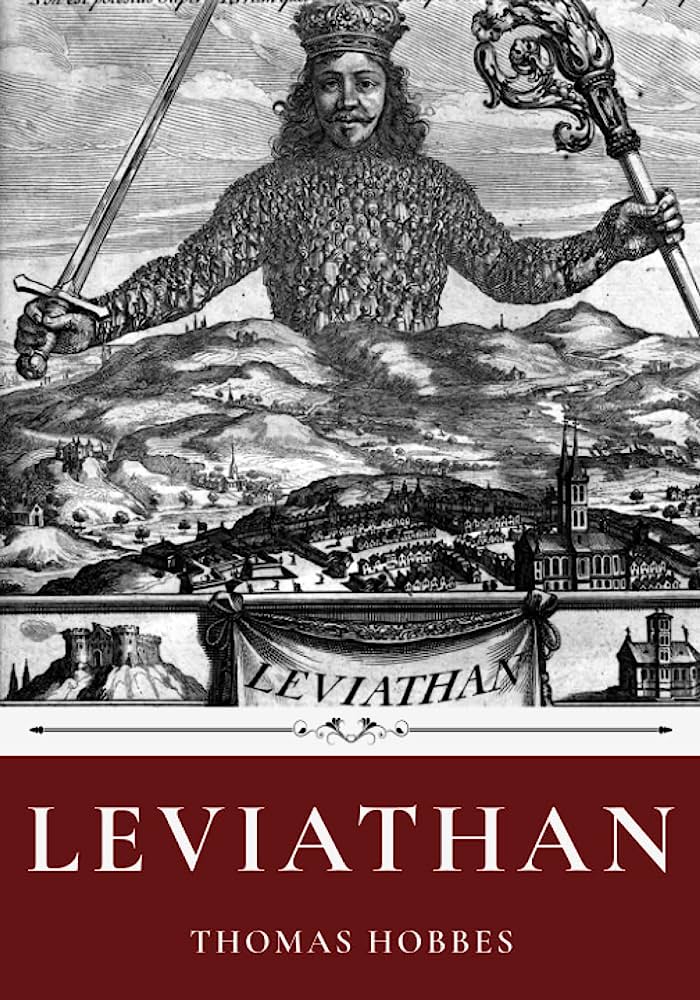
Leviathan
Book by Thomas HobbesWikipedia
247
MENTIONS
26
EPISODES
25
PODCASTS
Search complete. 247 mentions across 26 episodes found for "Leviathan".
Oct 31, 2026

Heka AstraHOST
Celsus described seven ruling demons, each tied to an animal and a planetary gate.
Heka AstraHOST
Both their order and the second book of Enoch start with the planet or gate of Saturn and end with the sun.
Heka AstraHOST
They believed Mikael and Samael composed the two serpents of creation.
Heka AstraHOST
Samael is the one linked to Lilith, the garden serpent, and the chief archon Yaldabaoth.
16 MINS LATER
Julian SolaninkaGUEST
And then Elijah is like the incarnation of the cold logos of If you think about it, Elijah is basically like a stand-in for God because I think his name actually means like supreme one or like a stand-in for God.
Julian SolaninkaGUEST
So in this case, it definitely does come to be that Carl Jung describes the baptism of wisdom.
Julian SolaninkaGUEST
that Nikolai Frederick described as well, the Illuminati bookstore owner and philosopher who inspired Eliphas Levi to draw the Baphomet.
Julian SolaninkaGUEST
So there is a direct connection here with the head.

David McGroganGUEST
So that's Hobbes.
David McGroganGUEST
The problem with Hobbes, there are lots of problems with Hobbes, but one of the problems with Hobbes is he doesn't really have an account of politics So he more or less says, well, the Leviathan simply imposes order, right? And it's not really for you or I, the hoi polloi, to inquire into the system of order that he's introducing.
David McGroganGUEST
You just have to accept it.
David McGroganGUEST
We have to think about the choices that the Leviathan is making in a more sophisticated way.
David McGroganGUEST
If the Leviathan... is intervening in society to resolve conflicts by applying the law, then by definition, it has to choose whose desires win in a particular conflict, right? You have different competing pursuers of desire.
David McGroganGUEST
They enter into a conflict.
David McGroganGUEST
The Leviathan has to resolve the conflict by choosing one set of preferences over another, right? So the state becomes more biased towards certain sets of preferences than others.
David McGroganGUEST
It's involved in making political choices, value-based choices about who it prefers.

Jae Yeon KimGUEST
Let's just focus on artificial.
Jae Yeon KimGUEST
What do you mean by artificial? I mean, those of us who study liberal arts or political science in college, you may remember Thomas Hobbes, Leviathan, social contract theory.
Jae Yeon KimGUEST
So Thomas Hobbes believed that real science is artificial science.
Jae Yeon KimGUEST
And the reason that he thought that way is because, unlike the nature, These societies are made by people.

Hans UtterGUEST
So, but let me just read this quote here.
Hans UtterGUEST
So, John Dee, just to say, if we look at Thomas Hobbes, we look at Leviathan, we look at these scientific control societies, you know, all this stuff.
Hans UtterGUEST
We can find this four or five hundred years ago before they didn't even have, we didn't have electricity and they're talking about electricity.
Hans UtterGUEST
You know, these type of things like are, you know, the global brain and everyone being integrated into this dematerialized, you know, death spear, basically, which is what they're trying to do, right, is upload everybody into these this overlay on the architecture of the universe, which is fundamentally against God, against nature.
Sean McCannHOST
And it's like a demiurge who created his own little realm for us to be trapped in, right?
Hans UtterGUEST
Oh, absolutely.
Hans UtterGUEST
And again, if you, if you do the research, especially these, you know, I mentioned Leviathan, but you know, there's a variety of other, um, uh you know other works that that you know clearly communicate this and we'll get a bit into the rosicrucian so what i want to state is that this the renaissance and this being connected with science as the as they move towards this materialistic scientific cartesian reality those in the upper echelons are still very much connected with this idea of magic sorcery and using all these things including using this to make inventions appear in the physical world right so there's cases of this where you know they're envisioning the computer and this state 500 years ago right and so this is where you cut across the normal sort of axial flow of history right and and so again john d i mean we are still living under this just a cold empire today um and and and our cult of science is is you know look at it i mean look look at what they're doing genetic modification you know you chimeric human animal hybrids you putting a freaking microchip in your brain i mean right
Sean McCannHOST
I mean, even the laws of where they made it so that a person can own life if it's genetically engineered.

Evy PoumpourasGUEST
I am absolutely, I think we are very lenient on crime.
Evy PoumpourasGUEST
And, you know, it reminds me too of the Leviathan, if you've ever read it by Hobbes.
Evy PoumpourasGUEST
It's like a political theory book.
Evy PoumpourasGUEST
And he talks about, Hobbes, he said, this was written a long time ago, Hobbes says, the human being, like as human beings, if you leave us by ourselves, we're going to look out for our own self-interests and we're going to hurt one another.

Tom AllenHOST
And Diderot is going to slam it.
Tom AllenHOST
Uh, uh, Thomas Hobbes, who wrote Leviathan, he's gonna cra- tra- trash the Crusades.
Tom AllenHOST
So it's gonna- we're gonna come out of the Enlightenment, and then kinda through the 20th century, the militance, and it's gonna become more of a politic- political thing in the 20th century.
Jono SayeHOST
Mm-hmm.

Courtenay TurnerGUEST
And of course, he says that Rome was one of them.
Courtenay TurnerGUEST
And then he talks about the Leviathan, like Thomas Hobbes' Leviathan as being a catacomb.
Courtenay TurnerGUEST
He talks about the anti-communist movement as being a catacomb, which is the restrainer, right? He's from Thessalonians.
Courtenay TurnerGUEST
He says it's the restrainer, and he believes the restrainer to Armageddon, like the one world, you know, order.

Miranda MelcherHOST
And really the debates are a lot more about kind of how do we practically achieve this and to what lengths should we or can we go to make this possible? That idea that all people are equal isn't something that has been true forever.
Miranda MelcherHOST
How did that happen? When did that happen? Why did that happen? Those are all really intriguing questions that obviously have implications for political theory, for philosophy, but also a lot more broadly, given just how much I think we all take for granted this idea that we now think all humans are fundamentally equal.
Miranda MelcherHOST
So there's a lot for us to get into here.
Miranda MelcherHOST
Teresa, thank you so much for joining me on the podcast.
Teresa BejanGUEST
So that's kind of always where I start.
Teresa BejanGUEST
And I sort of set out working on this book thinking that the trajectory would be short.
Teresa BejanGUEST
The common sense assumption, certainly in the fields of political theory and political philosophy, is that the idea of human equality, that all human beings are equal, is a distinctly modern idea.
Teresa BejanGUEST
So if we want to kind of go to the start of that to understand what it meant, we would only really need to go to the latter part of the 18th century, you know, with the great sort of natural rights declarations, the Declaration of Independence, the Declaration of the Rights of Man and Citizen, the Haitian Constitution.

Miranda MelcherHOST
And really the debates are a lot more about kind of how do we practically achieve this and to what lengths should we or can we go to make this possible? That idea that all people are equal isn't something that has been true forever.
Miranda MelcherHOST
How did that happen? When did that happen? Why did that happen? Those are all really intriguing questions that obviously have implications for political theory, for philosophy, but also a lot more broadly, given just how much I think we all take for granted this idea that we now think all humans are fundamentally equal.
Miranda MelcherHOST
So there's a lot for us to get into here.
Miranda MelcherHOST
Teresa, thank you so much for joining me on the podcast.
Teresa BejanGUEST
So that's kind of always where I start.
Teresa BejanGUEST
And I sort of set out working on this book thinking that the trajectory would be short.
Teresa BejanGUEST
The common sense assumption, certainly in the fields of political theory and political philosophy, is that the idea of human equality, that all human beings are equal, is a distinctly modern idea.
Teresa BejanGUEST
So if we want to kind of go to the start of that to understand what it meant, we would only really need to go to the latter part of the 18th century, you know, with the great sort of natural rights declarations, the Declaration of Independence, the Declaration of the Rights of Man and Citizen, the Haitian Constitution.

CamHOST
That's why we're here.
CamHOST
I can't stop thinking and talking and connecting other works of art, right? But I remember Thomas Hobbes' Leviathan as being one of the books that spoke to me more than pretty much any other work of philosophy I read, maybe some Descartes, just because it's really well-written.
CamHOST
It doesn't really matter how true something is.
CamHOST
I just enjoy the good writing.
CamHOST
He was a good writer.
CamHOST
You can't fuck with it.
CamHOST
But the cover of Leviathan is super interesting because it looks like this big figure that's kind of opulently dressed.
CamHOST
But if you zoom in and look at it real close, it's made up of all of these other figures.
16 more episodes mention Leviathan.
Create an account to see the whole feed, search across every transcript, and follow the entities you care about.