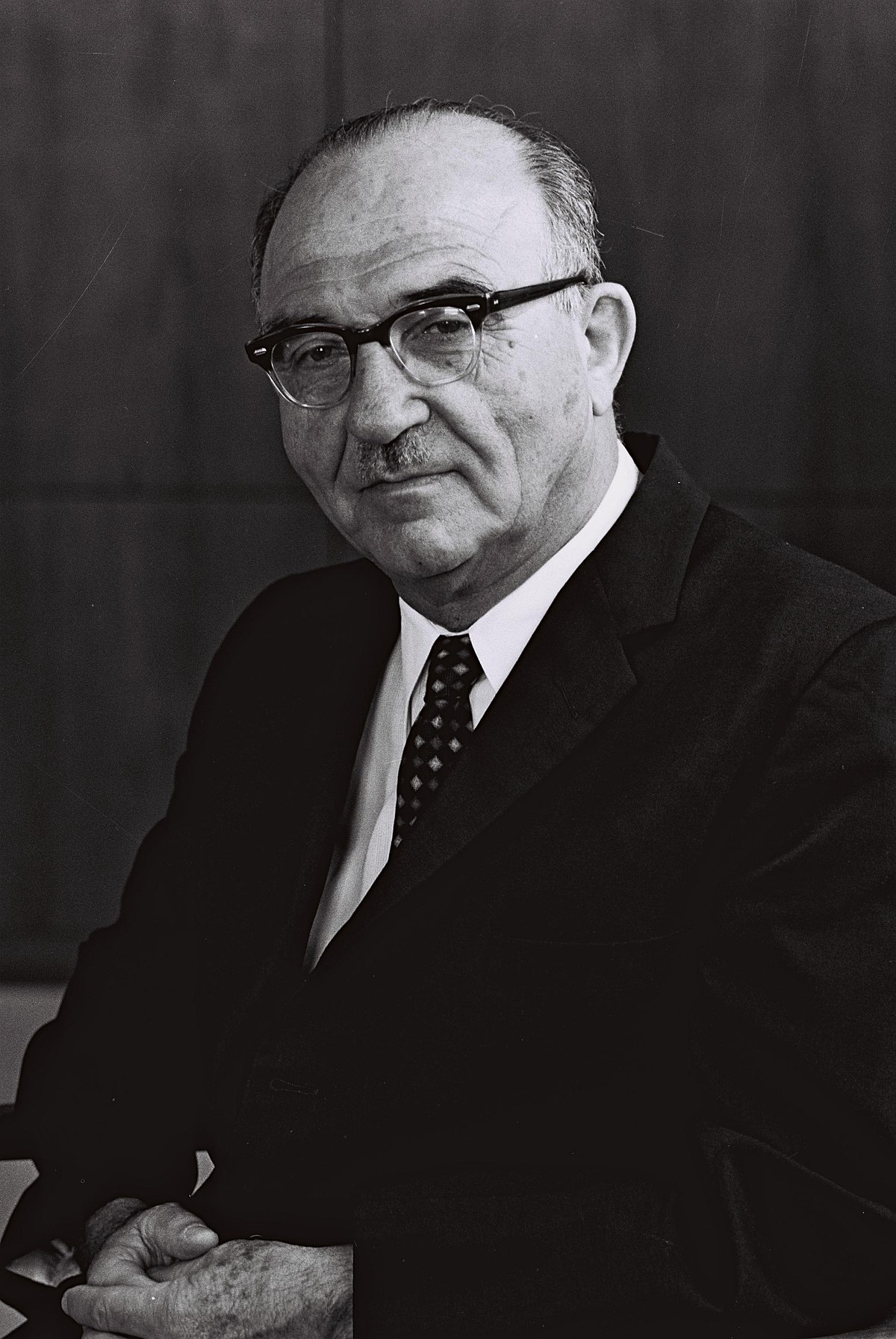
Levi Eshkol
Former Prime Minister of IsraelWikipedia
25
MENTIONS
13
EPISODES
13
PODCASTS
Search complete. 25 mentions across 13 episodes found for "Levi Eshkol".
Sep 23, 2026

Jeffrey SachsGUEST
And then when President, uh, Kennedy was s- absolutely livid that Israel was going to put nuclear weapons into the Middle East and insisted, "Now we have waited months, years for inspection.
Jeffrey SachsGUEST
We will come to inspect." That's when the first Prime Minister of Israel, Ben-Gurion, resigned, and he resigned, uh, in a tactical resignation because he was followed by a man named Levi Eshkol.
Jeffrey SachsGUEST
And Eshkol said to President Kennedy, "Oh.
Jeffrey SachsGUEST
Oh, oh, uh, sorry, I've just come into office.

Michael R. FischbachGUEST
And so he took it upon himself, both when he ran for Senate in 1964, and thereafter to become vocal, not on a continuous basis, but certainly advocating the United States to stand behind Israel, particularly in its struggle with Egypt and the Egyptian president, Jamal al-Nasr, provide them whatever assistance they need, including military support.
Michael R. FischbachGUEST
And then in And in December of 1967, the Israeli, in January 1968, the Israeli Prime Minister Levi Eshkol came to the United States and asked President Lyndon Johnson if the U.S. would provide these top-of-the-line aircraft, F-4 Phantoms.
Michael R. FischbachGUEST
And Johnson said, well, eventually, yes.
Michael R. FischbachGUEST
And Robert Kennedy immediately, he met Eshkol himself in New York two days after the meeting with Johnson and immediately came out and said, well, I think we should send these jets.
Morteza HajizadehHOST
And I guess still politicians all over the world.
Morteza HajizadehHOST
I live in Australia.
Morteza HajizadehHOST
I'm the prime minister of Australia now, Anthony Albanese, who in his young days when he was an MP was a supporter of the Palestinian cause.
Morteza HajizadehHOST
Now he's the prime minister.

Michael R. FischbachGUEST
And so he took it upon himself, both when he ran for Senate in 1964 and and thereafter to become vocal, not on a continuous basis, but certainly advocating the United States to stand behind Israel, particularly in its struggle with Egypt and the Egyptian president, Jamal al-Nasr, provide them whatever assistance they need, including military support.
Michael R. FischbachGUEST
And then in And in December of 1967, the Israeli, in January 1968, the Israeli Prime Minister Levi Eshkol came to the United States and asked President Lyndon Johnson if the U.S. would provide these top-of-the-line aircraft, F-4 Phantoms.
Michael R. FischbachGUEST
And Johnson said, well, eventually, yes.
Michael R. FischbachGUEST
And Robert Kennedy immediately, he met Eshkol himself in New York two days after the meeting with Johnson and immediately came out and said, well, I think we should send these jets.
Morteza HajizadehHOST
And I guess still politicians all over the world.
Morteza HajizadehHOST
I live in Australia.
Morteza HajizadehHOST
I'm the prime minister of Australia now, Anthony Albanese, who in his young days when he was an MP was a supporter of the Palestinian cause.
Morteza HajizadehHOST
Now he's the prime minister.

Michael R. FischbachGUEST
And so he took it upon himself, both when he ran for Senate in 1964 and and thereafter to become vocal, not on a continuous basis, but certainly advocating the United States to stand behind Israel, particularly in its struggle with Egypt and the Egyptian president, Jamal al-Nasr, provide them whatever assistance they need, including military support.
Michael R. FischbachGUEST
And then in So in December of 1967, in January 1968, the Israeli Prime Minister Levi Eshkol came to the United States and asked President Lyndon Johnson
speaker_0ADVERTISER
if
Michael R. FischbachGUEST
the U.S. would provide these top-of-the-line aircraft, F-4 Phantoms.

Yehuda GebererHOST
What do we do now? Do we s-- tell them to stay at sea until the ceasefire is over, or do we tell them to come to Israel?" So to that end, a meeting was arranged between Begin and senior Irgun officials on one side and representatives of Ben-Gurion's government on the other side.
Yehuda GebererHOST
Those two representatives were Yisrael Galilee and Levi Eshkol.
Yehuda GebererHOST
Levi Eshkol, I think people are familiar with, an old Mapai leader who later became the Prime Minister.
Yehuda GebererHOST
Yisrael Galilee is an important person in this story because he is the-- one of the acting heads of the Israeli military at this time.
Yehuda GebererHOST
And not only that, but he previously was one of the heads of the Palmach, who Ben-Gurion tried to get rid of when he was dismantling the Palmach.

Isaac ZileSOUNDBITE_SPEAKER
You also had Yitzhak Rabin, then a general, acknowledging that Nasser's concentrations were defensive in character and that the Israeli leadership at the time of the war knew this, an assessment he shared with his fellow Israeli generals such as Iser Wiseman, the commander of the Air Force, who also argued that Israel was not in any danger.
Isaac ZileSOUNDBITE_SPEAKER
But the most damning admission of Israeli guilt comes from the sitting Israeli prime minister at the time of the Six-Day War, Levi Eshkol, who outright admitted that he didn't think Nasser was trying to wage war, only to immediately switch gears and help invent a fake story claiming Egypt attacked first so Israel would appear to be the victim in the fog of war and the UN wouldn't force a ceasefire.
Isaac ZileSOUNDBITE_SPEAKER
Then, once Israel had achieved its military objectives, Eshkol and his government abandoned that lie.
Isaac ZileSOUNDBITE_SPEAKER
It was then and only then that the Israelis ditched their original claim that Egypt struck first and embraced the now infamous narrative that they had launched a preemptive strike in self-defense.
19 MINS LATER
Isaac ZileSOUNDBITE_SPEAKER
Instead, it entrenched its occupation of the territories, almost immediately began filling them with its own civilian settlers in a brazen act of colonialism, and remained intransigent.
Isaac ZileSOUNDBITE_SPEAKER
Another war was becoming increasingly inevitable.
Isaac ZileSOUNDBITE_SPEAKER
In early 1969, Golda Meir took over as Israeli Prime Minister following the death of Levi Eshkol.
Isaac ZileSOUNDBITE_SPEAKER
She notoriously had a propensity for intransigence and this ended up being her Achilles heel.

David MilstonHOST
And if that's not bad enough, we have the beginning of Parashat Shelach, where the people reject Israel.
David MilstonHOST
They think it's better to stay in the wilderness with the Mishkan, And if that's not bad enough, then we have Parashat Korach, where for the first time in our history, the tribe of Levi is involved in a scandal.
David MilstonHOST
Remember, the Levim weren't involved in Chet Ha'Egel, the Levim weren't involved in the Meraglim, and now the Levim rebel.
David MilstonHOST
Korach rebels, the Levim rebel, some of them at least with Korach.
David MilstonHOST
And if that's not bad enough, Moshe Rabbeinu falls in Parashat Chukot.
David MilstonHOST
So you're going out, this is the reality and what do we experience when we read about the reality in Torah is failure, is falling, is disaster.
22 MINS LATER
David MilstonHOST
In 1967, a man that very few of you have heard of because he's not very famous.
David MilstonHOST
He was very humble.

Brannon HowseHOST
Was Ben-Gurion still president during the 1956 Sinai campaign? If it
Aaron LavarcoGUEST
wasn't Ben-Gurion, it could have been Levi Eshkol, who was the prime minister in 1967.
Aaron LavarcoGUEST
But I think Ben-Gurion was still the prime minister at this stage.
Aaron LavarcoGUEST
Okay, we're going to double check.

Brannon HowseHOST
Was Ben-Gurion still president during the 1956 Sinai campaign? If it
Aaron LavarcoGUEST
wasn't Ben-Gurion, it could have been Levi Eshkol, who was the prime minister in 1967.
Aaron LavarcoGUEST
But I think Ben-Gurion was still the prime minister at this stage.
Aaron LavarcoGUEST
Okay, we're going to double check.

Travis KircherCORRESPONDENT
Then, in June of 1967, tensions were rising between Israel and Egypt over the closure of maritime passageways, particularly the Straits of Tyre.
Levi EshkolSOUNDBITE_SPEAKER
Premier Levi Eshkol says Israel has no intention of attacking its Arab neighbors, calling for a mutual reduction of Arab-Israeli forces massed along the border.
Travis KircherCORRESPONDENT
Israel feared a three-pronged attack from Egypt, Syria, and Jordan, and Israeli officials worried that the country might not survive it.
Travis KircherCORRESPONDENT
Never again, said Israel.
3 more episodes mention Levi Eshkol.
Create an account to see the whole feed, search across every transcript, and follow the entities you care about.