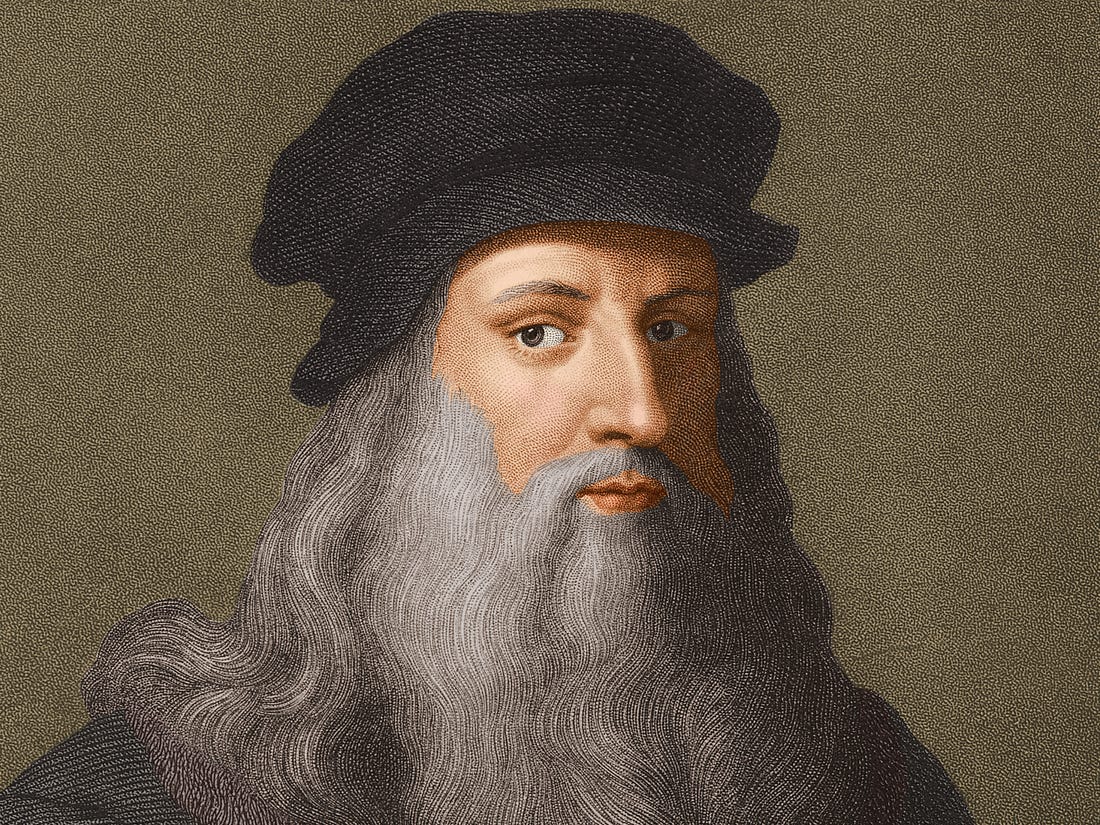
Leonardo da Vinci
Italian polymathWikipedia
1.3k
MENTIONS
668
EPISODES
539
PODCASTS
Search complete. 1270 mentions across 668 episodes found for "Leonardo da Vinci".
Sep 11, 2026
#327 - Think Like Leonardo da Vinci (Part 5)
M
0:37MikeHOST
All right, so what is five-star Friday, Mike? Well, first quick trivia question for you.
M
0:42MikeHOST
How many paintings by Leonardo da Vinci hang in the Louvre?
N
0:46NickHOST
Well, being that you already revealed that it's five-star Friday, I'm going to assume the answer is cinco.
N
0:52NickHOST
The answer is five.
Mantua: The Renaissance Court That Rivaled Florence | Italy's Masterpiece Series Episode 4
K
9:10Katerina FerraraHOST
She was one of the most educated, cultured, and politically astute women of her age.
K
9:16Katerina FerraraHOST
corresponding with Leonardo da Vinci, collecting masterpieces by Mantegna, Raphael, Titian, and Perugino, and assembling one of Europe's greatest collections of art and antiques.
K
9:26Katerina FerraraHOST
I have to admit that Isabella is one of my favorite figures in Renaissance history.
K
9:30Katerina FerraraHOST
The more I read about her, the more remarkable she becomes.
10 MINS LATER
K
19:05Katerina FerraraHOST
Admission, of course, was by invitation only.
K
19:07Katerina FerraraHOST
Princes, ambassadors, scholars, and visiting artists considered it a privilege to be shown inside because Isabella's collection quickly became one of the most admired in Europe.
K
19:17Katerina FerraraHOST
As we walked through her apartments, I couldn't help imagining Isabella herself moving through these rooms, meeting diplomats, writing letters to Leonardo da Vinci, discussing new commissions with Andrea, Montaigne, or entertaining distinguished guests from the courts across Europe.
K
19:32Katerina FerraraHOST
It's easy to forget that while kings and dukes often dominate the history books, Isabella was every bit as influential in shaping the artistic identity of Mantua.
Misscraft Episode 5 - Caught Farmhanded
J
55:04Jameson OxfordHOST
Irvin has like this lovely diagram of like the dissected scarecrow and the vines running through it, drawn in a little notepad by this point.
J
55:15JeffPANELIST
Irvin's over here fucking Leonardo da Vinci.
I
55:18IanPANELIST
Yeah, exactly.
I
55:19IanPANELIST
Yeah.
#G129 (graffiti to grail)
S
35:19SpencerHOST
Oh, and actually I did go.
S
35:20SpencerHOST
There's a da Vinci museum in Milan, and, um, there's a, like a digital recreation of the Last Supper, and they've been able to do scans because it's all old and falling apart.
S
35:35SpencerHOST
They've been able to do digital scans and, like, see, see things that you can't see with the naked eye, and they've, they, there's like, uh, there's, uh, like d- uh, test drawings that he did and stuff.
S
35:50SpencerHOST
Um, so this picture, I don't think this is a, a factual.
Herbals, Their Origin and Evolution A Chapter in the History of Botany-Agnes Arber
J
6:22Josh LeachNARRATOR
The great majority of the illustrations are reproduced from photographs taken directly from the originals by Mr. W. Tams of Cambridge, to whom I am greatly indebted for the skill and care with which he has overcome the difficulties incidental to photographing from old books, the pages of which are so often wrinkled, discolored, or worm-eaten.
J
6:48Josh LeachNARRATOR
For the use of plate 18, which appeared in Leonardo da Vinci's notebooks, I am under obligations to the author, Mr. Edward McCurdy, M.A., and to Messrs. Duckworth and Company.
J
7:02Josh LeachNARRATOR
Text figures 7, 18, 77, 78, and 112 are reproduced by the courtesy of the Council of the Bibliographical Society from papers by the late Dr. Payne, to which the references will be found in Appendix 2, while for the use of text figure 108, I am indebted to the Royal Numismatic Society.
J
7:27Josh LeachNARRATOR
For permission to utilize the modern facsimile of the famous Dioscorides manuscript of Juliana Anicia, from which plates 1, 2, and 15 are derived, I have to thank Professor Dr. Josef Ritter von Karabasek of the K.K. Hoff Bibliothek in Vienna.
4 HRS 37 MINS LATER
K
284:45K. HandNARRATOR
The former is reproduced on a small scale in plate 17.
K
284:48K. HandNARRATOR
It is scarcely possible to imagine a more perfect habit drawing of a plant.
K
284:54K. HandNARRATOR
In Italy, Leonardo da Vinci's exquisite study of plants, of which plate 18 is an example, must also have pointed the way to a better era of herbal illustration.
K
285:04K. HandNARRATOR
In his work, the artistic interest predominates over the botanical to a greater extent than is the case with Dürer's drawing.
Renaissance and the Reformation A Textbook of European History 1494-1610-Emmeline Tanner
P
60:56Pamela NagamiNARRATOR
Pietro Perugino, who died in fifteen twenty-four, the master of Raphael; Mantegna, fourteen thirty to fifteen oh six, the inventor of engravings; the Bellini and Carpaccio, who died in fifteen nineteen.
P
61:13Pamela NagamiNARRATOR
But it is the very end of the fifteenth century and the first thirty years of the sixteenth that give us the greatest names in Renaissance paintings, the names of Leonardo da Vinci, fourteen fifty-two to fifteen nineteen, painter, sculptor, architect, engineer, scientist, and musician; Michelangelo; Raphael, fourteen eighty-five to fifteen twenty, whose work, particularly in the Vatican frescoes, was so perfect that when he died inspiration seemed to pass from his followers as color fades from clouds at sunset; Andrea del Sarto, who died in fifteen thirty-one; and the four great painters of the Venetian school, Giorgione, fourteen seventy-eight to fifteen eleven; Titian, fourteen seventy-seven to fifteen seventy-six; Tintoretto, who died in fifteen ninety-four; and Veronese, who died in fifteen eighty-eight.
P
62:16Pamela NagamiNARRATOR
It was natural that this most glorious of all periods in the history of art should be followed by one of mediocrity, when the artist, in striving after perfection of style, lost almost all spontaneity of inspiration, and that there could be no new period of artistic production until there were new spiritual impulses to give rise to it.
P
62:39Pamela NagamiNARRATOR
D.
#890 - Walls: Iconic Presidential Speeches & Papal History
S
1:38speaker_6UNKNOWN
Da Vinci.
G
1:40Gianna GelosiHOST
The correct answer is Leonardo da Vinci.
G
1:42Gianna GelosiHOST
Question number four.
S
1:43speaker_1SOUNDBITE_SPEAKER
Pope Leo XIV was born September
We Went to the Charlie Kirk Statue Unveiling. It Got SCARY.
W
1:44Wren WoodsonHOST
So he was asked like, do you think the statue's cursed? And he said, maybe, I don't know.
W
1:50Wren WoodsonHOST
and then he compared his artistic struggle to michael angelo sculpting the david and leonardo da vinci sculpting the mona lisa like all great you know great works of art yeah there's some struggle but of course once photos went viral because the artist has been sharing photos and videos of the sculpture since it's been done and it's gotten so much hate online most people say like i can't wait to urinate on it my favorite comment was public bathrooms are hard to find in new york
M
2:15Mabel KabaniHOST
At least there's a use for it, I guess.
M
2:18Mabel KabaniHOST
We're going to go check it out because it's going to be unveiled in like 10 minutes.
The Invention of Doubt: Science and the Problem with Certainty
A
12:10Ada PalmerHOST
Another part of it is a change in who invention is for.
A
12:16Ada PalmerHOST
So when we look at Leonardo da Vinci's descriptions of what he can do at the moment that he's given as a gift by the Medici family to the Duke of Milan, which is the sort of thing that happens to you in the Renaissance.
A
12:28Ada PalmerHOST
And he describes, you know, I can make an obelisk elevator so you can have an obelisk in your garden that's on a secret elevator and it can go up and down and impress your guests.
A
12:36Ada PalmerHOST
And I can invent all sorts of cool war machines and I can invent how to make a giant thing.
Yasmin Alrabiei: Where Art and Science Meet (Video)
L
12:08Lydia HigtonHOST
Yeah, it's so interesting.
L
12:09Lydia HigtonHOST
I mean, when you were just talking about it, all I could think about is I think about like in the Renaissance era or like a long time ago, because we're far more specialised now where like an artist is like just, not just an artist, but like they're an artist, you're a painter and we kind of are all like, don't know if you're a scientist you're a scientist whereas you go back to like the Renaissance or like Da Vinci or somebody like they would be painter they would be a scientist they would be a mathematician they would be an architect and where you had so many different skills that all kind of interconnect and you can kind of see that there is a connection between them but the way that I don't really know why we've done this to ourselves but we put ourselves in these different categories and I feel like in a way we're kind of limiting our brains because there's so much potential to broaden and apply creativity in different ways.
Y
13:00Yasmin AlrabieiGUEST
Yeah, I think some people as well would argue that commitment to specialization is making things, is taking things away from their essence.
Y
13:11Yasmin AlrabieiGUEST
And I think Hassan Fatih, who is this iconic Egyptian architect, he would say that architecture without architecture without spirituality is engineering, and architecture without philosophy is just engineering.
658 more episodes mention Leonardo da Vinci.
Create an account to see the whole feed, search across every transcript, and follow the entities you care about.