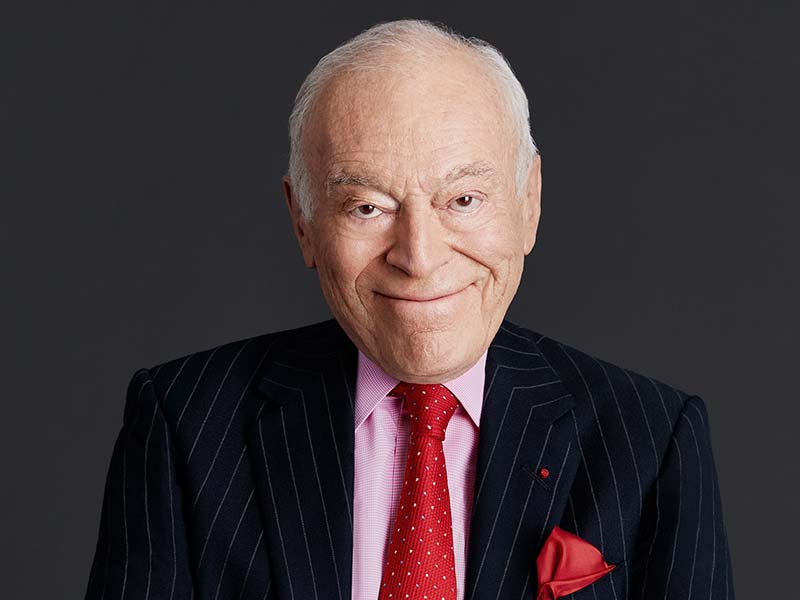
Leonard Lauder
American philanthropist and former CEO of Estée LauderWikipedia
19
MENTIONS
13
EPISODES
12
PODCASTS
Search complete. 19 mentions across 13 episodes found for "Leonard Lauder".
Oct 15, 2026

Hamish HodderHOST
But what I didn't expect to find was that there's actually one product that we buy more of when times are tough.
Hamish HodderHOST
This is Leonard Lauder, the son of Joseph and Este Lauder.
Hamish HodderHOST
His parents started producing skin lotion in the 1940s and grew the company into one of the biggest cosmetic empires in the world.
Hamish HodderHOST
And as the chairman of the company in 2001, Leonard noticed a rather unusual pattern in the sales of their products.
Hamish HodderHOST
It's just a nonprofit organization.
Hamish HodderHOST
But its tally of U.S. recessions is recognized by the Bureau of Economic Analysis.
Hamish HodderHOST
Leonard Lauder's explanation for this was that when women needed to cut back on their luxury purchases, they tended to just spend more on smaller things like lipstick.
Hamish HodderHOST
When lipstick sales go up, people don't want to buy dresses.

Oliver BarkerGUEST
And I, I should explain that, you know, by far the majority of works that Sotheby's sells are probably in the region of $25,000.
Oliver BarkerGUEST
You know, what makes the headlines, of course, are kind of, you know, the $100 million-plus sort of objects, whether it be the Mercedes Ruhlmann Coupe, for example, or more recently, the Gustav Klimt, later a portrait that we were fortunate enough to sell from Leonard Lauder's collection.
Oliver BarkerGUEST
But, you know, the stock and trade, if you like, is very, very different.
Oliver BarkerGUEST
But again, that's what's so interesting.
36 MINS LATER
Oliver BarkerGUEST
Um, and as we build sophistication or interest, you know, again, our, our, our sort of spheres open up, and we kind of have relationships with people that perhaps we wouldn't have had the confidence to have if we didn't have that understanding, or natural curiosity leads you to build relationships kind of elsewhere.
Oliver BarkerGUEST
And it kind of still amazes me that how collectors can actually start to build sophistication in one area.
Oliver BarkerGUEST
I mean, you know, for example, when we sold Leonard Lauder's collection, um, he was a man who had been a highly successful businessman, who had inherited from his mother this incredible business, um, had made a huge success of it, obviously, but had found the time to become arguably the world's greatest collector of Cubist art, which famously he then gifted to the Metropolitan Museum of Art.
Oliver BarkerGUEST
And I very sadly never met Leonard Lauder, but I had the most profound respect for him as a collector.

Steven SaumHOST
[laughs]
Walter IsaacsonGUEST
Because when Leonard Lauder tried to convince me to do the book, he said, "I want you to do a pamphlet." I said, "Well, nobody reads pamphlets," you know, "I'll write 800." No, he said, "No." And he said, "If Thomas Paine can do it in 96 pages, you can do it."
Steven SaumHOST
[laughs]
Walter IsaacsonGUEST
So I tried to keep it the exact length of Thomas Paine.
Hamish HodderHOST
Kind of.
Hamish HodderHOST
There's a theory that's been thrown around since the '90s that lipstick sales rise during tougher times, and where did this theory come from? Leonard Lauder.
Hamish HodderHOST
Yep, the son of Joseph and Estée Lauder.
Hamish HodderHOST
I did a deeper dive on this in my recession indicator video last year, and truthfully, there isn't much validity to the theory.

Poppy KingGUEST
Yeah, it was very interesting.
Poppy KingGUEST
I mean, if you were to tell the little like, so that seven-year-old at 30, which is when I moved to New York in 2002, for a position that was created for me by Leonard Lauder, who at the time was the chairman of the Lauder Corporation.
Poppy KingGUEST
You know, and I was saying to Erica, you know, the insanity of this, that on the first day that I turned up for that role, so Leonard Lauder or had relocated me from Australia, bought my brand in order to buy the intellectual property, gone all to this trouble, you know, the head of this, the chairman of a major beauty company to bring me to do my kind of marketing for his corporation.
Poppy KingGUEST
And on my way in that very, very, very first day on the Fifth Avenue GM building, kind of on my way in, a plastic surgeon handed me his cart and said I could fix... your features, basically.
Poppy KingGUEST
And it just made me realise, it just goes to show, I mean, if there is anything that just shows you how absurd and how absolutely arbitrary all this is.
Poppy KingGUEST
Leonard Lauder, the chairman of Estée Lauder, had hired me i mean i really felt like turning around to this plastic surgeon guy that just volunteered that information right with his card right and saying oh that's really interesting so i'm actually here to be a beauty executive so i'm so glad you told me that kind of like you can fix my face you know you know and so so you know the thing is is that little girl who was so worried about was I a witch, was I a princess, was I going to have to change myself in order to be acceptable, all that kind of stuff.
Poppy KingGUEST
You know, the chairman of a corporation brought me to...
Poppy KingGUEST
So it just...

Alex SteinherrGUEST
I don't think it'll mean as much to everyone listening.
Alex SteinherrGUEST
But, you know, Leonard Lauder, someone that obviously I have a lot of respect for, who's been very... kind to me in my career and who, you know, you have had a great relationship
Elizabeth HurleyGUEST
with.
Elizabeth HurleyGUEST
That was Estée Lauder's son, her eldest son, who ended up running the company and transforming it into the massive Estée Lauder Companies powerhouse it was.

Bobbi BrownGUEST
Right? I'm like, okay.
Bobbi BrownGUEST
Um, so you know, it just kinda happened and y- you know, Leonard Lauder was the one that just saw what he knew that I and the company could become.
Stacy LondonHOST
Yeah.
Stacy LondonHOST
I mean, and did become.

Sally McMullenHOST
And one of them, and one of the most popular ones, is the lipstick index.
Sally McMullenHOST
So during the early 2000s recession, chairman of Estée Lauder, Leonard Lauder, coined the term after noticing that when overall consumer spending dropped and big-ticket items remained unsold, Estée Lauder actually sold more lipsticks because consumers were buying smaller low-cost treats like a lipstick as a source of emotional comfort when they were feeling some of that economic turmoil and couldn't, say, put money towards a house.
Sally McMullenHOST
They're like, "I'll buy a lipstick instead." [laughs]
Alex HouriganHOST
Yeah.

Michael BordenaroHOST
And this says that people sometimes buy a small luxury when a larger one is out of reach.
Michael BordenaroHOST
Leonard Lauder of Estee Lauder, he came up with this idea when lipstick sales in the 2001 recession were surging at a time when the rest of the economy wasn't doing so well.
Michael BordenaroHOST
Back then, lipstick sales were up 11%.
Michael BordenaroHOST
And basically, it's a pretty easy one to understand.

DonHOST
It reminds me of the old lipstick index from the Great Recession.
speaker_1HOST
Oh, the Leonard Lauder theory.
DonHOST
Exactly.
DonHOST
Back in the early 2000s, when the economy crashed and times got incredibly tough, women stopped buying luxury items like designer handbags or expensive shoes.
3 more episodes mention Leonard Lauder.
Create an account to see the whole feed, search across every transcript, and follow the entities you care about.