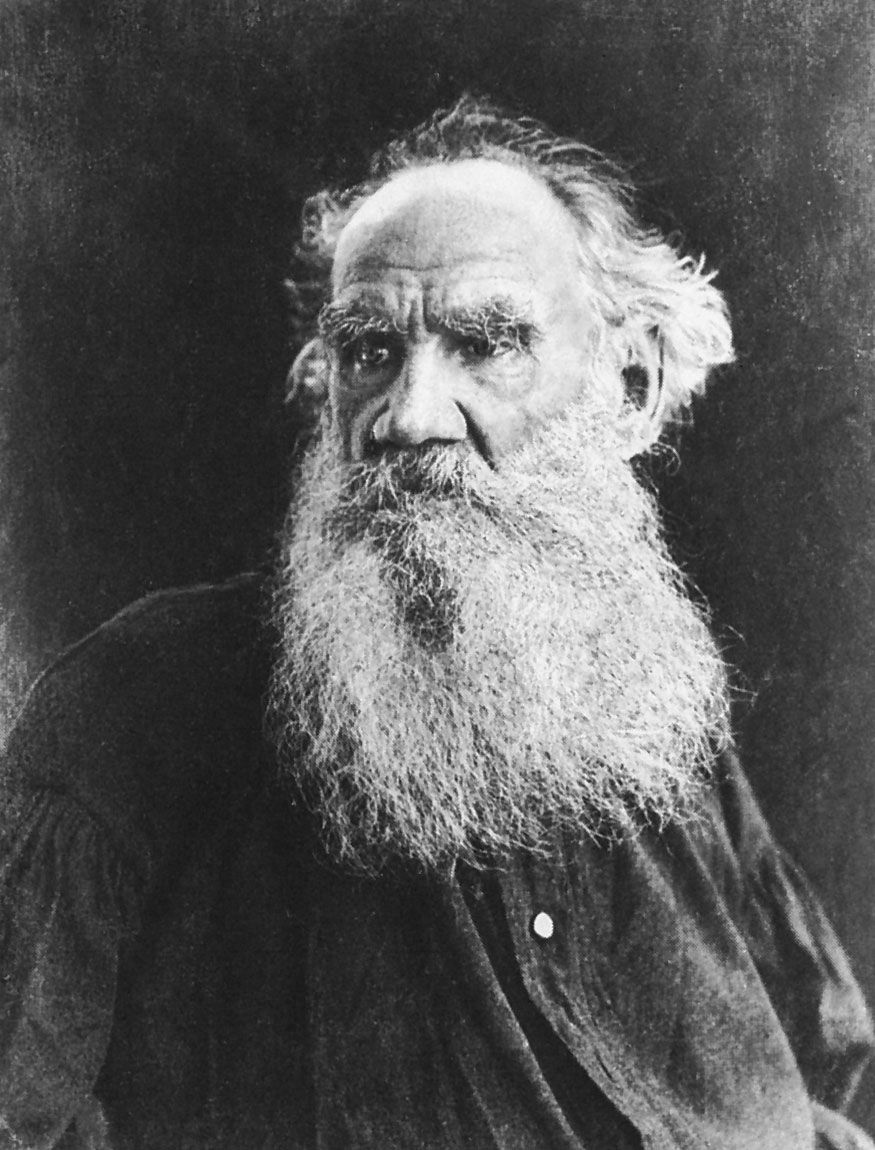
Leo Tolstoy
Russian writerWikipedia
1.3k
MENTIONS
432
EPISODES
364
PODCASTS
Search complete. 1308 mentions across 432 episodes found for "Leo Tolstoy".
Oct 31, 2026

Andrew McGivernHOST
And there's a link right here in the show notes.
Andrew McGivernHOST
Today's quote comes from Leo Tolstoy.
Andrew McGivernHOST
Leo Tolstoy lived from 1828 to 1910.
Andrew McGivernHOST
He was a Russian novelist, moral philosopher, and social reformer, widely regarded as one of the greatest writers in world literature.
Andrew McGivernHOST
He's best known for his epic novels War and Peace and Anna Karenina.

Mabel TaylorHOST
think
Grace ByronGUEST
like those books were really like turned into this like but they're weird and witchy and gothic-y and like lovely and like they're so poetic um and I and then again and then the Russians I'm a big fan of the Russians which I feel like we didn't really get to touch on but I love Tolstoy and I love Dostoevsky and I love Chekhov um so I think 2027 is
Madeline PorsellaHOST
gonna be my Russian year um I know I've, I've honestly avoided the Russians.
Madeline PorsellaHOST
I just feel like it's just a whole can of worms.

speaker_0NARRATOR
And very soon this effort again changed into a desire to be stronger than others, to be more famous, more important, and richer than others.
speaker_0NARRATOR
End of chapter 1 Chapter 2 of A Confession by Leo Tolstoy Someday I will narrate the touching and instructive history of my life during those ten years of my youth.
speaker_0NARRATOR
I think very many people have had a like experience.
speaker_0NARRATOR
With all my soul I wished to be good, but I was young, passionate, and alone, completely alone, when I sought goodness.
6 MINS LATER
speaker_0NARRATOR
And culture is measured by the circulation of books and newspapers.
speaker_0NARRATOR
And we are paid money and are respected because we write books and newspapers, and therefore we are the most useful and the best of men.
speaker_0NARRATOR
End of chapter 2 chapter three of a confession by leo tolstoy so i lived abandoning myself to this insanity for another six years till my marriage during that time i went abroad life in europe and my acquaintance with leading and learned europeans confirmed me yet more in the faith of striving after perfection in which i believed for i found the same faith among them that faith took with me the common form it assumes with the majority of educated people of our day it was expressed by the word progress it then appeared to me that this word meant something i did not as yet understand that being tormented like every vital man by the question of how it is best for me to live In my answer, live in conformity with progress, I was like a man in a boat who, when carried along by wind and waves, should reply to what for him is the chief and only question, whether to steer, by saying, We are being carried somewhere.
speaker_0NARRATOR
I did not then notice this.

John BrandonNARRATOR
as a bookbinder apprentice at a very early age he took to his heels and went on the road of the world where he soon came in conflict with revolutionary ideas in the labour movement that greatly inspired him and urged him to read and study it might be more appropriately said that he developed a ravenous appetite for knowledge and research of all the works of human science At that time, socialistic ideas had just begun to exercise great influence upon the thinking mind of the European continents.
John BrandonNARRATOR
the zeal and craving for knowledge displayed by the working people of those days can hardly be properly estimated especially by the proletariat of this country whose literature and source of knowledge chiefly consists of the daily papers working men who worked ten and twelve hours in factories and shops spent their evenings in study and reading of economic political and philosophical works ferdinand la salle karl marx engels buchunin and later kropotkin also henry george's progress and poverty added to these were the works of materialistic natural science schools such as darwin huxley moleschott karl ludwig buchner haeckel that constituted the mental diet of a large number of workingmen of that period just as the revolutionary economists were hailed as the liberators of physical slavery so were the materialistic naturalistic sciences accepted as the saviours from mental narrowness and darkness most was untiring in his work of popularising these ideas and as he could quickly grasp things he was tremendously successful in simplifying scientific books into pamphlets and essays accessible to the ordinary intelligence of the working people he possessed a marvellous memory and once he got hold of an amount of data he could easily avail himself of it at any moment this was particularly true in the domain of history with its compilation of blood-curdling events from which he drew his conclusions of how the human race ought not to live together with his journalistic activity he combined oral propaganda his power of delivery was marvellous and those who heard him in his early days will understand why the powers of the world stood in awe before him he not only had a very convincing way but he succeeded in keeping his audiences spellbound or to bring them to the highest pitch of enthusiasm the scene of his first great activity was in vienna where he was soon met with many indictments and persecutions from the authorities who mercilessly pursued him for the rest of his life after a term of imprisonment in several american prisons he went to germany where he became the editor of the free press in berlin but his original and biting criticism of bureaucracy again brought him in conflict with the powers that be the berlin prison pleistocene soon closed its doors on the culprit even to-day those who visit that famous institution of civilization are still shown most at that time bismarck carried an unsuccessful battle against the power of the catholic church eager to subordinate her to the state authority it happened that the famous leader of the catholic party majunk was sent for a term of imprisonment to platoncy where the prisoners were let out for their daily walk the leader of the reds john most met the leader of the blacks the situation was comical enough to cause amusement to both both being brilliant they found enough interesting material for conversation which helped them over the dreariness and monotony of prison life several years later bismarck succeeded in enacting the muzzle law against social democracy which destroyed the freedom of the press and assembly the question arose then what could be done most had been elected to the reichstag representing the famous factory town chemnitz but his experience in parliament only served him to despise the representative system and professional law-making more than ever when leaders of social democracy like bebel and liebknecht thought it more expedient to adapt themselves to conditions most went to london where he continued his revolutionary literary crusade in the freiheit he came in contact with karl marx engels and various other refugees who lived in england marx assured most that his sharp pen in the freiheit was not likely to cause him any trouble in england so long as the conservative party was in power but that nothing good was to be expected of the liberal party marx was right shortly after most's arrival in london his paper was seized and he was arrested on the indictment for inciting to murder because he paid a glowing tribute to the revolutionists of russia who on the first of march eighteen eighty one executed alexander the second he was tried and sentenced to eighteen months imprisonment to one of the barbarous english prisons most gradually developed into an anarchist representing communist anarchism the organization of production and consummation based on free industrial groups and which excludes state and bureaucratic interference his ideas were related to those of propotkin and elisi reclus he often assured me that he considered propotkin his teacher and that he owed much of his mental development to him the next aim of the hounded man was america but it does not appear that he was followed across the ocean by his lucky star he soon was made to feel that free speech and free press in this great republic was but a myth time and again he was arrested brutally treated by the police and sentenced to time in the penitentiary added to this came the fearful attacks and misrepresentations of most and his ideas by the press many of the articles making him appear as a wild beast ever plotting destruction the last sentence inflicted upon him was after the solgaz act he was arrested for an article by the radical karl heinzen that had been written many years ago and the author of which had been dead a long time the article had not the slightest relation to the act did not contain a single reference to the conditions of this country and treated altogether the european conditions of fifty years ago in the face of this sentence one cannot but help think of tolstoy's power of darkness only the power of darkness in the minds of the judges before whom most was tried and the newspaper men who helped in arousing public opinion against him were responsible for the sentence inflicted upon him taking most's life superficially it would appear that his road was hard and thorny but looking at it from a thorough viewpoint one will realize that all his hardships and injustices had made of him a relentless uncompromising rebel who continued to wage war against the enemies of the people With but few exceptions, the American journalists censured the immoral profession of Mrs. Warren.
John BrandonNARRATOR
Is it not heavenly irony that God pressed the headman's sword of morals into the hands of the newspaper writers? Perhaps the great god Pan thought they would be the fittest to handle the sword, since they are so intimately associated with mental prostitution.
John BrandonNARRATOR
End of chapter 5 RECORDING BY JOHN BRANDON
45 MINS LATER
speaker_9NARRATOR
The new drama means reproduction of nature in all its phases, the social and psychological included.
speaker_9NARRATOR
It embraces, analyzes, and enriches all life.
speaker_9NARRATOR
it goes hand in hand with the longing for materially and mentally harmonious institutions it rehabilitates the human body establishes it in its proper place and dignity and brings about the long-deferred reconciliation between the mind and the body full of enthusiasm with the pulse of time throbbing in his veins the modern dramatist compiles mountains of material for the better understanding of man and the influences that mould and form him he no longer presents capital acts extraordinary events or melodramatic expressions it is life in all its complexity that is being unfolded before us and so we come closer to the source of the forces that destroy and build up again the forces that make for individual character and direct the world at large life as a whole is being dealt with and not mere particles formerly our eyes were dazzled by a display of costumes and scenery while the heart remained unmoved this no longer satisfies one must feel the warmth of life in order to respond to be gripped the sphere of the drama has widened most marvelously in all directions and only ends where human limitations begin together with this a marked deepening of the inner world has taken place still there are those who have much to say about the vulgarity contained in the modern drama and how its inaugurators and following present the ugly and untruthful untrue and ugly indeed for those who are buried under a mass of inherited views and prejudices the growth of the scope of the drama has increased the number of the participants therein formerly it was assumed that the fate of the ordinary man the man of the masses was altogether too obscure too indifferent to serve as material for anything tragic since those who had never dwelt in the heights of material splendor could not go down to the darkest and lowest abyss because of that assumption the low and humble never gained access to the center of the stage they were only utilized to represent mobs those that were of importance were persons of high position and standing persons who represented wealth and power with superiority and dignity yet with shallow and superficial airs the ensemble was but a mechanism and not an organism and each participant was stiff and lifeless each movement was forced and strained the old fate and hero drama did not spring from within man and the things about him it was merely manufactured most remarkable incidents unheard-of situations had to be invented if only to produce externally an appearance of coinciding cause and effect and not a single plot could be without secret doors and vaults terrible oaths and perjury if ibsen gorky hauptmann gabriel d'allunzio and others had brought us nothing else but a liberation from such grotesque ballast from such impossibilities as destroy every illusion as to the life and port of a play they would still be entitled to our gratitude and the gratitude of posterity but they have done more out of the confusion of trap-doors secret passages folding screens they have led us into the light of day of undisguised events with their simple distinct outlines in this light the man of the heap gains in life force importance and depth the stage no longer offers a place for impossible deeds in the endless monologues of the hero the important feature is harmonious concert of action the hero on a stage that conscientiously stands for real art and aims to produce life is about as superfluous as the clown who amused the audience between the acts after all the spectacle of one star display one cannot help but hail the refreshing contrast shown in the man of destiny by the clever bernard shaw where he presents the legend hero napoleon as a petty intriguer with all the inner fear and uneasiness of a plotter in these days of concerted energy of the co-operation of numerous hands and brains in the days when the most far-reaching effect can only be accomplished through the summons of a manifold physical and mental endeavor the existence of these loud heroes is circumscribed within rather limited lines previous generations could never have grasped the deep tragedy in that famous painting of millet that inspired edwin murkham to write his man with the hoe our generation however is thrilled by it and is there not something terribly tragic about the lives of the great masses who pierced the colossal stone cliffs of the simplin or who are building the panama canal they have and are performing a task that may safely be compared with the extraordinary achievements of hercules works which according to human conception will last into eternity the names and the characters of these workmen are unknown the historians coldly and disinterestedly pass them by the new drama has unveiled this kind of tragedy it has done away with the lie that sought to produce a violent dramatic effect through a plunge from the sublime to the ridiculous those who understand tolstoy's power of darkness wherein but those of the lowest strata appear will be overwhelmed by the terrible tragedy in their lives in comparison with which the worries of some crowned head or the money troubles of some powerful speculator will appear insignificant indeed that which this master unfolds before us is no longer a plunge from heaven to hell the entire life of these people is an infernal the terrible darkness and ignorance of these people forced on them by the social misery of a dull necessity produces greater soul sensations in the spectator than the stilted tragedy of a corneille Those who witness a performance of Gerhard Hauptmann's Haenel, and fail to be stirred by the grandeur and depth of that masterpiece, regardless of its petty poorhouse atmosphere, deserve to see nothing else than the Wizard of Oz.
speaker_9NARRATOR
And again is not the long thunderous march of hungry strikers in Zola's Germinal as awe-inspiring to those who feel the heartbeat of our age, even as the heroic deeds of Hannibal's warriors were to his contemporaries? the world's stage ever represents a change of participants the one who played the part of leading man in one century may become a clown in another entire social classes and castes that formerly commanded first parts are to-day utilized to make up stage decorations or as figurantes plays representing the glory of knighthood or minnesingers would only amuse to-day no matter how serious they were intended to appear once anything lies buried under the bulk of social changes it can affect coming generations only so far as the excavated skeleton affects the geologist this must be borne in mind by sincere stage-art if it is not to remain in the stifling atmosphere of tradition if it does not wish to degrade a noble method that helps to recognize and disclose all that is rich and deep in the human into a commonplace hypocritical and stupid method if the artist's creation is to have any effect it must contain elements of real life and must turn its gaze toward the dawn of the morn of a more beautiful and joyous world with a new and healthy generation that feels deeply its relationship with all human beings over the universe In a report of the Russian government, it is stated that the conduct of the soldiers in the struggles of the streets was such that in no instance did they transgress the limit which is prescribed to them in their oath as soldiers.

Dave MaplesdenGUEST
Okay, it might be worth reading in that case.
Dave MaplesdenGUEST
The Death of Ivan Ilyich, Leo Tolstoy, published in 1886.
Dave MaplesdenGUEST
And in this short novel by the great Russian writer, the description of the progression of illness becomes a tool for exploring the fear of death and the human need to find meaning in existence.
Dave MaplesdenGUEST
And while I read it, many doctors consider it more instructive than numerous textbooks.

Dave RossiGUEST
Well, that is a great question.
Dave RossiGUEST
Leo Tolstoy, the death of Ivan Illich.
Dave RossiGUEST
I remember hearing this story from Wayne Dyer.
Dave RossiGUEST
Leo Tolstoy was talked into being a lawyer from his parents and his wife.
Dave RossiGUEST
My parents are amazing people and I love them to death and I still do.
Dave RossiGUEST
We're incredibly close.
21 MINS LATER
Dave RossiGUEST
I've never had it before.
Dave RossiGUEST
I don't really need it now.

Caroline HepkerHOST
transforming itself.
Caroline HepkerHOST
I think Social Wellness Story interested me because, as I say, parallels to other European countries, to other novels like Anna Karenina, Tolstoy, or Great Expectations from Dickens, and maybe some of those controversial adaptations like Emerald Fennell's Wuthering Heights, or, well, there's a new Pride and Prejudice and a new Sense and Sensibility film out this year, which are much more traditional than So I see that argument more and more.
Caroline HepkerHOST
A rapidly changing society.
Caroline HepkerHOST
We're looking to the past.

TonyHOST
Some sort of, this data is pulled from, the book data is pulled from openlibrary.org, which is a free open source.
TonyHOST
And so this is Anna Karenina by Tolstoy, which I do own a copy of.
TonyHOST
As
AndyHOST
do I.
20 MINS LATER
AndyHOST
I
TonyHOST
own a copy.
TonyHOST
Number 18, War and Peace by Leo Tolstoy.
TonyHOST
Have you read that?

Zack RogowGUEST
And I say, I can't imagine.
Zack RogowGUEST
Could I ask you what it's like, by the way, being dead? And my dad says, well, it's not like you have blintzes with Tolstoy in the morning and then you push boulders up a hill with Sisyphus in the afternoon.
Zack RogowGUEST
You're not really a you.
Zack RogowGUEST
You're just a bunch of particles wafting in the solar wind, more or less.
12 MINS LATER
Zack RogowGUEST
It's not an easy thing, especially when you go so early, the way I did.
Zack RogowGUEST
And I say, I can't imagine.
Zack RogowGUEST
Could I ask you what it's like, by the way, being dead? And my dad says, well, it's not like you have blintzes with Tolstoy in the morning and then you push boulders up a hill with Sisyphus in the afternoon.
Zack RogowGUEST
You're not really a you.

Jim ThayerHOST
6.
Jim ThayerHOST
From Leo Tolstoy's Anna Karenina, Happy families are all alike.
Jim ThayerHOST
Every unhappy family is unhappy in its own way.
Jim ThayerHOST
7.
422 more episodes mention Leo Tolstoy.
Create an account to see the whole feed, search across every transcript, and follow the entities you care about.