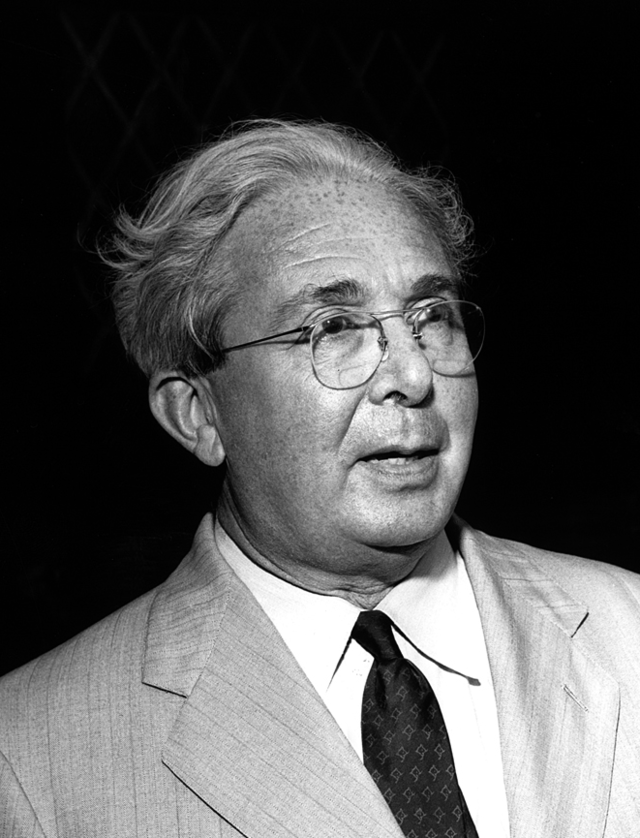
Leo Szilard
Hungarian-American physicistWikipedia
38
MENTIONS
21
EPISODES
21
PODCASTS
Search complete. 38 mentions across 21 episodes found for "Leo Szilard".
Sep 24, 2026

GarrettHOST
And when World War II broke out, Warner Heisenberg stayed in Germany, and he worked on their nuclear programs.
GarrettHOST
And guys like Albert Einstein, Ed Teller, Leo Szilard, uh, John von Neumann, all these guys, uh, went to the United States because otherwise they would've been killed by Hitler's Nazis.
GarrettHOST
The, the thing that started the Manhattan Project in the first place was a letter from Leo Szilard and Albert Einstein to President Roosevelt, and they were warning President Roosevelt that The Germans seemed to have a program that was enriching uranium, or that the Germans were, seemed to be interested in this new science they found that can make really powerful bombs with uranium.
GarrettHOST
Leo Szilard and Albert Einstein warned FDR that the United States had to get ahead of the Germans on this technology.
GarrettHOST
And, uh, anyways, after the war, Werner Heisenberg, he says, uh, this is the quote from Heisenberg.
GarrettHOST
He says, quote, I would say that I was absolutely convinced of the possibility of our making a uranium engine, but I never thought that we would make a bomb.

FerdinandHOST
But it's a story of humanity.
FerdinandHOST
And the next story was around 1933, And it's the story of Leo Szilard.
FerdinandHOST
And he had a very terrifying imagination.
Didi AllesweissHOST
Szilard standing at a London crosswalk thinking about neutrons.

Kevin RooseGUEST
There's, there's sort of this, there's this argument about moral responsibility that comes out in some of these conversations.
Kevin RooseGUEST
Um, Dario is, is an interesting case, uh, because I, I learned while reporting this book that his scientific hero, the, the person he has sort of patterned his career after, is this World War II scientist, um, who sort of helped to invent what became the, the atomic bomb, Leó Szilárd.
Kevin RooseGUEST
Um, he was a, a sort of reluctant participant in the Manhattan Project.
Kevin RooseGUEST
He came up with the nuclear chain reaction, and then he tried to keep this a secret so that the Nazis couldn't discover it.

JoeHOST
The neutron provided the bullet, artificial radioactivity showed atoms could be manipulated, and fission supplied the explosive reaction and energy release mechanism.
JoeHOST
discoveries accelerated in 1939 when Hungarian physicist Leo Salad and Italian physicist Enrico Fermi realized that uranium fission could trigger a chain reaction where neurons released would go on to split more uranium atoms, which was the fundamental principle that would make atomic bombs possible.
JoeHOST
Fermi would later demonstrate this experimentally by creating the world's first controlled nuclear chain reaction in 1942 under the stands of the University of Chicago's football stadium, which involved a Geiger counter beeping faster and faster as reactions accelerated.
JoeHOST
As the discoveries continued, so did the interest in the implications of such discoveries, especially by those waging war across Europe.
JoeHOST
The Race During this time, Nazi Germany was on the move.
JoeHOST
Many leading scientists fled Germany and other fascist regimes, bringing their knowledge to the Allied nations.
JoeHOST
Leo Szilard was one of this group, and as he fled the Nazi horror, he became increasingly concerned that Germany might develop atomic weapons first.
JoeHOST
In August 1939, Szilard drafted a letter that Albert Einstein signed and sent to President Franklin Roosevelt.

Connor LeahyGUEST
But what happened with nuclear weapons was very interesting.
Connor LeahyGUEST
So the person who came up with the idea of the nuclear weapon was a physicist named Leo Szilard, and he basically calculated that a nuclear bomb would be possible.
Connor LeahyGUEST
L- again, long before one was built, before we even had nuclear reactors.
Connor LeahyGUEST
He just did some math on a paper, and he was like, "Oh, shit, you really can totally build a nuclear bomb."
Danny JonesHOST
What's his name again?
Connor LeahyGUEST
Leo Szilard.
Danny JonesHOST
Leo Szilard.
Connor LeahyGUEST
Yeah, S-Z-I-L-A-R-D.

Dalton McGeeHOST
Here's your other unlock question, Sarah.
Dalton McGeeHOST
In August of 1939, Leo Szilard.
Dalton McGeeHOST
Pronunciation?
Sara CalloriGUEST
I'm not actually sure.
Dalton McGeeHOST
Yeah, I know.
Dalton McGeeHOST
I just want to say it right.
Dalton McGeeHOST
In August of 1939, Leo Szilard and Eugene Wigner drafted a letter warning of extremely powerful bombs of a new type by the Germans.
Dalton McGeeHOST
A letter that was signed by what theoretical physicist before being delivered to President Roosevelt?

Abby BrinkerHOST
Einstein's 1939 letter to President Franklin Roosevelt helped bring the potential military implications of nuclear research to the attention of the US government.
Abby BrinkerHOST
I'm just gonna read, um, an excerpt, not the whole thing "Sir, some recent work by E. Fermi and L. Szilard, which has been communicated to me in manuscript, leads me to expect that the element uranium may be turned into a new and important source of energy in the immediate future.
Abby BrinkerHOST
Certain aspects of the situation which has arisen seem to call for watchfulness, and, if necessary, quick action on the part of the administration.
Abby BrinkerHOST
I believe, therefore, that it is my duty to bring to your attention the following facts and recommendations.

Bruce CaldwellGUEST
Uh, there were economists on the Coles Commission- Okay, the Coles Commission was then located at the University of Chicago, perhaps the most prominent of them being Schalling, uh, Copeman's.
Bruce CaldwellGUEST
Uh, uh, and also there were natural scientists, the physicist Enrico Fermi, uh, Leo Szilard, uh, uh, population geneticist Sewall Wright.
Bruce CaldwellGUEST
So these people were all there discussing what is science? Okay? The very methodological question that we started with.
Bruce CaldwellGUEST
Uh, should it be practiced in different ways in different fields, et cetera.

Bruce CaldwellGUEST
Uh, there were economists on the Coles Commission- Okay, the Coles Commission was then located at the University of Chicago, perhaps the most prominent of them, Schalling, uh, Copeman's, uh, uh...
Bruce CaldwellGUEST
And also, there were natural scientists, the physicist Enrico Fermi, uh, Leo Szilard, uh, uh, population geneticist Sewell Wright.
Bruce CaldwellGUEST
So these people were all there discussing, what is science? Okay.
Bruce CaldwellGUEST
The very methodological question that we started with.

Dan SnowNARRATOR
In Japan, the view was that the attacks were unjustified and the magnitude of the devastation made the actions inherently immoral.
Dan SnowNARRATOR
Many people around the world agreed, including such luminaries as Albert Camus and a number of the scientists involved with the Manhattan Project, such as Dr. James Frank, Albert Einstein and Leo Szilard.
Dan SnowNARRATOR
The future president, Dwight D. Eisenhower, wrote of his grave misgivings in his memoir, The White House Years, citing his belief that Japan was already defeated and that America should avoid shocking world opinion by the use of a weapon whose employment was no longer mandatory as a measure to save American lives.
Dan SnowNARRATOR
The director of the Nuclear Studies Institute at the American University in Washington, Peter Kuznick, wrote these damning words about President Truman.
11 more episodes mention Leo Szilard.
Create an account to see the whole feed, search across every transcript, and follow the entities you care about.