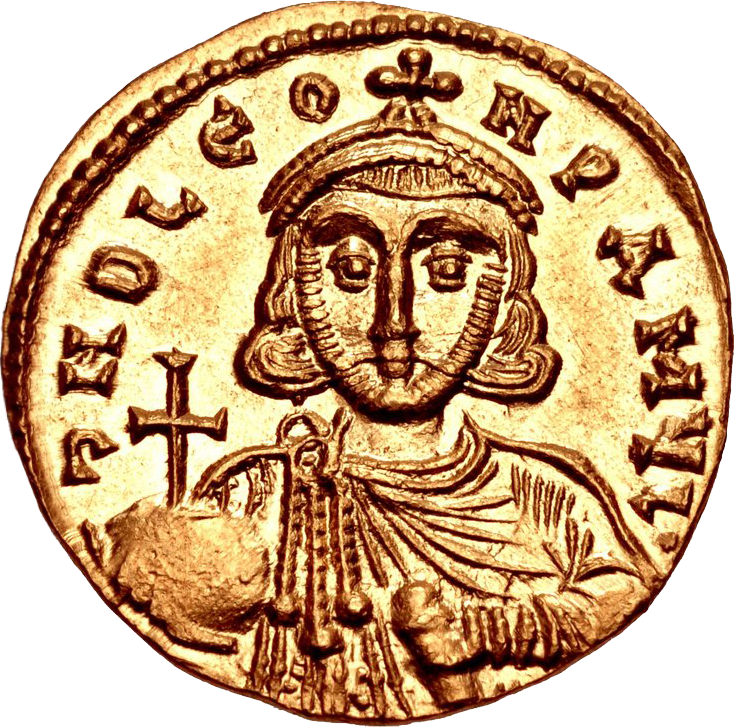
Leo III the Syrian
Former Emperor of Byzantine EmpireWikipedia
434
MENTIONS
19
EPISODES
17
PODCASTS
Search complete. 434 mentions across 19 episodes found for "Leo III the Syrian".
Sep 25, 2026

Pamela NagamiNARRATOR
Of late, that is to say during the greater part of the mayoralty of Charles Martel, the antagonism between pope and emperor had been increased by the dispute about the worship of images.
Pamela NagamiNARRATOR
In 726, Leo III, the great Isaurian emperor who had successfully repelled the Saracens from the walls of Constantinople, put forth his edicts for the destruction of the sacred images throughout the empire.
Pamela NagamiNARRATOR
These decrees, which roused some of the Greeks to actual insurrection, were met by sullen disobedience on the part of the Italians.
Pamela NagamiNARRATOR
The authority of the exarch of Ravenna was set at naught.
3 HRS 23 MINS LATER
Pamela NagamiNARRATOR
This or something like this we may believe to have been the secret underlying thought of the Leos and the Constantines when they heard what the Frank was doing in Italy.
Pamela NagamiNARRATOR
Through the greater part of the 8th century the iconoclastic controversy was the dominating element in the politics of the empire.
Pamela NagamiNARRATOR
We have already seen something of the career of the first great image-breaker, Leo III.
Pamela NagamiNARRATOR
On his death, which happened in 740, two years before the birth of Charlemagne, he was succeeded by his son, Constantine V, as able a general, as strong a statesman, and as determined an image-breaker as his father.

Adam MarcetichNARRATOR
last in point of date come the libraries of byzantium the city which the emperor constantine in three hundred thirty a d made the capital of the eastern portion of the empire and named after himself he at once began to gather books there and his successors followed his example the various libraries were established and those which survived the fires which occurred from time to time in the city existed until its capture by the turks in fourteen fifty two on this occasion and also after the assault by the crusaders in twelve o three the libraries probably suffered.
Adam MarcetichNARRATOR
It was said, too, by some, that Leo III wantonly destroyed a large number of books, but the assertion cannot be proved.
Adam MarcetichNARRATOR
Among the lost treasures of Constantinople was the only authentic copy of the Proceedings of the Council of Nice, held in 325 AD, to deal with the Arian heresy.
Adam MarcetichNARRATOR
The ultimate fate of the Imperial Library at Constantinople yet remains a problem.

Adam MarcetichNARRATOR
last in point of date come the libraries of byzantium the city which the emperor constantine in three hundred thirty a d made the capital of the eastern portion of the empire and named after himself he at once began to gather books there and his successors followed his example the various libraries were established and those which survived the fires which occurred from time to time in the city existed until its capture by the turks in fourteen fifty two on this occasion and also after the assault by the crusaders in twelve o three the libraries probably suffered.
Adam MarcetichNARRATOR
It was said, too, by some, that Leo III wantonly destroyed a large number of books, but the assertion cannot be proved.
Adam MarcetichNARRATOR
Among the lost treasures of Constantinople was the only authentic copy of the Proceedings of the Council of Nice, held in 325 A.D., to deal with the Arian heresy.
Adam MarcetichNARRATOR
The ultimate fate of the Imperial Library at Constantinople yet remains a problem.

Pamela NagamiNARRATOR
Another of those foreign soldiers, who, while the constitution of the empire went on unaltered, made the most vigorous chiefs of the executive power, was proclaimed emperor by the troops of Asia, and he founded an imperial line which lasted till the days of Charles the Great.
Pamela NagamiNARRATOR
This was the Isaurian Leo III, 717-802, known as the Iconoclast, the image-breaker.
Pamela NagamiNARRATOR
He, like Heraclius, received the empire in an hour of great peril.
Pamela NagamiNARRATOR
The Saracens, with the fame of their astonishing conquests, were now a second time before Constantinople.
34 MINS LATER
Pamela NagamiNARRATOR
Charles' services to the pope were recompensed and his victorious career of more than thirty years crowned by the restoration at Rome in his person of the Roman Empire and the imperial dignity.
Pamela NagamiNARRATOR
The same authority which had made him patrician and consecrated him king now created him emperor of the Romans.
Pamela NagamiNARRATOR
On Christmas Day, 800, when Charles came to pay his devotions before the altar of St. Peter's, Pope Leo III, without Charles' knowledge or wish, so Charles declared to his biographer Einhard, and it may be prematurely as regards Charles' own feeling, placed a golden crown on his head while all the people shouted, To Charles, the most pious Augustus, crowned of God, the great peace-giving emperor of the Romans, life and victory.
Pamela NagamiNARRATOR
By all round him, the pope and clergy, the Roman chiefs and people, the great men of the Franks, he was chosen and thrice proclaimed emperor at Rome, the mother of empire, where Caesars and emperors were wont to sit, and by the pope himself he was adored after the manner of the emperors of old.

Pamela NagamiNARRATOR
Progress of the Reforming Movement.
Pamela NagamiNARRATOR
The Pontificate of Leo IX, 1047-54, Part 1.
Pamela NagamiNARRATOR
Whilst the emperor had been asserting his authority in Italy, rebellion had broken out behind him, north of the Alps, amongst the nobles who had resented his strong rule.
Pamela NagamiNARRATOR
Godfrey, Duke of Lotharingia, was the leader of the insurgents, and before the emperor could attack them, Godfrey had taken Nijmegen and Verdun and laid siege to Lüttich, Liège, where he was kept in check by the bishop.
6 MINS LATER
Pamela NagamiNARRATOR
As they drew near Rome, they were met by a great concourse of people and clergy.
Pamela NagamiNARRATOR
Bruno entered the city barefoot and professed himself ready to return if his appointment was not agreeable to them.
Pamela NagamiNARRATOR
Loud acclamations left no doubt of their approval, and on February 12, 1049, he was consecrated pope under the name of Leo IX.
Pamela NagamiNARRATOR
The short pontificates of his two predecessors and the long vacancies between them had brought the affairs of the papacy into a state of sad confusion.

Pamela NagamiNARRATOR
The history of the empire in the eighth century turns almost entirely around the iconoclastic controversy.
Pamela NagamiNARRATOR
After the great siege of Constantinople that opened the reign of Leo III, the Saracens did not seriously menace the heart of the empire, though they continued their attacks on outlying provinces.
Pamela NagamiNARRATOR
Nor again did the emperors make any effective attempt to reassert their authority in Italy.
Pamela NagamiNARRATOR
But internally the empire was taking the form that it was destined to retain for centuries.
1 HR 8 MINS LATER
Pamela NagamiNARRATOR
Yet the anomalous condition of Europe might have lasted on for much longer had not Irene's rise to power destroyed whatever respect had been felt in the West for the Imperial House.
Pamela NagamiNARRATOR
Europe was for the first time without an Emperor, and just at this moment a series of events happened that made an Emperor specially necessary.
Pamela NagamiNARRATOR
At the end of the year 795 Hadrian died, and Leo III, 795 to 816, was elected in his place.
Pamela NagamiNARRATOR
The new Pope was apparently the nominee of a party, and there is some reason to think that rumors unfavorable to his integrity and moral conduct had reached Charles.

Pamela NagamiNARRATOR
They became more secular and less learned.
Pamela NagamiNARRATOR
It is idle to conjecture how far this degradation of the Church would have gone had it not been arrested by a singular train of events ending in the elevation of the Teutonic king Charles the Great to the throne of the Roman Empire in the West and the firm establishment of the idea to last for ages that the Empire, being coextensive with the Church, must be ruled by two heads, the temporal and the spiritual, the emperor and the pope.
Pamela NagamiNARRATOR
By the formation of a close alliance between these two central powers, Western Christendom was saved from grave disorder.
Pamela NagamiNARRATOR
But a conflict between them sooner or later was inevitable, and after the death of Charles the contest of the Church with the world came to mean a struggle for rights between these two forces, between royal and ecclesiastical authority, between the emperor or smaller sovereigns endeavoring to control the Church and the Church asserting its claims to independence.
Pamela NagamiNARRATOR
The first acute stage in this contest was reached in the eleventh century, but to understand clearly the conditions of the strife it is necessary to trace however briefly how the connection between the papacy and the Teutonic kings north of the Alps grew up, although to do this we have to go back a long way.
Pamela NagamiNARRATOR
In the middle of the eighth century the papacy was in a feeble and perilous condition.
Pamela NagamiNARRATOR
The line of the Western emperors had long since come to an end in 476.
Pamela NagamiNARRATOR
Italy was nominally subject to the emperors at Constantinople, but the exarchate of Ravenna, where their vice-regents had ruled since the days of Justinian, was crumbling away beneath the pressure of the Lombards, who held all Italy in their hands except the extreme south and some small bits of territory round Rome, Venice, and Naples.

William AlbrechtGUEST
ways.'"You're definitely right about that.
William AlbrechtGUEST
In fact, there is a writing known as The Pseudo-Dialogue between Leo III, who was a Catholic emperor, and the Muslim caliph, Umar II.
William AlbrechtGUEST
Now, we know that it is a pseudo-dialogue, but it was written as an apologetic effort, if you will.
William AlbrechtGUEST
It was written in the 700s, so we're talking about, I believe Muhammad died around 632.

Irenaeus DunlevyGUEST
After the invisible God is made visible, an abundance of paintings, images, and devotionals spring up in the early church.
Irenaeus DunlevyGUEST
This abundance of sacred images and icons grew across Christendom, but there also arose controversy surrounding them, the most notable of which is the iconoclastic controversy of the eighth and ninth century, which was initiated by Emperor Leo III.
Irenaeus DunlevyGUEST
Serious questions and theological debates ensued about the positive and negative consequences of images for the worship of God.
Irenaeus DunlevyGUEST
The Second Council of Nicaea and the thought of St. John Damascene ultimately won the day for the iconophiles, except for the challenges we still face with our Protestant brethren today.
20 MINS LATER
Irenaeus DunlevyGUEST
Whereas the time of the Old Covenant consisted of a type of visual or sensible asceticism with regard to depictions of God and holy things, we see a new type of purification taking place in the time of the Church.
Irenaeus DunlevyGUEST
Visualizations of the Lord and the saints act as useful means of devotion that can be said to help purify the human imagination.
Irenaeus DunlevyGUEST
This idea, however, was greatly challenged by the iconoclast controversy in the Byzantine Empire, which commenced in 726 AD when Emperor Leo III removed the icon of Christ from the Colche Palace gate in Constantinople.
Irenaeus DunlevyGUEST
So we have Leo III on the left, graven image, and we have his son, Constantine V.

Pamela NagamiNARRATOR
Of late, that is to say during the greater part of the mayoralty of Charles Martel, the antagonism between pope and emperor had been increased by the dispute about the worship of images.
Pamela NagamiNARRATOR
In 726, Leo III, the great Isaurian emperor who had successfully repelled the Saracens from the walls of Constantinople, put forth his edicts for the destruction of the sacred images throughout the empire.
Pamela NagamiNARRATOR
These decrees, which roused some of the Greeks to actual insurrection, were met by sullen disobedience on the part of the Italians.
Pamela NagamiNARRATOR
The authority of the exarch of Ravenna was set at naught.
3 HRS 27 MINS LATER
Pamela NagamiNARRATOR
Bury, History of the Later Roman Empire, Chapter 2, page 456 But notwithstanding this, the emperor at Byzantium never forgot that he was Roman, but always looked upon Italy as his lawful, his almost inalienable possession.
Pamela NagamiNARRATOR
Gaul, Spain, Britain, it might be necessary to abandon these to the barbarians, but Italy, but Rome, were rightfully his, and all the shades of all the buried Caesars would pass an angry procession before the eyes of the degenerate successor who should be so base as formally to abandon his right to hold them.
Pamela NagamiNARRATOR
This or something like this we may believe to have been the secret underlying thought of the Leos and the Constantines when they heard what the Frank was doing in Italy.
Pamela NagamiNARRATOR
Through the greater part of the 8th century the iconoclastic controversy was the dominating element in the politics of the empire.
9 more episodes mention Leo III the Syrian.
Create an account to see the whole feed, search across every transcript, and follow the entities you care about.