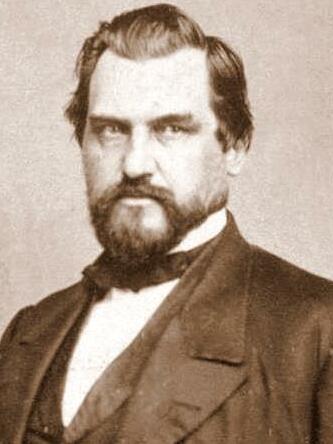
Leland Stanford
Attorney and former United States SenatorWikipedia
26
MENTIONS
16
EPISODES
16
PODCASTS
Search complete. 26 mentions across 16 episodes found for "Leland Stanford".
Oct 12, 2026

Anika BurgessGUEST
He had this idea to try to photograph movement or motion.
Anika BurgessGUEST
And there's lots of stories around whether or not he was doing it because of Stanford having a bet, Leland Stanford having a bet about how horses actually move.
Anika BurgessGUEST
But the net result is that Maybridge set up a bank of cameras along a racetrack at Palo Alto and took photographs of a horse in motion and proved once and for all that their feet do come off the ground.
Anika BurgessGUEST
And from his work, along with obviously other inventors and innovators, grew motion pictures.

Anna LeaHOST
The apocryphal story is that the only people who reliably got rich during those heady days were the people who ran hotels, brothels, restaurants, laundry services, but some people did get fantastically wealthy.
Anna LeaHOST
On the broken backs of Chinese migrant laborers, railroad magnates became American barons, and one, Leland Stanford, used his wealth to seed a university that would bear his name and be responsible for so many ideas that would lead to our modern gold rush.
Anna LeaHOST
It's impossible to walk around the Bay Area and not see shocking wealth disparity fueled in large part by the tech industry.
Anna LeaHOST
From the beginning of silicon chip manufacturing that would give Silicon Valley its name, factory workers tried to unionize against low pay, miserable conditions, and years of their efforts resulted in no formal agreements with management.

Will KrasneHOST
This is a legacy defining thing that's gonna have his name be remembered for hundreds of years, more than just the super rich guy.
Will KrasneHOST
'Cause does anyone really remember what Andrew Carnegie did that well? Do people know that Leland Stanford was a guy?
Hiten SamtaniHOST
[laughs] Good point.
Will KrasneHOST
These names are forever.

Scott RankHOST
The conviction that wealth is there for the taking if you move fast enough, that the rules can be written after the money is made, and that whoever gets there first wins.
Scott RankHOST
A logic that ran straight from the hydraulic mines that blasted apart in mountainsides to Leland Stanford's horse farm at Palo Alto, where the same culture of speculative risk and ruthless speed became Silicon Valley.
Scott RankHOST
Hope you enjoyed this discussion with Nathaniel Philbrick.
Scott RankHOST
And one more thing before we get started with this episode, a quick break for a word from our sponsors.
39 MINS LATER
Scott RankHOST
So how does the Transcontinental Railroad on the western leg take its form and how does that change California and America's history?
Nathaniel PhilbrickGUEST
Yeah, I mean, it's kind of an amazing story how these shopkeepers that, you know, are more than that, they're commercially very savvy.
Nathaniel PhilbrickGUEST
Leland Stanford, Collis Huntington, you know, being the foremost names, they became known as the big four.
Nathaniel PhilbrickGUEST
You know, they were way over their financial heads initially.

Frank GolbeckGUEST
... yeah, his name was Doc Strong, and he was a pharmacist up in, uh, Dutch Flats, like, kind of near Nevada City.
Frank GolbeckGUEST
They prospected, or they, they surveyed the first site of the Transcontinental Railroad going across the Sierra Nevada, and then started a company, and he raised, like, $50,000 from, like, Leland Stanford and other people.
Frank GolbeckGUEST
And then they went and lobbied Congress and got the, uh, Pacific Railroad Act passed, which then funded the building of the railroad.
Frank GolbeckGUEST
And so, like, ancestrally, I think I'm kind of dealing with, uh, an ancestor who was kind of a like, "Let's do this," kind of guy, who maybe didn't consider the impacts that that way of thinking would have upon the world.

Nathaniel PhilbrickGUEST
And they're literally battling it out in Congress, um, uh, in 1849, and it comes down to a duel fought outside California beside a lake, uh, in which David Broderick, a US senator, would be shot to death by a pro-slavery state, uh, Supreme Court justice, leaving California wide open, uh, to go with the South, uh, in the event of the Civil War.
David RubensteinHOST
There was another senator named Leland Stanford.
Nathaniel PhilbrickGUEST
Yes.
David RubensteinHOST
And he became famous for building a university, among other things, I guess, right?
Nathaniel PhilbrickGUEST
Well, and th- this is part in, uh, uh, what Stanford would, uh, build the Transcontinental Railroad.
Nathaniel PhilbrickGUEST
And I think what is underappreciated is the Transcontinental Rail- Railroad was begun during the Civil War as a war measure to keep California in the Union.
Nathaniel PhilbrickGUEST
And so Leland Stanford and the other k- they're known as the Big Four, would become billionaires of their time.
Nathaniel PhilbrickGUEST
And, uh, uh, they were very, they were not appreciated in California because they would create a transportation monopoly that would strangle business.

Joy ChikondeHOST
since we're in the neighborhood of independence it is independence day in nigeria which was obtained in 1960 it is also unification day in cameroon obtained in 1961 also independence day in tuvalu since 1978 and lastly it is defenders day in ukraine which was established in 2015 Now, on to the next stop.
Joy ChikondeHOST
We arrive in the year 1891 at Stanford University, which was founded in Palo Alto, California, by a railroad magnate and politician by the name of Leland Stanford, together with his wife, Jane.
Joy ChikondeHOST
This was also the year the university admitted its first students.
Joy ChikondeHOST
Let's now move to 1906.

Nathaniel PhilbrickGUEST
There's two companies, one, the Central Pacific in the West, battling an Eastern company, and then they're just building it as quickly as possible.
Nathaniel PhilbrickGUEST
And what are known as the, commonly known as the Big Four, former shopkeepers from Sacramento, including Leland Stanford, would become the 19th century equivalent of billionaires.
Nathaniel PhilbrickGUEST
In just a few years, through the building of the Transcontinental Railroad, Stanford would purchase a farm that he would name Palo Alto.
Nathaniel PhilbrickGUEST
Stanford, of the big four, was the one who was interested in technological innovation.

Jeff O'NealHOST
Uh, went to study English at Stanford, but left without a degree.
Jeff O'NealHOST
Leland Stanford and Stanford University make an appearance here.
Jeff O'NealHOST
Um, moved to New York to try to make it as a writer.
Jeff O'NealHOST
Didn't work out, great.

Will SwaimHOST
No, I'm sorry.
Will SwaimHOST
Leland Stanford.
Will SwaimHOST
Sorry.
Will SwaimHOST
Confusing him with John C. Fremont, who will emerge later in the show.
6 more episodes mention Leland Stanford.
Create an account to see the whole feed, search across every transcript, and follow the entities you care about.