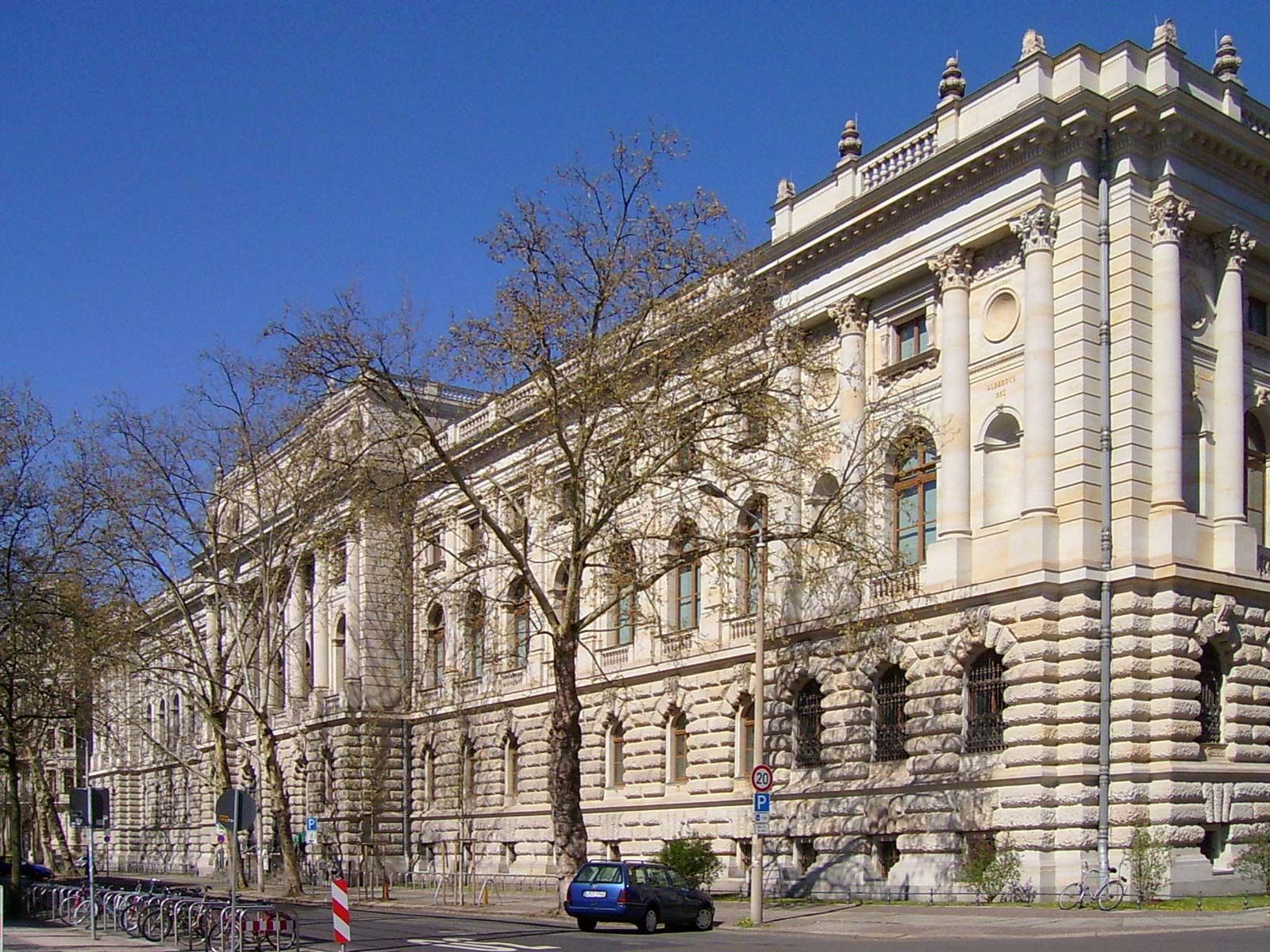
Leipzig University
University in Leipzig, GermanyWikipedia
47
MENTIONS
35
EPISODES
32
PODCASTS
Search complete. 47 mentions across 35 episodes found for "Leipzig University".
Oct 16, 2026

Kate DelaneyHOST
Wow.
Charles King Marklein Sr.GUEST
He was the, uh, uh- ... head of Germanic studies at George Washington University, studied abroad at the University of Leipzig.
Charles King Marklein Sr.GUEST
If you look Edward Sert up on the internet, you'd go on for pages of some of the research he did on German languages and everything.
Charles King Marklein Sr.GUEST
And just as an aside, before we get to the rest of them, in 1914, he was studying at the University of Leipzig in, it was August 1914.
Charles King Marklein Sr.GUEST
My great-grandfather and my great-aunt, who was just a little kid at the time, went over to visit him.
Charles King Marklein Sr.GUEST
Well, August 194- 1914 is when the First World War started, and they were caught behind the enemy lines.

Kate DelaneyHOST
Wow.
Charles King MarkleinGUEST
He was the, uh, um, head of Germanic Studies at George Washington University, studied abroad at the University of Leipzig.
Charles King MarkleinGUEST
I- if you look Edward Sert up on the internet, then you'd go on for pages of some of the research he did on German languages and everything.
Charles King MarkleinGUEST
And just as an aside before we get to the rest of them, in 1914, he was studying at the University of Leipzig in, it was August 1914.
Charles King MarkleinGUEST
My great-grandfather and my great-aunt, who was just a little kid at the time, went over to visit him.
Charles King MarkleinGUEST
Well, August 194- 14 is when the First World War started, and they were caught behind the enemy lines.

Vidas PinkeviciusHOST
For example, today, uh, we would like to share, uh, our experience of visiting the Bach country, Leipzig.
Vidas PinkeviciusHOST
Uh, our recent, uh, uh, tour with Vilnius University Choir, Gaudeamus, led us to Leipzig University.
Vidas PinkeviciusHOST
And we even visited, uh, Bach's- the Bach Museum, and almost touched the Bach, uh, uh, statue.
Ausra Motuzaite-PinkevicieneHOST
Yes, and we visited the Thomas, St. Thomas Kirche, St. Thomas Church, uh, where Bach worked.
Ausra Motuzaite-PinkevicieneHOST
And, and, uh, finally we played, uh, joint concert, uh, at the Leipzig University, uh, s- Paulinum Church.
Vidas PinkeviciusHOST
The most striking feature for me of that, uh, trip obviously was, uh, ability to, to go to the Bach Museum and, um, and, uh, see all the, uh, places and, and, uh, documents.
Vidas PinkeviciusHOST
And hear, hear the, the music authentically performed, uh, and it was very interactive museum experience.
8 MINS LATER
Vidas PinkeviciusHOST
Secrets of Organ Playing mug, beautiful, a beautiful, um, uh, present, early Christmas present perhaps.

speaker_0NARRATOR
The composer was taking shape.
speaker_0NARRATOR
And the young man who arrived at Leipzig University in 1701 to study law, at his mother's insistence one final time, would very quickly make that ambition impossible to maintain.
speaker_0NARRATOR
Chapter Two, Life and Career.
speaker_0NARRATOR
Teilemann arrived at the University of Leipzig in 1701 to study law.

Eryk Michael SmithHOST
He was educated at St. John's University in Shanghai, where classes were taught exclusively in English.
Eryk Michael SmithHOST
He then went on to Harvard for his master's and Leipzig University in Germany for his Ph.D. in linguistics.
Eryk Michael SmithHOST
You could say that by the time he returns to China in the 1920s, he's one of those quote unquote model westernized men.
John RossHOST
Yes, yes.

speaker_0HOST
The figure of ninety-eight point six was established as the standard by a German physician named Carl Reinhold August Wunderlich in eighteen sixty-eight.
speaker_0HOST
Wunderlich was a professor of medicine at the University of Leipzig, and he was unusually committed to the idea that medicine should be grounded in careful, systematic measurement rather than subjective impression.
speaker_0HOST
At the time, taking a patient’s temperature was not yet a routine practice.
speaker_0HOST
Thermometers existed, but they were cumbersome instruments, often a foot long, and could take twenty minutes or more to produce a reading.

John Van StanNARRATOR
In the autumn of 1864, he began his university life in Bonn and studied philology and theology.
John Van StanNARRATOR
At the end of six months, he gave up theology, and in the autumn of 1865 followed his famous teacher Ritschl to the University of Leipzig.
John Van StanNARRATOR
There he became an ardent philologist and diligently sought to acquire a masterly grasp of this branch of knowledge.
John Van StanNARRATOR
But in this respect, it would be unfair to forget that the school of Pforta, with its staff of excellent teachers, scholars that would have adorned the chairs of any university, had already afforded the best of preparatory trainings to anyone intending to take up philology as a study, more particularly as it gave all pupils ample scope to indulge any individual tastes they might have for any particular branch of ancient history.
10 MINS LATER
John Van StanNARRATOR
Now Ritschl, who had early recognized my brother's extraordinary talents, must have written a letter of such enthusiastic praise, quote, Nietzsche is a genius.
John Van StanNARRATOR
He can do whatever he chooses to put his mind to, end quote, that one of the more cautious members of the council is said to have observed, quote, If the proposed candidate be really such a genius, then it were better did we not appoint him, for in any case, he would only stay a short time at the little University of Bale, end quote.
John Van StanNARRATOR
My brother ultimately accepted the appointment, and in view of his published philological works, he was immediately granted the doctor's degree by the University of Leipzig.
John Van StanNARRATOR
He was twenty-four years and six months old when he took up his position as professor in Bale, and it was with a heavy heart that he proceeded there, for he knew, quote, the golden period of untrammeled activity, end quote, must cease.

Elena EsselGUEST
Let's try this.
Elena EsselGUEST
And so we teamed up with an expert in surface texture measurements here at the University of Leipzig.
Elena EsselGUEST
And she basically did measurements of samples.
Elena EsselGUEST
This was not artifacts, but bones that could have been raw material for artifacts.
speaker_2NARRATOR
The figure of 98.6 was established as the standard by a German physician named Carl Reinhold August Wunderlich in 1868.
speaker_2NARRATOR
Wunderlich was a professor of medicine at the University of Leipzig, and he was unusually committed to the idea that medicine should be grounded in careful, systematic measurement rather than subjective impression.
speaker_2NARRATOR
At the time, taking a patient's temperature was not yet a routine practice.
speaker_2NARRATOR
Thermometers existed, but they were cumbersome instruments, often a foot long, and could take 20 minutes or more to produce a reading.

David WalesNARRATOR
Soon her wishes prevailed, and though both she and Rudel were aware of the youth's eternal soul struggle between music and the law, Robert made a promise of a sort to embrace jurisprudence.
David WalesNARRATOR
And so, at Easter 1828, we find him enrolled at the University of Leipzig as a studiosus juris.
David WalesNARRATOR
Scarcely arrived in Leipzig, he struck up a warm friendship with another law student, Gisbert Rosen, who shared Robert's poetic enthusiasms, particularly his devotion to Jean Paul.
David WalesNARRATOR
Rosen was on the point of removing to Heidelberg to continue his legal studies, and Schumann quickly formed a plan to accompany his friend on his journey with a few stopovers on the way.
25 more episodes mention Leipzig University.
Create an account to see the whole feed, search across every transcript, and follow the entities you care about.