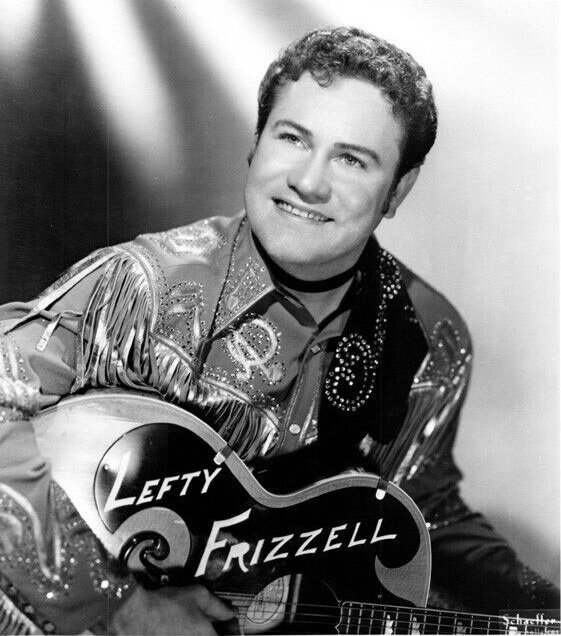
Lefty Frizzell
American singer-songwriterWikipedia
23
MENTIONS
18
EPISODES
18
PODCASTS
Search complete. 23 mentions across 18 episodes found for "Lefty Frizzell".
Sep 19, 2026

Mick SmithHOST
He was making a statement, you don't need strings and choruses to make great country music.
Mick SmithHOST
Similarly, Lefty Frizzell, with Long Black Veil in 1959, maintained that honky-tonk authenticity even as the industry was moving away from it.
Mick SmithHOST
Some artists straddled both worlds.
Mick SmithHOST
That's where it gets really interesting.

Dave StroudHOST
That was from 1958.
Dave StroudHOST
And tradition never escaped Lefty Frizzell.
Dave StroudHOST
And we heard Lefty's Long Black Veil.
Dave StroudHOST
And that was, of course, redone by the band some, jeez, let's see, what, what, 40, 25 years later.

Jim RooneyGUEST
And then the The disc jockey, Nelson Bragg, was playing all the current music.
Jim RooneyGUEST
Well, Hank Williams was still alive, and Webb Pierce, and Lefty Frizzell, and Hank Snow, and all of that music.
Jim RooneyGUEST
Kitty Wells, Hank Thompson.
Jim RooneyGUEST
And I just really loved it, and I loved Hank Williams.

Kevin SwansonHOST
That started in 1949.
Kevin SwansonHOST
But a year later, Lefty Frizzell wants to go to the park where it's dark and he doesn't want to fool around.
Kevin SwansonHOST
Or does he? If you got the money, honey, I've got the time, came out in 1951.
Kevin SwansonHOST
Then Webb Pierce's 1952 release, A Backstreet Affair, blames his adultery on his wife's adultery, but explicitly excuses this breaking of the Seventh Commandment.

Steve DowersHOST
Now, country music at that time was his major music influence, along with western twang, which was also known as country jazz.
Steve DowersHOST
Now, he played by the name of Lefty Frizzell, F-R-I-Z-Z-E-L-L.
Steve DowersHOST
Now, Lefty Frizzell was an exponent of this country jazz, and that led Roy to adopt a moniker of Lefty Wilbury when he was in the Travelling Wilbury days.
Steve DowersHOST
Now, he had a polio scare in 1944, and that's not he did, but there was a polio scare in the area in 1944, and that prompted his parents to send he and his brother Grady Lee to Burnham, Texas, to live with his grandmother.
Josh RevensHOST
Now, he

Greg LonesomeHOST
New Riders of the Purple Sage with Lonesome L.A.
Greg LonesomeHOST
Cowboy and Lefty Frizzell, Cigarettes and Coffee Blues.
Greg LonesomeHOST
That's a fantastic one.
Greg LonesomeHOST
Gotta love Lefty.

B KnoxGUEST
I mean, I joke on stage when I play a song of mine called The Many Deaths of Rose Murphy, which is basically a murder ballad.
B KnoxGUEST
Um, I thought it sounded like a Marty Robbins-type murder ballad, or like a, you know, Lefty Frizzell type thing, and then I listen back and I'm like, "No, that's, that's a sea shanty." [laughs]
CamHOST
[laughs]
B KnoxGUEST
Whether, whether I like it or not, that's where it ends up, so.

DarrenHOST
So kind of an interesting song written again by Harlan Howard, 1967.
DarrenHOST
Lefty Frizzell, prior to that, a big hit for him, Gone, Gone, Gone in 65.
DarrenHOST
And Buck Owens, 1964.
DarrenHOST
All those songs were one of the 4,000 that Harlan Howard wrote.

Dylan StoneHOST
And Jake Worthington basically showed up wearing a vintage suit, carrying a steel guitar, and reminding Nashville that country music didn't start with a drum loop and a guy yelling truck every 12 seconds.
Dylan StoneHOST
This Texas traditionalist grew up soaking in the sounds of honky-tonk legends like Lefty Frizzell and George Jones.
Dylan StoneHOST
His mission? Bring back the twang, the heartbreak, the kind of country where the singer actually sounds like he's lived a little.
Dylan StoneHOST
Next New Thing is a wink at the music business because Jake knows the funny truth.

Kristen KoppisCORRESPONDENT
Saginaw has also served as a muse for songwriters.
Kristen KoppisCORRESPONDENT
In 1964, honky-tonk pioneer Lefty Frizzell put the city on the map with his song, Saginaw, Michigan, which topped the country charts for 23 weeks and even earned a Grammy nomination.
Fred ReifSOUNDBITE_SPEAKER
Fred
Kristen KoppisCORRESPONDENT
Reif is the author of several books that explore Saginaw's music history.
speaker_13SOUNDBITE_SPEAKER
If I ever get to Saginaw again
Kristen KoppisCORRESPONDENT
The historians I spoke with can only speculate why Saginaw became a common denominator in several popular songs.
Kristen KoppisCORRESPONDENT
There's no evidence that Lefty Frizzell or the Monkees ever came to the city.
Kristen KoppisCORRESPONDENT
Maybe Saginaw's rich industrial history made it seem alluring.
8 more episodes mention Lefty Frizzell.
Create an account to see the whole feed, search across every transcript, and follow the entities you care about.