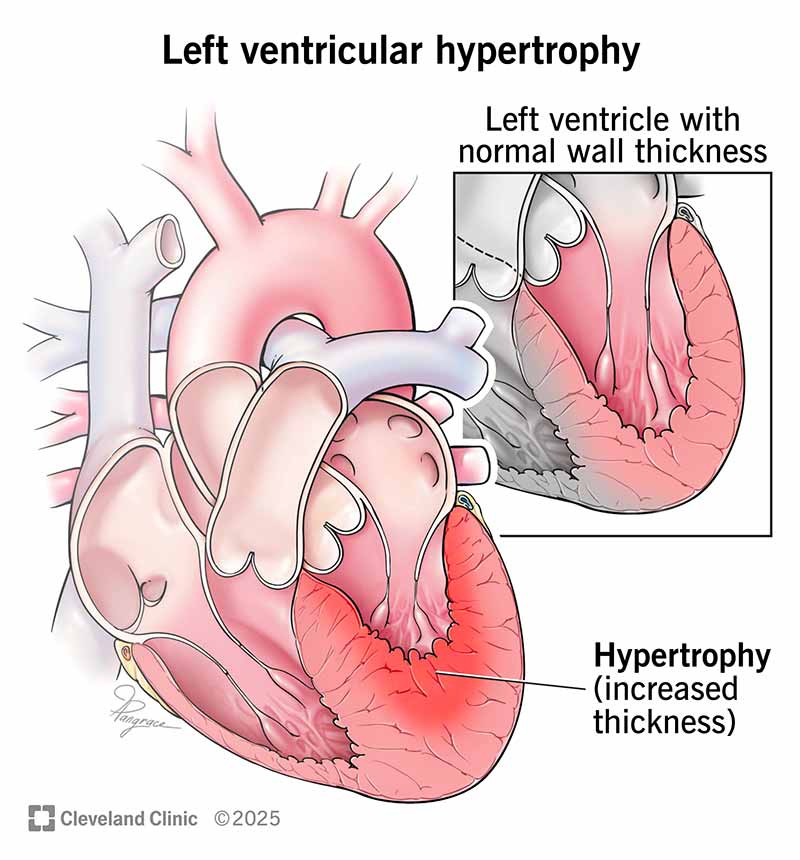
left ventricular hypertrophy
DiseaseWikipedia
22
MENTIONS
6
EPISODES
5
PODCASTS
Search complete. 22 mentions across 6 episodes found for "left ventricular hypertrophy".
Sep 11, 2026

Drew DonaldsonHOST
And they literally just tell you.
Drew DonaldsonHOST
I mean, I was convinced I was gonna have some sort of problematic number just 'cause of years of abusing stuff, and I got a zero, and they also tell you if you have any LVH, left ventricular hypertrophy.
Drew DonaldsonHOST
So I had no sign of LVH and a zero for the calcium score.
Drew DonaldsonHOST
You only have to do it every five years or so, and it was literally, like, that basically cured what I thought was long-term anxiety, um, just not having to worry about that.
Drew DonaldsonHOST
So heavily recommended.

Payal KohliGUEST
So as a detective, it's up to me to know essentially how much organ damage and organ damage you're having.
Payal KohliGUEST
So are you having LVH sort of out of proportion to your blood pressure? Are you having chronic kidney disease or kidney damage, proteinuria out of proportion? Are you starting to develop a HFPEF phenotype? Have you had a stroke? If you have signs of these and organ damage with your hypertension, that makes me worry, not just that it's a more aggressive phenotype, but perhaps something else underlying could be driving it.
Payal KohliGUEST
And then, of course, you look at the blood work and you look for clues like hypokalemia because we know that aldosterone and hyperaldosteronism is so common, more common than we appreciate, in fact, but that can cause potassium wasting.
Payal KohliGUEST
So if you have a hypokalemic phenotype, on your blood work, that could potentially be a sign.

speaker_0HOST
And that is how you diagnose left bundle branch block on 12 lead EKG.
speaker_0HOST
Diagnosis of left ventricular hypertrophy on 12 lead EKG.
speaker_0HOST
So there's a number of different standardized criteria that one can use to diagnose LVH.
speaker_0HOST
Oftentimes providers just look at the lateral leads, V5, V6, or AVL, and say, meh, the R-wave or S-wave look big, so probably LVH.
speaker_0HOST
But there is formal standard criteria, and they should be used when diagnosing LVH.
speaker_0HOST
The first criteria is, that can be used is called the Cornell criteria.
speaker_0HOST
And then there's actually a modified Cornell criteria that's shorter to use.
speaker_0HOST
There's a third criteria.

Paul BarnettHOST
Um, and some people are genetically predisposed to left ventricular hypertrophy.
Paul BarnettHOST
This is why it's important to control our blood pressure, to control our lipids, to stay away from, from, um, compounds that could potentially, um, in- cause, uh, increase in, in, um, growth in left, in heart size.
Paul BarnettHOST
But for mo- mostly, most of the time when L- LVH happens, it's because there's some, some, there's a blockage downstream- There's a partial blockage that the blood pressure is running out of control, and there's some genetic component that plays in there that, that's going to exacerbate it.
Paul BarnettHOST
It's likely that person still would have had problems long term, but it's-- this is why it's important to stay on top of testing, you know, getting, getting a, um, echocardiogram done every couple years.
Paul BarnettHOST
Um, could have caught that early and reversed some of that.
17 MINS LATER
Paul BarnettHOST
I mean, it's more cortisol.
Paul BarnettHOST
Just all the things that are counterproductive for growth.
Paul BarnettHOST
I think we need to do enough cardio to keep your heart healthy, probably HIIT cardio, although I [sighs] was talking to somebody about HIIT cardio that may [chuckles] maybe that could contribute to LVH.

speaker_1HOST
Like the voltage criteria for left ventricular hypertrophy-
speaker_2HOST
Right
speaker_1HOST
... or LVH, that is a perfect example of this.
speaker_2HOST
It really is.
speaker_1HOST
Because you look at the precordial leads, right?
speaker_2HOST
Huge spikes.
speaker_1HOST
Massive spikes.
speaker_1HOST
On paper, it absolutely meets the textbook Sokolow-Lyon criteria for LVH.
speaker_7HOST
And just like a bicep lifting heavy weights, the muscle thickens.
speaker_7HOST
Left ventricular hypertrophy, or LVH.
speaker_7HOST
On the ECG, this means massive voltage towering R waves, really deep S waves.
speaker_6HOST
But Dr. Taylor brings up a tough clinical dilemma here.
speaker_6HOST
The ECG is highly specific for LVH, but notoriously insensitive.
speaker_6HOST
It misses a lot of cases.
speaker_7HOST
It does.
speaker_7HOST
They have powerful hearts but really thin chest walls, so the electrodes pick up massive signals.